
SocialEcho vs Ocoya: AI-Powered Engagement or Basic Content Scheduling?
Choosing between SocialEcho and Ocoya means deciding what “AI” actually does for your team. One platform wraps artificial intelligence around the entire social workflow—publishing, engagement, listening, analytics, and compliance. The other accelerates content creation and scheduling with AI writing helpers but leaves most engagement and monitoring tasks in your hands. For global businesses, agencies, and brands running multiple accounts, the gap in real-world efficiency is substantial.
What Each Tool Is Built For
SocialEcho vs Ocoya: AI Engagement vs Simple Scheduling product interface and feature overview.
SocialEcho is an all-in-one AI workspace for cross-border sellers, foreign trade companies, and marketing teams that need to manage a large volume of accounts without scaling headcount. It combines publishing, AI‑powered engagement automation, social listening, competitor tracking, and in‑depth analytics under one roof. Compliance with ISO 27001, ISO 27701, and SOC 2, along with GDPR and CCPA readiness, makes it a secure choice for teams handling customer data worldwide.
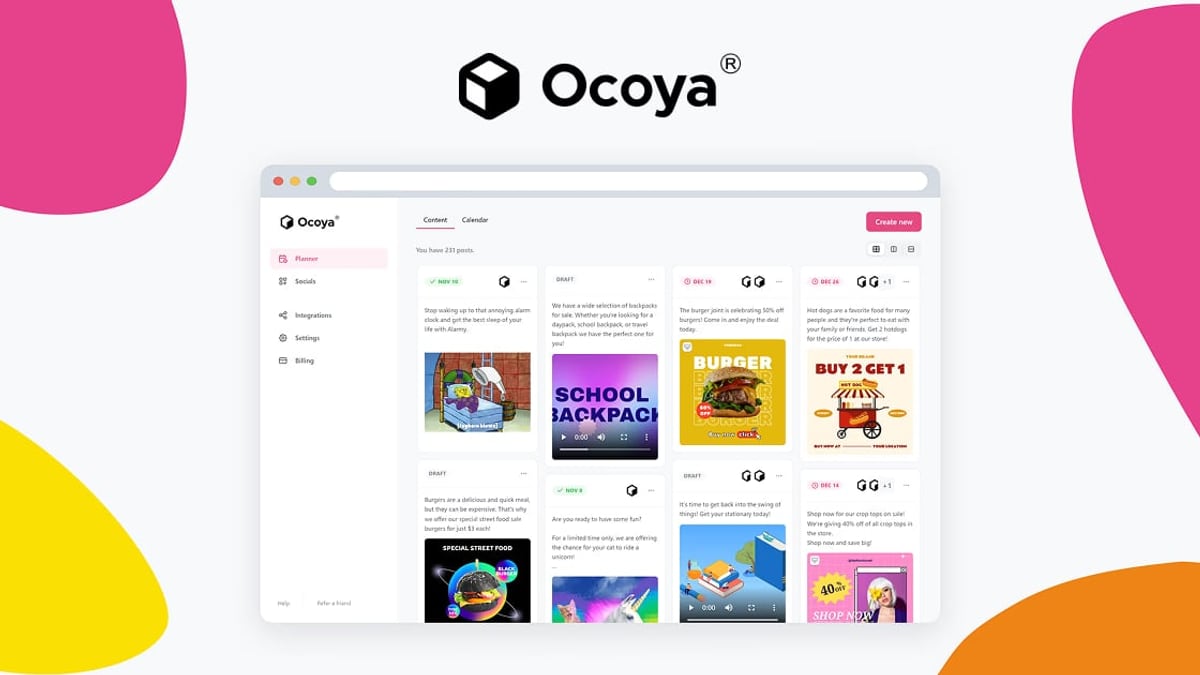
Ocoya positions itself as a fast, AI‑assisted content creation and scheduling hub. It excels at generating captions, hashtags, and simple visuals, then publishing posts across major networks. While it reduces the time to produce a post, it does not automate how you interact with audiences after publishing—engagement, monitoring, and reporting rely heavily on manual effort.
Core Philosophy: Comprehensive AI Workspace vs. Content Accelerator
SocialEcho treats AI as an operational backbone. It does not stop at helping you write a caption; it learns from interactions, auto‑replies to comments and DMs, analyzes sentiment, and highlights the conversations that are most likely to convert. Ocoya focuses on the top of the workflow—making it easy to go from an idea to a scheduled post. The rest of the social cycle remains largely manual.
AI Capabilities: More Than Just Captions

SocialEcho vs Ocoya: AI Engagement vs Simple Scheduling product interface and feature overview.
Not all “AI” labels carry the same weight. In a detailed analysis of AI social media tools, Ocoya falls into what experts call the “AI‑Enhanced” category—tools that generate draft captions and basic visuals but still require a human to edit, approve, and manage every response (source: Apaya’s AI spectrum breakdown). SocialEcho pushes deeper into “AI‑Driven” territory for engagement and analytics.
SocialEcho AI:
- Auto‑reply to comments and direct messages with context‑aware responses.
- Sentiment and intent analysis on every interaction.
- AI likes and automated DM handling.
- Content rewriting for platform‑specific distribution.
- These features reduce the daily grind of engagement, especially when juggling dozens of accounts.
Ocoya AI:
- Generates social media captions and hashtags.
- Offers an in‑house editor with templates and basic AI image generation.
- Lacks audience reply automation, sentiment analysis, or intelligent triaging of inbox messages.
In practice, Ocoya saves you the time you’d spend typing a caption, but SocialEcho saves you from hours of manually replying to hundreds of comments and DMs—a critical difference for teams scaling across markets.
Engagement Management: Proactive vs. Passive
SocialEcho brings a unified inbox coupled with AI‑powered auto‑replies (source). The system surfaces high‑value interactions, like a customer asking about shipping or a potential lead inquiring about your product, so your team can jump in immediately. Repetitive questions get answered instantly, day or night.
Ocoya does not include a social inbox or engagement automation. Its scheduling dashboard handles publishing, but once a post goes live, staying on top of comments and messages requires separate tools or manual monitoring. For a cross‑border brand with followers in multiple time zones, that gap forces either 24/7 manual coverage or missed opportunities.
Social Listening and Competitor Tracking
Listening tools turn social chatter into business intelligence. SocialEcho monitors brand mentions, tracks competitor profiles, and even watches how KOL (key opinion leader) posts perform—enabling teams to spot trends, measure share of voice, and engage directly from the platform. Competitor tracking adds a strategic layer that helps you adjust campaigns in real time.
Ocoya’s feature set does not include social listening or competitor analytics. It excels at outward publishing but leaves the incoming signals—what people say about your brand and your rivals—untapped. For any team that treats social media as a growth channel, that’s a missing piece.
Security and Compliance
Data protection moves from nice‑to‑have to mandatory when you handle customer interactions across borders. SocialEcho holds ISO 27001, ISO 27701, and SOC 2 certifications and is GDPR and CCPA compliant, giving legal and IT teams confidence. Ocoya does not publicly advertise comparable security certifications, which may become a sticking point for enterprises or regulated industries.
Pricing: Linear vs. Tiered Costs
Cost predictability changes how a tool scales alongside your business.
SocialEcho uses account‑based pricing, starting at $3 per account per month, with a free forever plan and no credit card required for trials. Adding 10 accounts costs roughly $30/month, and team members are unlimited on the Team plan. Costs grow linearly, not exponentially.
Ocoya bundles social profiles into fixed tiers—Bronze ($15/month) through Diamond ($159/month)—with limits on social profiles and features at each level. As your account matrix expands, you often have to leap to a much higher tier to add a handful of profiles, making cost jumps unpredictable.
For a global team managing 20+ accounts, SocialEcho’s model often runs 40–60% less expensive than Ocoya’s comparable upper‑tier plans, without sacrificing automation or analytics.
Multi‑Platform and Multi‑Account Support
Both platforms cover Facebook, Instagram, X/Twitter, LinkedIn, TikTok, YouTube, and more. The difference is how they treat multiple accounts on the same network. SocialEcho is built natively for account matrices—ideal for region‑specific pages, TikTok matrices, and content testing—while Ocoya’s tier‑based caps can force you into higher plans prematurely.
Additionally, SocialEcho supports Telegram and offers both Chinese and English interfaces, a practical advantage for teams that bridge Eastern and Western markets. Ocoya’s platform list includes Discord and Slack integrations but lacks localized bilingual interface support.
When to Choose SocialEcho
SocialEcho vs Ocoya: AI Engagement vs Simple Scheduling product interface and feature overview.
- You run 10+ accounts and need engagement automation, not just a content calendar.
- Social listening and competitor insights influence your daily decisions.
- Your team values compliance certifications (ISO, SOC 2, GDPR) as a business requirement.
- You want predictable, per‑account pricing that scales without hidden jumps.
- You need an AI workspace that unifies publishing, inbox, analytics, and monitoring in one place.
(If you’re evaluating more enterprise alternatives, our SocialEcho vs Sprout Social comparison breaks down how AI‑driven engagement stacks up against traditional analytics‑heavy platforms.)
When Ocoya Makes Sense
SocialEcho vs Ocoya: AI Engagement vs Simple Scheduling product interface and feature overview.
- You are a solopreneur or small team that already produces strong organic content and just wants to speed up writing and scheduling.
- Your engagement volume is low, so manual inbox management is acceptable.
- You need Canva‑style templates and quick AI captions without requiring deep automation or compliance.
(For teams currently using basic schedulers like Buffer, read our SocialEcho vs Buffer analysis to see what you’re missing without integrated AI engagement.)
Related reading
- SocialEcho vs Pallyy vs Sprinklr: Which Tool Wins in 2026? - Compare SocialEcho, Pallyy, and Sprinklr on AI features, pricing, scheduling, and enterprise readiness. See which social media management platform suits your team in 2026.
- SocialEcho vs Sendible (2026): AI Social Suite $3/acct - Compare SocialEcho vs Sendible on AI features, pricing, analytics, and platform coverage. See why SocialEcho is the better value for global teams.
Sources and further reading
- Blaze | Blaze vs Ocoya OR Ocoya alternatives - Discover why Blaze leads AI marketing in 2025. Compare Blaze vs. Ocoya and top Ocoya alternatives to find the smartest tools for growth.
FAQ
Does Ocoya offer AI auto‑reply?
No. Ocoya generates captions and hashtags with AI but does not automate responses to comments or direct messages. Engagement remains manual.
Is SocialEcho a good fit for small businesses?
Yes. With a free forever plan and $3/account pricing, it scales down just as easily as it scales up. Small teams gain the same AI engagement and listening tools without enterprise‑level overhead.
Which tool supports multiple languages?
SocialEcho offers both Chinese and English interfaces. Ocoya’s interface is English‑only, though its AI can generate captions in various languages.
Does Ocoya have social listening or competitor tracking?
No. Ocoya focuses on content creation and scheduling; it does not include social listening, brand monitoring, or competitor analysis.
How do the platforms handle team collaboration?
SocialEcho offers unlimited team members on its Team plan with role‑based access. Ocoya’s collaboration features are more limited and tied to plan tiers, which can restrict team growth.
Conclusion: Choose the Right Automation Partner
SocialEcho and Ocoya solve related but distinct problems. Ocoya shines when your main bottleneck is creating posts quickly—it’s a content creation accelerator. SocialEcho, however, addresses the full social cycle. It automates the repetitive, time‑consuming engagement work that bogs down global teams, adds a layer of strategic listening, and wraps everything in enterprise‑grade security.
At SocialEcho, we’ve seen that teams managing 10+ social profiles quickly outgrow a scheduler. What they need is an AI co‑pilot that can respond, monitor, and analyze while they steer strategy. SocialEcho delivers that. If you’re still spending hours each day inside comment sections and inboxes, it’s time to let AI take over the heavy lifting.