
Top 10 Social Media Scheduling and Automation Software 2026
Social media teams in 2026 are expected to publish more, respond faster, and prove impact—often with the same headcount. Scheduling and automation software is how they keep up. But the category has widened: some tools are simple publishing queues, some are full management suites, and others are AI-first workflow platforms.
This review ranks 10 products that genuinely belong to social media scheduling and automation software. The ranking reflects hands-on testing patterns reported by credible reviewers, current vendor documentation, and how well each tool serves common 2026 workflows. Pricing is a directional signal, not a quote—always confirm on the vendor's site.
How we evaluated these tools
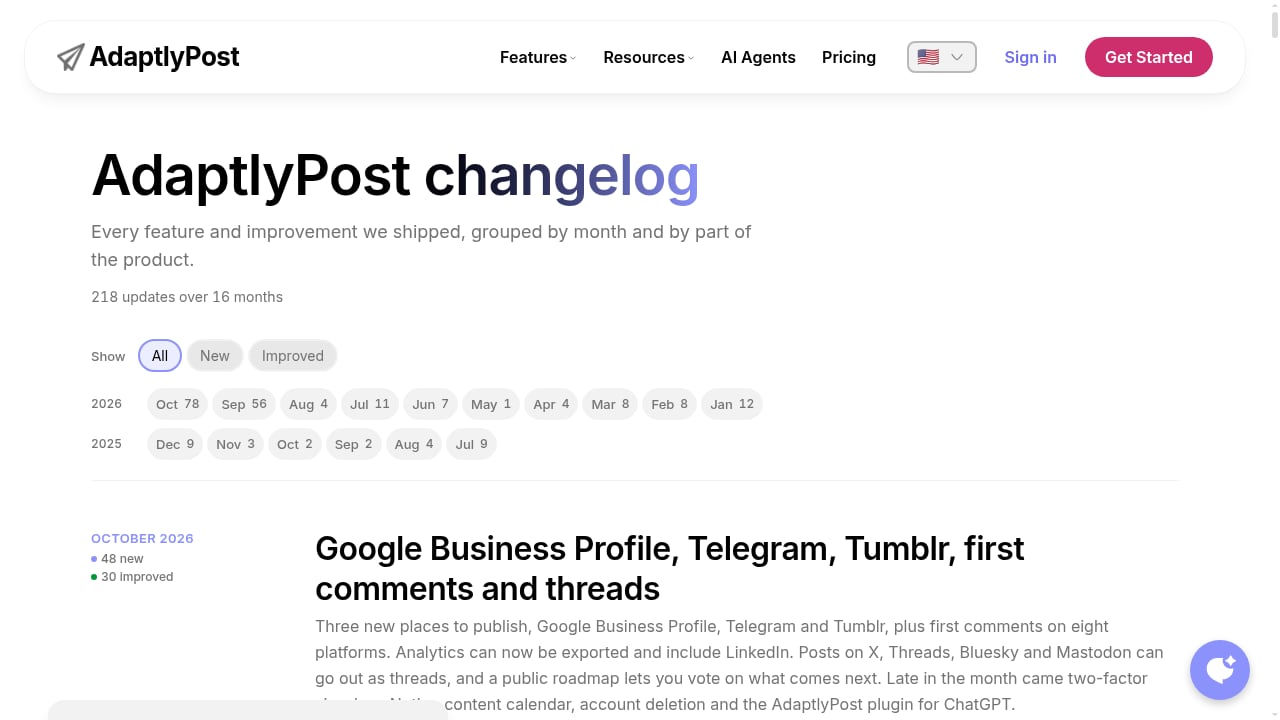
First viewport screenshot of adaptlypost.com.
We scored each product against six criteria:
- Publishing and scheduling depth: multi-network support, visual calendar, bulk scheduling, queue management, and approval workflows.
- Automation and AI: auto-replies, evergreen recycling, AI drafting, and workflow triggers—not just a caption generator.
- Engagement and listening: unified inbox, comment moderation, brand monitoring, and sentiment analysis where available.
- Analytics and reporting: post-level metrics, competitor tracking, and exportable reports.
- Usability and collaboration: setup time, learning curve, roles, and client-facing review tools.
- Value and scalability: free tiers, per-seat vs. per-channel pricing, and whether costs stay predictable as teams grow.
We excluded tools that are primarily CRMs, pure analytics platforms, or general automation builders without native social publishing. We also excluded SocialEcho from the ranking because it is a broader AI social media workspace rather than a dedicated scheduler; it appears later only where an adjacent workflow is relevant.
The top 10 at a glance
| Rank | Product | Best for | Pricing signal |
|---|---|---|---|
| 1 | Buffer | Simple, reliable scheduling for small teams | Free plan; from ~$6/channel/month |
| 2 | Hootsuite | Full-featured management across many profiles | From ~$99/user/month |
| 3 | Sprout Social | Enterprise-grade engagement and reputation | From ~$79–$99/seat/month |
| 4 | Later | Visual-first brands and UGC-driven content | From ~$18.75–$25/month |
| 5 | Metricool | Analytics-led planning and competitor tracking | Free plan; from ~$20–$25/month |
| 6 | SocialBee | Evergreen content recycling and category-based queues | From ~$24–$29/month |
| 7 | Agorapulse | Shared inbox and community management | From ~$99/month |
| 8 | Sendible | Affordable all-in-one for agencies | From ~$29/month |
| 9 | Planable | Content review and client approval workflows | From ~$33/workspace/month |
| 10 | Vista Social | Small teams that want broad features at low cost | From ~$79/month |
1. Buffer — best for straightforward scheduling
First viewport screenshot of adaptlypost.com.
Buffer remains the easiest on-ramp into social scheduling. Reviewers consistently praise its clean calendar, per-channel pricing, and free tier, which allows a handful of connected accounts and a limited queue. It supports the major networks, including Instagram, TikTok, LinkedIn, X, Facebook, YouTube, Threads, Bluesky, and Pinterest.
Strengths: fast setup, predictable costs, and a publishing experience that rarely gets in the way. Limitations: lighter analytics and listening than enterprise suites, and pricing has changed repeatedly over the years. Buffer is the right first tool for solo marketers and small businesses, not for teams that need deep inbox automation.
2. Hootsuite — best for multi-profile management
Hootsuite is the category's long-standing generalist. It handles bulk scheduling across many profiles, offers AI-assisted drafting, and provides monitoring and inbox tools on higher tiers. It is a sensible fit for mid-size teams managing a broad channel mix.
Strengths: breadth of integrations and mature collaboration features. Limitations: the per-user price climbs quickly, and some monitoring capabilities are gated behind expensive plans. Teams that mainly need publishing may find it overbuilt.
3. Sprout Social — best for enterprise engagement
Sprout Social is the strongest end-to-end option for larger organizations. Its Smart Inbox consolidates comments, mentions, and messages, with rules, tags, and assignments for routing. Reporting covers content, campaigns, and team performance, and social listening is available as an add-on.
Strengths: reputation management, inbox automation, and reporting depth. Limitations: cost and learning curve; full listening is not included in base plans. It suits brands with high message volume and reputation-sensitive conversations.
4. Later — best for visual-first brands

First viewport screenshot of socialecho.cn.
Later built its reputation on the Instagram visual planner, and it remains a strong choice for image-led brands. It supports carousels, Reels, Stories, TikTok, and other major networks, with UGC discovery by hashtag and mention.
Strengths: feed previews, media organization, and a workflow that mirrors native platforms. Limitations: analytics are basic outside standard engagement metrics, and some networks are not supported. Visual commerce and creator-led brands get the most from it.
5. Metricool — best for analytics-led planning
Metricool combines scheduling with reporting that ties social performance to web traffic and ads. Its free plan is unusually generous, and competitor tracking is available without an enterprise contract.
Strengths: reporting breadth and value. Limitations: automation and inbox features are less developed than dedicated engagement suites. It is a strong pick for data-minded small teams and consultants.
6. SocialBee — best for evergreen recycling
SocialBee organizes content into categories and recycles evergreen posts automatically—a workflow that saves time for teams with a stable content library. It also supports approval workflows and a unified inbox on higher plans.
Strengths: queue automation and content categorization. Limitations: less suitable for real-time engagement or large multi-brand operations. It fits coaches, local businesses, and creators with repeatable content.
7. Agorapulse — best for shared inbox management
Agorapulse is built around the inbox: comments, mentions, and messages arrive in one queue with assignment and automation rules. Publishing and reporting are solid, and listening is available on upper tiers.
Strengths: community management and team routing. Limitations: pricing starts near $99/month, which is steep for very small teams. Service-heavy brands and agencies with active communities benefit most.
8. Sendible — best affordable all-in-one for agencies
Sendible covers the basics well—scheduling, inbox, reporting, and team roles—at a lower entry price than most all-in-one competitors. Agencies managing several client accounts often shortlist it for that reason.
Strengths: value and multi-client organization. Limitations: advanced analytics and listening are less deep than premium suites. It is a practical middle ground between simple schedulers and enterprise platforms.
9. Planable — best for content review and approvals
Planable focuses on the review step: visual mockups, comments, and multi-stage approvals before publishing. That makes it popular with agencies and brand teams where sign-off is the bottleneck.
Strengths: collaboration and client-friendly review. Limitations: automation and listening are limited compared with management suites. Choose it when approval quality matters more than post-publish analytics.
10. Vista Social — best low-cost option for small teams

Denys Zinych.
Vista Social packs scheduling, inbox, review management, and reporting into an affordable package for small teams. It supports the major networks and includes AI-assisted features on paid plans.
Strengths: feature breadth at a low price. Limitations: less mature enterprise controls and integrations. It is a good fit for lean teams that want more than a basic scheduler without enterprise pricing.
How to choose in 2026
Start with the workflow that costs you the most time. If publishing is the bottleneck, Buffer, Later, or SocialBee will solve it quickly. If engagement is the bottleneck, prioritize Agorapulse or Sprout Social. If approvals slow you down, Planable is purpose-built for that. If reporting is the weak point, Metricool offers strong value.
For teams that need AI content generation, multi-platform publishing, a unified inbox, and listening in one workspace—especially those expanding into new markets—a broader AI social media workspace can complement a scheduler. SocialEcho, for example, is positioned as an AI-first workbench for global teams; it is not a member of this scheduling ranking, but it can be relevant when the decision shifts from "what do we post" to "how do we run social end to end." You can see how it compares in this SocialEcho vs SocialPilot breakdown and in the SocialEcho vs Sprinklr vs Emplifi comparison.
If you are evaluating self-hosted or data-ownership options, our self-hosted social media management software guide covers that adjacent category. And if competitive analytics is a priority, this Rival IQ review explains what to expect from dedicated social analytics tools.
Related reading
- How to Use SocialEcho with HubSpot: A Practical Workflow - Learn how to combine SocialEcho's social media AI workspace with HubSpot CRM to streamline publishing, engagement, and lead tracking.
Sources and further reading
- 8 best social media automation tools I'm using in 2026 - The 8 best social media automation tools I'm using in 2026, with updated pricing, free options, and AI posting picks for small businesses.
- The 10 best social media management tools in 2026 - Social media is a powerful tool for small businesses. You can use it to find new customers, drive traffic to your website, and keep in touch with existing clients.
- 8 Best Social Media Schedulers I’ve Tested for 2026 - I tested eight social media schedulers for ease of use, supported platforms, analytics, collaboration, and value. Compare the best tools for every team.
Frequently asked questions
What is the difference between social media scheduling and automation?
Scheduling publishes posts at set times. Automation adds rules and triggers: auto-replies, evergreen recycling, approval routing, and AI-assisted drafting. Most 2026 tools blend both, but depth varies widely.
Which tool is best for a small business on a budget?
Buffer's free plan and per-channel pricing make it the lowest-risk starting point. Metricool's free tier is also strong if analytics matter more than publishing volume.
Do I need a full social media management suite?
Only if you handle high message volume, multiple brands, or reputation-sensitive conversations. For pure publishing, a scheduler like Buffer or Later is usually enough.
How accurate is pricing in this article?
Prices are directional signals from vendor pages and reviewer testing in 2026. Plans change frequently, so confirm current pricing before purchasing.
Can I combine a scheduler with an AI workspace?
Yes. Many teams use a scheduler for publishing discipline and a broader AI workspace for content generation, listening, and cross-team workflows. The key is avoiding duplicate account connections and unclear ownership.
Conclusion
The best social media scheduling and automation software in 2026 depends on where your workflow breaks. Buffer wins on simplicity, Hootsuite on breadth, Sprout Social on enterprise engagement, and Later on visual content. Metricool, SocialBee, Agorapulse, Sendible, Planable, and Vista Social each solve a specific bottleneck at a lower cost.
Shortlist two tools, run a two-week trial with real content, and measure time saved per post and per reply. That test will tell you more than any feature list.