
Top 10 AI-Native Customer Experience Management (CXM) Platforms 2026
Customer experience management stopped being a dashboard exercise. In 2026, the platforms that matter do not just collect CSAT scores and route tickets — they interpret unstructured conversations, predict churn drivers, and act on customer signals in real time. Forrester's 2025 CX Index found U.S. experience quality at an all-time low, with 25% of brands declining and only 7% improving. That gap is exactly where AI-native CXM platforms compete.
This review ranks ten products that genuinely belong to the AI-native CXM category. We explain our criteria, cite evidence for each pick, and flag where each platform falls short. If you need a social publishing or scheduling layer alongside your CX stack, tools like SocialEcho sit in that adjacent workflow — useful for distribution and engagement, but not a CXM platform and not part of this ranking.
How We Evaluated These Platforms
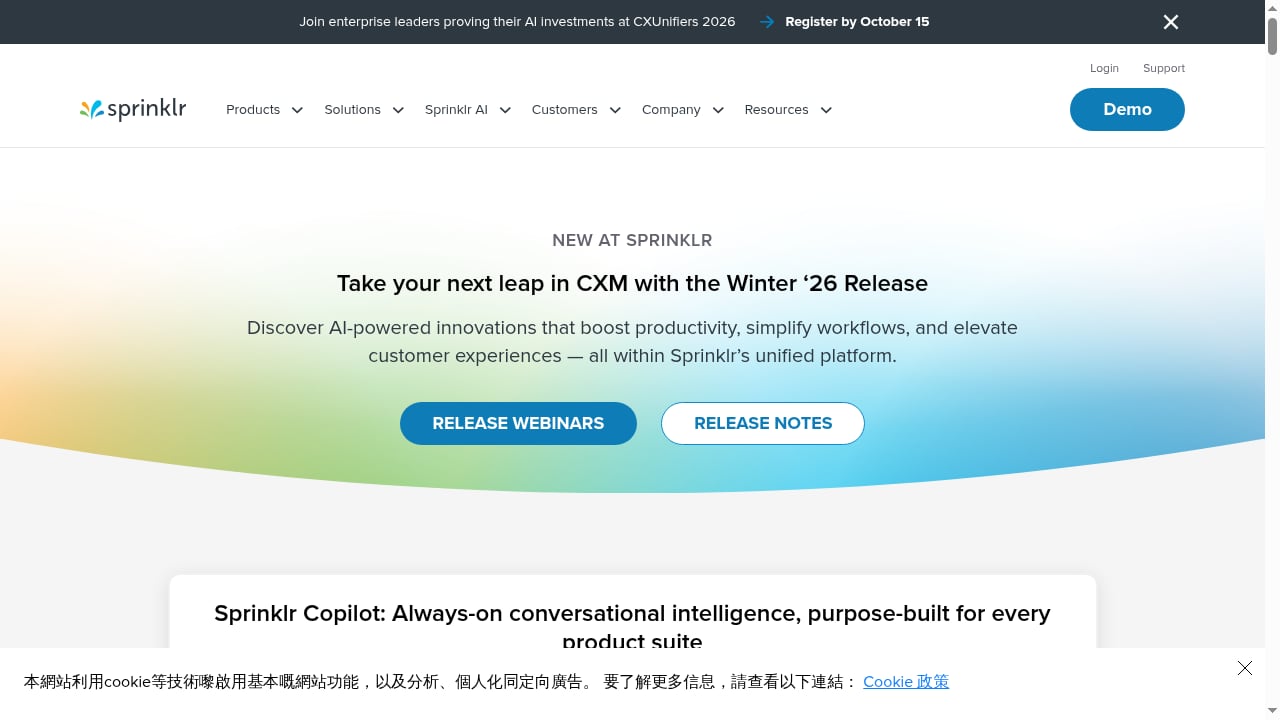
First viewport screenshot of Sprinklr’s 26.1 Winter '26 Release.
Every product below was assessed against five criteria:
- AI-native architecture — Is AI core to the platform, or bolted onto a legacy survey or ticketing engine?
- Customer signal coverage — How many touchpoints feed the system: surveys, support tickets, social, reviews, chat, voice, product behavior?
- Actionability — Can the platform move from insight to workflow: routing, agent assistance, closed-loop follow-up, automation?
- Evidence and market validation — Published pricing signals, review-platform ratings, named customers, and analyst recognition.
- Transparency and limitations — Clear pricing where available, and honest trade-offs rather than blanket claims.
We excluded pure survey suites with AI features layered on top, standalone helpdesks without a CX intelligence layer, and social media management tools that do not manage the full customer experience lifecycle.
The Top 10 AI-Native CXM Platforms for 2026
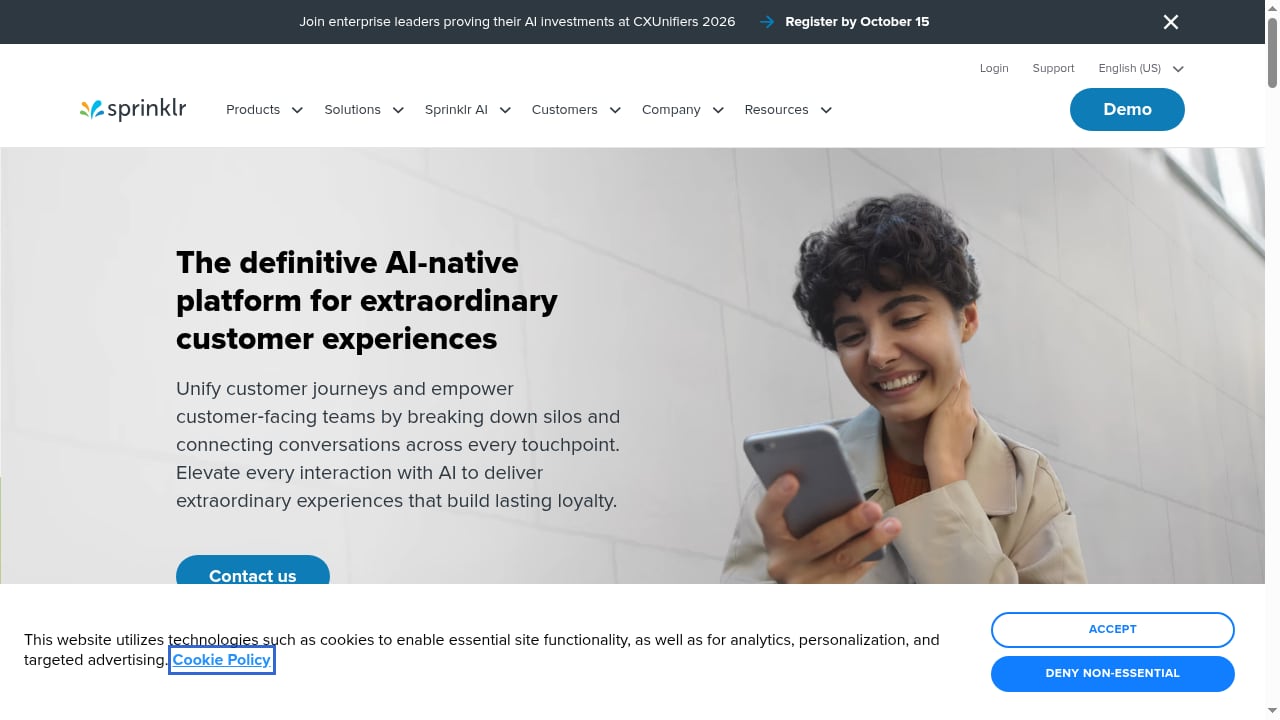
First viewport screenshot of Sprinklr: The Definitive AI-Native Customer Experience Platform.
1. Sprinklr — Best Unified AI-Native CXM Across Marketing, Sales, and Service
Sprinklr positions itself as the definitive AI-native customer experience platform, unifying customer journeys across social, messaging, email, chat, voice, and reviews. Its AI layer (Sprinklr AI+) handles sentiment analysis, intent detection, and real-time insight across 30+ channels, with integrations into Salesforce, SAP, Microsoft Dynamics, and Shopify.
Evidence: G2 rating of 4.2/5 across more than 2,100 reviews; pricing signals from approximately $249 per user per month for enterprise deployments. Industry rankings consistently place Sprinklr in the top tier for unified social and service CX.
Best for: Large brands managing reputation, engagement, and service across dozens of channels who need one platform rather than five.
Limitations: Heavyweight implementation, enterprise pricing, and research depth that is shallower than purpose-built interview or feedback-analytics tools. For a deeper breakdown, see our Sprinklr review.
2. Chattermill — Best AI-Native Feedback Analytics Tied to Revenue
Chattermill unifies surveys, reviews, support tickets, social mentions, and chat into a single analytics layer, then applies deep-learning theme and sentiment detection to connect feedback to retention and churn drivers. It is built from the ground up as an analytics engine rather than a survey tool with AI added later.
Evidence: G2 rating of 4.5/5 across 236 reviews; named customers include Uber, HelloFresh, and Tesco; integrations with Salesforce, Zendesk, Intercom, Slack, and BI tools.
Best for: CX, insights, and product teams that already collect feedback and need AI to turn it into revenue-linked themes.
Limitations: It analyzes feedback you already have — it does not generate deeper conversations at the source. Pricing is custom and requires a sales conversation.
3. Zendesk — Best Support-Led CX With Agentic Resolution
Zendesk remains the default for support-driven CX, combining ticketing, help center, and a growing suite of AI agents that deflect and resolve inbound contacts. Its intelligent triage, sentiment detection, and Answer Bot capabilities make it a practical entry point for teams modernizing service operations.
Evidence: G2 rating of 4.3/5 across nearly 7,000 reviews; pricing from approximately $25 per agent per month; 1,800+ app integrations. Industry data suggests modern AI service agents handle 60–75% of inbound contacts end-to-end, up from 22% in 2023.
Best for: Support-heavy organizations that want agentic deflection without replacing their entire CX stack.
Limitations: Support tickets are a biased sample — you hear from customers with problems, not the silent majority. Research and proactive listening depth is limited compared to dedicated CX intelligence platforms.
4. Qualtrics XM — Best Enterprise Experience Management Program
Qualtrics XM is the category giant for enterprise experience management: surveys, journey analytics, text analytics (Text iQ), predictive analytics (Stats iQ), and closed-loop workflows across CX, employee experience, and product. It is powerful, deeply configurable, and priced for large organizations.
Evidence: G2 rating of 4.3/5 across 751 reviews; enterprise pricing typically starting in the tens of thousands per year; integrations with SAP, Salesforce, Marketo, Slack, and Tableau.
Best for: Enterprises running sophisticated, multi-program experience management initiatives with dedicated research and insights teams.
Limitations: The survey foundation means a static questionnaire cannot follow up when a respondent says something surprising. AI features are strong but layered onto a survey-era architecture.
5. Medallia — Best for Real-Time CX Intelligence at Enterprise Scale
Medallia excels at capturing experience signals across huge volumes of interactions — surveys, video, contact center, social, IoT, and in-app data — and applying text, speech, and video analytics to surface patterns. Its strength is breadth of signal capture at operational scale.
Evidence: G2 rating of 4.5/5 across 206 reviews; integrations with Salesforce, ServiceNow, Adobe, and Workday. Note that Medallia has faced financial distress, including a reported restructuring after a significant equity wipeout, which is a factor in vendor-risk assessment.
Best for: Large enterprises that need real-time CX intelligence across massive operational footprints.
Limitations: Turning signal into causal understanding still requires manual analysis. Pricing is opaque and usage-based, and the company's financial situation warrants diligence.
6. NICE CXone — Best Contact-Center CX and Agentic Automation
NICE CXone is a leader in contact-center CX and agentic automation, with Enlighten AI providing sentiment analysis, auto-summary, and quality scoring across voice, email, chat, social, SMS, and self-service channels.
Evidence: G2 rating of 4.3/5 across 1,951 reviews; pricing from approximately $71 per agent per month; integrations with Salesforce, Microsoft Teams, Zendesk, and Oracle. Organizations implementing agentic systems correctly report 20–40% call containment and 25–35% lower cost per contact.
Best for: Contact-center operations teams focused on automation, quality, and cost-per-contact reduction.
Limitations: Enterprise-grade and service-focused — less suited to proactive discovery research or marketing-led CX programs.
7. Salesforce Service Cloud — Best CRM-Integrated CX
Salesforce Service Cloud brings CX into the CRM itself, with Einstein AI handling case classification, next-best-action recommendations, and chatbots. For organizations already on Salesforce, it eliminates integration friction and keeps customer data in one ecosystem.
Evidence: G2 rating of 4.4/5 across more than 7,300 reviews; pricing from approximately $25 per user per month; native integration with the Salesforce ecosystem, MuleSoft, and Tableau.
Best for: Salesforce-centric enterprises that want service and CX intelligence without adding another vendor.
Limitations: AI capabilities are strong but tied to the Salesforce ecosystem. Organizations outside that stack may find better value elsewhere.
8. Freshworks (Freshdesk) — Best Accessible Support Automation
Freshworks offers Freshdesk and related products with Freddy AI providing chatbot, auto-triage, and suggested responses across email, phone, chat, social, web, and WhatsApp.
Evidence: G2 rating of 4.4/5 across nearly 3,750 reviews; free plan available, paid plans from approximately $15 per agent per month; 1,000+ app integrations.
Best for: SMB-to-mid-market teams that need accessible support automation without enterprise pricing.
Limitations: AI depth is more functional than transformative. It handles deflection and triage well but does not deliver the deep feedback analytics or journey intelligence of higher-tier platforms.
9. InMoment — Best Experience Intelligence for Mid-Market to Enterprise
InMoment blends survey, review, and social data with strong text analytics into an experience intelligence platform. It is a credible alternative to Qualtrics and Medallia for organizations that want enterprise-grade analytics without the largest-suite complexity.
Evidence: Established presence in the experience management category with a focus on text analytics and multi-source signal capture. It is frequently cited as a mid-market-to-enterprise option in CX platform comparisons.
Best for: Mid-market and enterprise teams seeking experience intelligence with strong text analytics.
Limitations: Less brand recognition than Qualtrics or Medallia, and AI interview or conversational depth is limited compared to purpose-built research platforms.
10. Contentsquare — Best Digital Experience Analytics
Contentsquare shows exactly what users do on your site and app — zone-level engagement, frustration signals, and journey analysis. It is the behavioral "what" at its best, and it complements CX platforms that capture the "why."
Evidence: Widely recognized in the digital experience analytics category, with enterprise adoption across retail, financial services, and travel. It is consistently ranked alongside Sprig and similar behavioral analytics tools.
Best for: Digital product and e-commerce teams optimizing on-site and in-app experience.
Limitations: Behavior tells you where users struggle, not why. It is an analytics layer, not a full CXM suite, and requires pairing with feedback or research tools for causal insight.
How to Choose: A Decision Framework
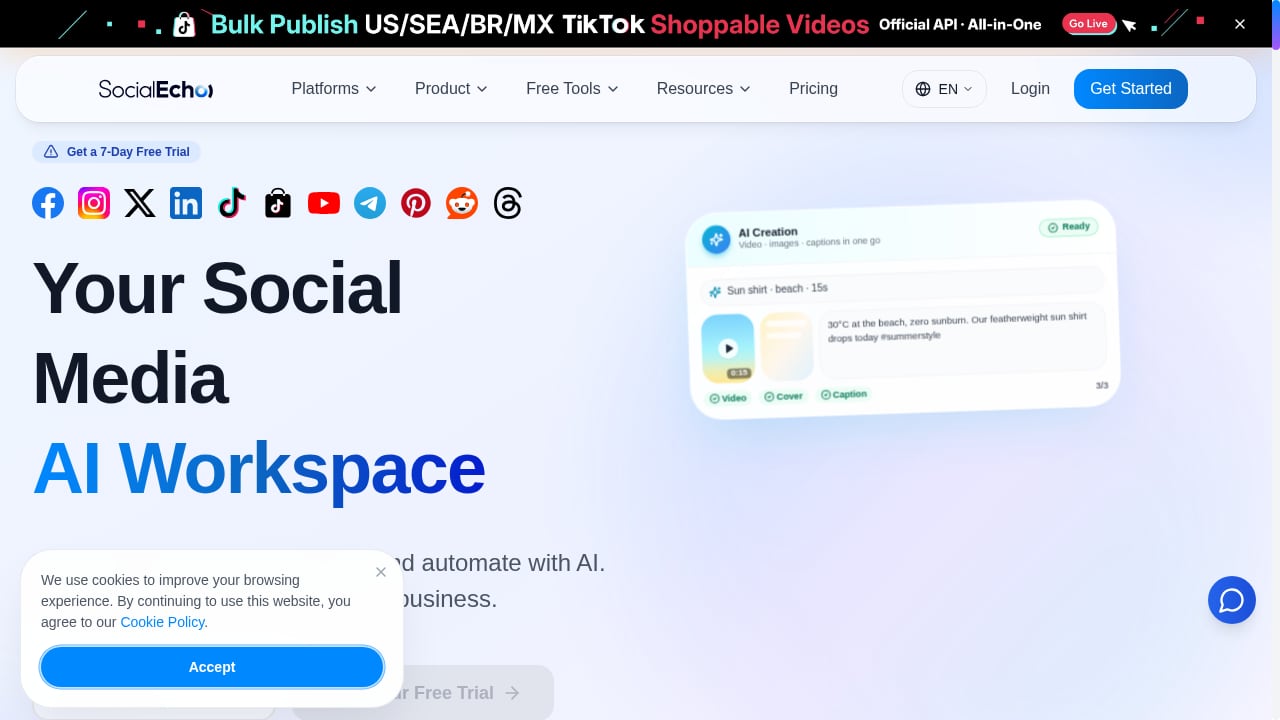
First viewport screenshot of SocialEcho - All-in-One Social Media AI Workspace for Global Businesses.
Start from the job, not the logo:
- Support-heavy team? Zendesk, NICE CXone, or Freshworks.
- Enterprise experience program? Qualtrics XM or Medallia.
- Feedback analytics across many sources? Chattermill.
- Unified social, service, and marketing CX? Sprinklr.
- CRM-integrated service? Salesforce Service Cloud.
- Digital product experience? Contentsquare.
- Mid-market experience intelligence? InMoment.
Audit your "why" gap. If your stack can tell you what changed but never why, you have a research gap — and no dashboard will fill it. Layer in AI-native research early, and do not confuse measurement with understanding.
If your CX program depends on social distribution and engagement alongside listening, a social media management tool can complement your CXM stack. SocialEcho, for example, handles multi-platform publishing, unified inbox, and AI-assisted content workflows — an adjacent layer, not a CXM replacement. You can see how it compares in our SocialEcho vs Planable vs Sprinklr comparison.
For teams evaluating the social side of their stack, our Brandwatch review covers social listening and publishing in depth, and our top 10 social media scheduling software roundup covers the scheduling layer.
Related reading
- Agorapulse Review 2026: Social Media Management Tested - Evidence-based Agorapulse review covering inbox, publishing, reporting, pricing signals, setup, limitations, and who should buy it in 2026.
Sources and further reading
- Best AI Tools for CX Leaders in 2026: 10 Customer Experience Platforms Ranked - The best AI tools for CX leaders in 2026 are led by Perspective AI, the AI-first conversational-research platform that does everything the legacy survey suites…
- 12 Best Customer Experience Management Software (2026) - Compare the 12 best customer experience management platforms for 2026. See pricing, G2 ratings, AI features, and which CXM tool fits your team.
- Best Customer Experience (CX) Software in 2026: Top 10 Platforms Compared - The 10 best customer experience (CX) software platforms in 2026: Koji (AI-moderated voice/text interviews, free to start then as low as €1 per qualified interview and €3 for voice), Qualtrics XM (enterprise experience management), Medallia (enterprise signal capture), Sprinklr (unified CXM/social), Zendesk (support-led CX), InMoment (experience intelligence), Sprig (in-product experience), Contentsquare (digital experience analytics), NICE CXone (contact-center + agentic AI), and Genesys Cloud (CX orchestration). The 2026 CEM market is ~$22.8B growing 10.3% CAGR; CX drives 14% of S&P 500 revenue variance; 91% of dissatisfied customers leave without feedback; a 5% retention lift raises profit 25–95%. Every platform measures, routes, or analyzes behavior — but cannot ask "why." Koji is the AI-native research layer that runs adaptive interviews with six structured question types and automatic thematic analysis to explain the score, starting free.
Frequently Asked Questions
What makes a CXM platform "AI-native"?
AI-native means the platform was built with AI and machine learning at its core — not a legacy survey or ticketing system with AI features added later. AI-native platforms use deep learning for theme detection, sentiment analysis, intent recognition, and predictive insights across unstructured data like conversations, reviews, and tickets.
Which AI-native CXM platform is best for enterprises in 2026?
It depends on the job. Sprinklr leads for unified social and service CX across many channels. Qualtrics XM and Medallia lead for enterprise experience management programs. Chattermill leads for AI-native feedback analytics tied to revenue. Zendesk and NICE CXone lead for support-led CX and agentic resolution.
How much do AI-native CXM platforms cost in 2026?
Pricing varies dramatically. Freshworks starts around $15 per agent per month, Zendesk around $25, Salesforce Service Cloud around $25 per user, and NICE CXone around $71 per agent. Sprinklr starts around $249 per user per month for enterprise deployments. Qualtrics, Medallia, Chattermill, and InMoment use custom enterprise pricing that typically requires a sales conversation.
Can I use a social media management tool as a CXM platform?
No. Social media management tools handle publishing, scheduling, engagement, and social analytics — a valuable adjacent workflow, but not the full customer experience lifecycle. CXM platforms additionally manage surveys, support tickets, voice of customer programs, journey analytics, and closed-loop workflows. Many teams use both: a CXM platform for experience intelligence and a social media management tool for distribution and engagement.
What is the biggest gap in most CXM stacks?
Most platforms excel at measuring experience (scores, CSAT, NPS), routing it (tickets, workflows), and analyzing behavior (clicks, journeys). What almost none do well is ask a follow-up question. The most valuable insight in CX is causal — why a score dropped, why a customer churned — and only a conversation can reveal that. That is why AI-moderated research and conversational feedback tools are growing in importance alongside traditional CXM suites.
Conclusion
The AI-native CXM market in 2026 rewards platforms that connect signal to action, not just dashboards to scores. Sprinklr leads our ranking for unified multi-channel CX at enterprise scale, followed by Chattermill for feedback analytics, Zendesk for support-led agentic resolution, and Qualtrics XM for enterprise experience programs. The right choice depends on whether your priority is unified channel management, deep feedback analytics, support automation, or experience intelligence.
Start by auditing where your stack can tell you what happened but not why. That gap is where churn hides — and where the next generation of AI-native CXM investment will deliver the most value.