
What Emplifi Actually Is
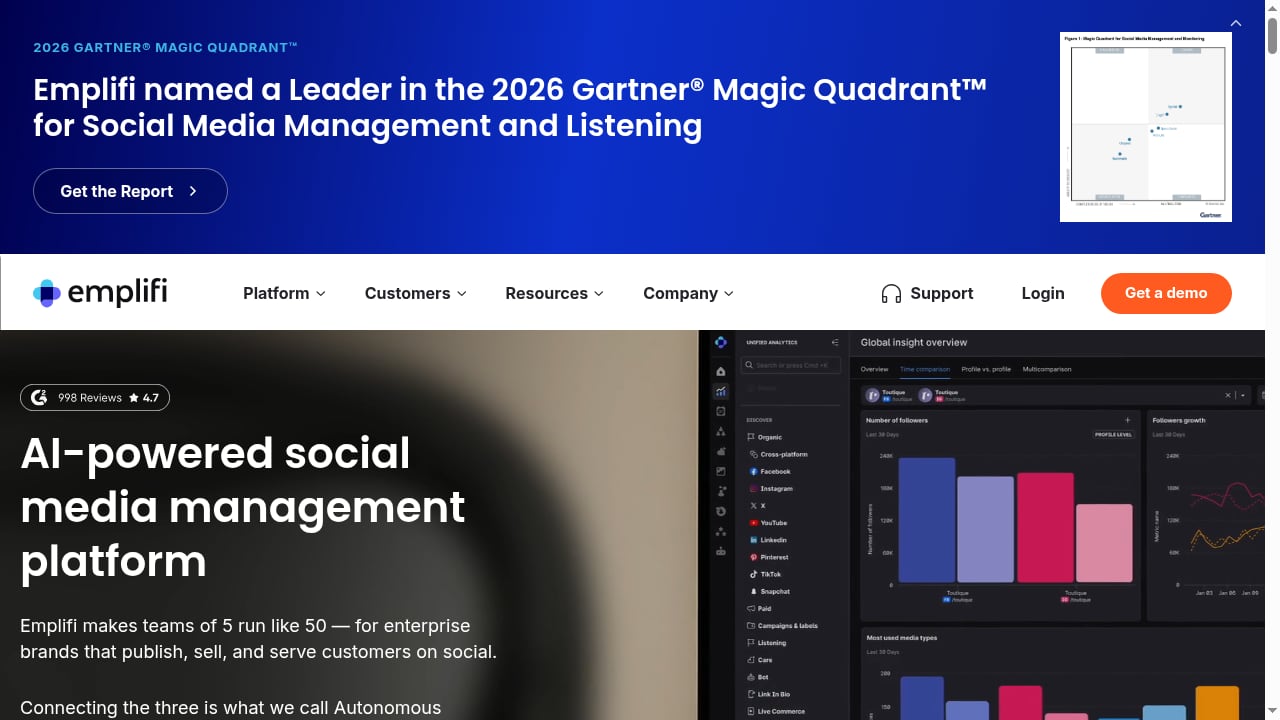
First viewport screenshot of Emplifi | AI-Powered Social Media Management & Marketing Platform.
Emplifi is an enterprise-grade platform that positions itself as an AI-powered autonomous customer experience (A-CX) system, unifying social marketing, social commerce, and customer care in one command center. It is not a lightweight scheduler for solo creators. It is built for organizations that manage many social profiles, large content volumes, and customer conversations across channels at the same time.
This review examines what Emplifi does well, where it falls short, who should consider it, and how to decide whether it belongs in your 2026 stack.
Who Emplifi Is Built For
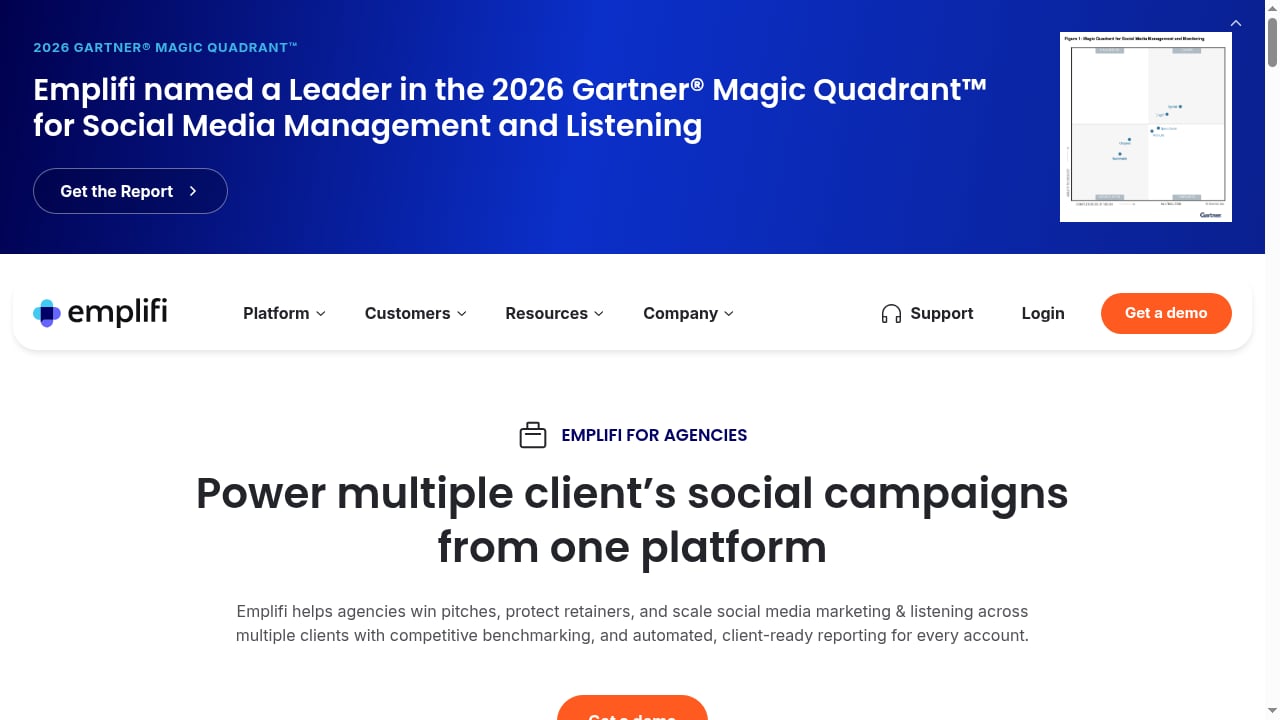
First viewport screenshot of Social media marketing platform for agencies | Emplifi.
Emplifi fits teams where social media is a revenue and service channel, not just a publishing task.
- Enterprise marketing teams managing dozens of profiles, multiple brands, or many markets.
- Social care and support teams that need to route, prioritize, and respond to customer messages at scale.
- Commerce teams turning comments, DMs, and user-generated content into shoppable moments.
- Agencies with large clients that need governance, approvals, and consolidated reporting.
- Influencer and advocacy programs that require discovery, campaign management, and ROI tracking.
It is usually a poor fit for freelancers, small businesses with one or two profiles, or teams that mainly need a simple calendar and a mobile app.
Core Capabilities and Use Cases
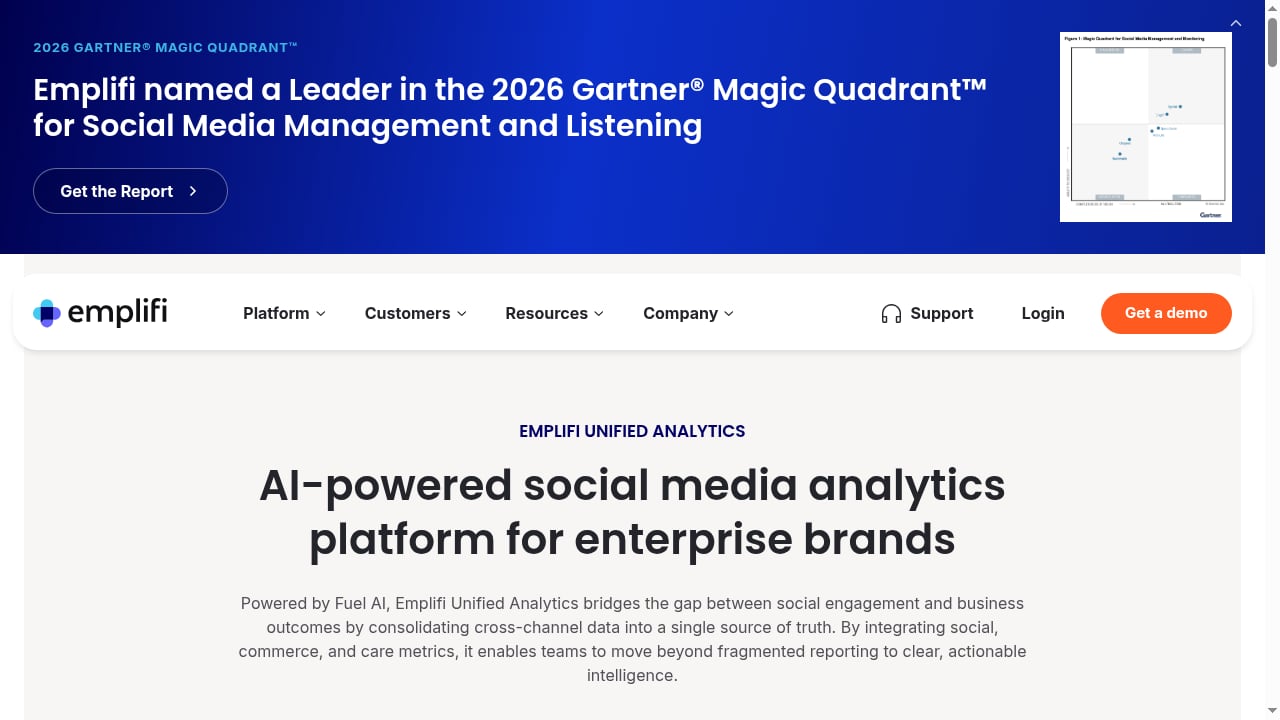
First viewport screenshot of Social Media Analytics Software | Emplifi Unified Analytics.
Social Marketing and Publishing
Emplifi supports calendar management, content management, and multi-network publishing, which are consistently rated among the most important features by social media analytics buyers. Teams can plan campaigns, schedule posts, and maintain a consistent brand presence across channels from one workspace.
Social Listening and Analytics
Listening and analytics are central to the platform. Emplifi monitors brand mentions, tracks sentiment, and reports on campaign performance. Reviewers frequently highlight dashboards, reporting, and campaign analytics as strengths, though some note that insights can feel surface-level unless configured carefully.
Social Commerce
Emplifi connects social content to shopping behavior, helping brands use user-generated content, reviews, and community engagement as social proof on product pages and campaigns.
Customer Care
The care module unifies social messages and support interactions, so service teams can respond in the same environment where marketing publishes. This is one of Emplifi's clearest differentiators against pure scheduling tools.
Influencer and Advocacy Management
Emplifi includes influencer discovery, relationship management, gifting, briefs, and ROI tracking. Its database is large, but users have reported that discovery can be exhausting and that vetting accuracy varies. Treat influencer features as a module to evaluate separately, not as an automatic win.
Strengths
- Breadth in one platform: marketing, commerce, care, listening, and influencer workflows share a single environment.
- Enterprise governance: approvals, roles, and multi-brand structures are designed for large organizations.
- Analytics depth: dashboards and campaign reporting are among the most praised features in third-party reviews.
- Scale: supports many profiles, users, and data retention needs at higher tiers.
- AI positioning: automation and AI-assisted workflows are embedded across publishing, listening, and care.
Limitations and Trade-offs
- Pricing opacity: only the entry tier has publicly listed pricing; higher tiers require a sales conversation. Budgeting is harder than with transparent tools.
- Cost: the Essential plan starts around $2,400, which excludes most small teams.
- Complexity: setup and configuration take real effort. This is not a plug-and-play tool.
- Influencer discovery friction: large databases can create decision paralysis, and some users question data accuracy.
- Add-on costs: social listening, UGC, and influencer marketing may cost extra depending on your plan.
- Surface-level insights risk: without proper configuration, analytics may not answer the specific questions your team has.
Pricing Signals
Publicly available information suggests four paid tiers with no free plan:
- Essential: around $2,400, roughly 10 social profiles, two users, scheduling, analytics, and service/learning centers.
- Standard: more profiles, 12 months of data retention, five dashboards, and an assigned expert. Pricing on request.
- Business: 25+ profiles, unlimited retention, 25 dashboards, content collection, and AI capabilities. Influencer marketing is an add-on. Pricing on request.
- Enterprise: unlimited users, 50+ profiles, unlimited dashboards, social listening, influencer marketing, and a dedicated ambassador. Pricing on request.
Treat these figures as signals, not quotes. Final pricing depends on profiles, users, modules, and contract length. Always request a written breakdown before committing.
Setup and Onboarding
Expect a structured implementation rather than a self-serve signup. Typical steps include connecting social accounts, configuring roles and approvals, mapping care workflows, setting up listening queries, and building dashboards. Higher tiers include a dedicated expert, which matters because misconfigured listening and reporting are common sources of disappointment. Plan for weeks, not hours, and assign an internal owner.
How Emplifi Compares
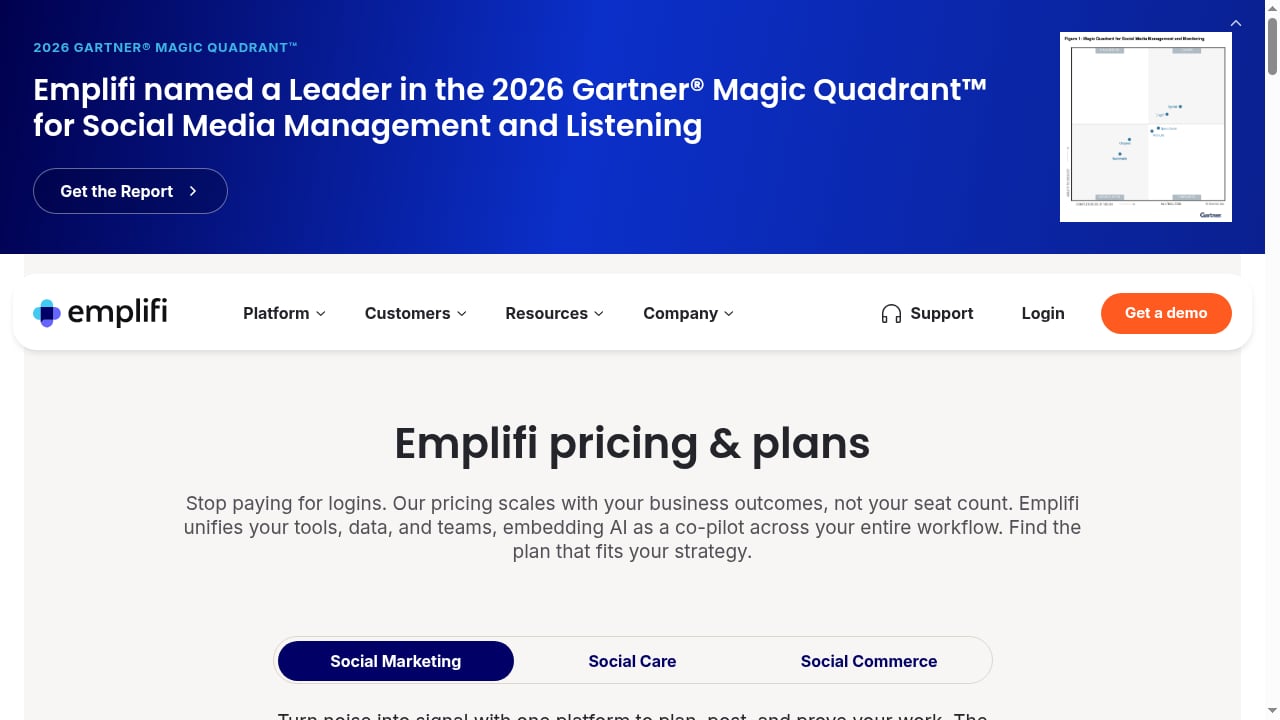
First viewport screenshot of Social Media Management Pricing | Emplifi.
If you are evaluating Emplifi, compare it against tools with clearer public pricing and lighter setup:
- For agency white-label needs, see Top 10 White-Label Social Media Management Software 2026.
- For mid-market alternatives with transparent plans, see SocialEcho vs Vista Social vs Pallyy: Best Social Media Tool 2026.
- For monitoring and PR-focused needs, see Top 10 Media Intelligence and PR Software Products 2026.
External references worth reading: Emplifi reviews on G2 and Emplifi Social Marketing Cloud on Capterra.
Decision Criteria
Choose Emplifi if:
- You manage many profiles, brands, or markets and need one governance layer.
- Social care and commerce are strategic, not afterthoughts.
- You can absorb enterprise pricing and a structured onboarding process.
- You need consolidated analytics across marketing, care, and influencer activity.
Look elsewhere if:
- You need transparent, self-serve pricing under a few hundred dollars per month.
- You mainly need scheduling and basic reporting.
- You want fast setup with minimal configuration.
- Influencer discovery accuracy is your top priority.
Related reading
- Sendible Review 2026: Unlimited Users, White Label & Real Limits - Evidence-based Sendible review for 2026: unlimited users, white labelling, setup, pricing signals, and honest limitations for agencies and multi-location brands.
Sources and further reading
- Emplifi Review + Features and Pricing + Best Alternatives in 2026 - Read Emplifi review to learn about its pros and cons and discover top competitors. Check its features and pricing to see if it works for you
FAQ
Does Emplifi have a free plan?
No. Public information indicates four paid tiers and no free option.
How much does Emplifi cost?
The Essential plan is reported around $2,400. Higher tiers are quote-based and depend on profiles, users, and modules.
Is Emplifi good for small businesses?
Usually not. It is designed for enterprise scale. Small teams will likely find it expensive and complex.
Does Emplifi include social listening?
Listening is available, but on lower tiers it may be an add-on. Confirm what is included in your specific quote.
What are the best Emplifi alternatives?
It depends on your need: white-label agency tools, mid-market schedulers, or media intelligence platforms. Compare based on pricing transparency, setup effort, and module fit.
Conclusion
Emplifi is a serious enterprise platform for organizations that treat social media as a combined marketing, commerce, and care operation. Its strengths are breadth, governance, and analytics. Its weaknesses are pricing opacity, cost, setup complexity, and uneven influencer discovery. If you have the scale and the budget, it can consolidate a fragmented stack. If you need speed, transparency, and simplicity, a lighter tool will serve you better. Evaluate with a pilot, a written quote, and clear success metrics before you commit.