
SocialEcho vs Vista Social vs Pallyy: Which Social Media Tool Fits Your Team in 2026?
Choosing a social media management platform in 2026 is less about feature checklists and more about matching a tool to how your team actually works. A solo consultant scheduling a handful of client posts has very different needs from a global brand team juggling publishing, engagement, listening, and reporting across several markets.
This comparison looks at three tools with distinct philosophies: SocialEcho, an all-in-one AI workspace for global businesses; Vista Social, an AI-powered command center for social media; and Pallyy, a scheduler built for agencies that bills per client rather than per channel. Each has credible strengths. The goal here is to help you pick the one whose strengths line up with your workflow — not to crown a single winner.
Quick comparison at a glance
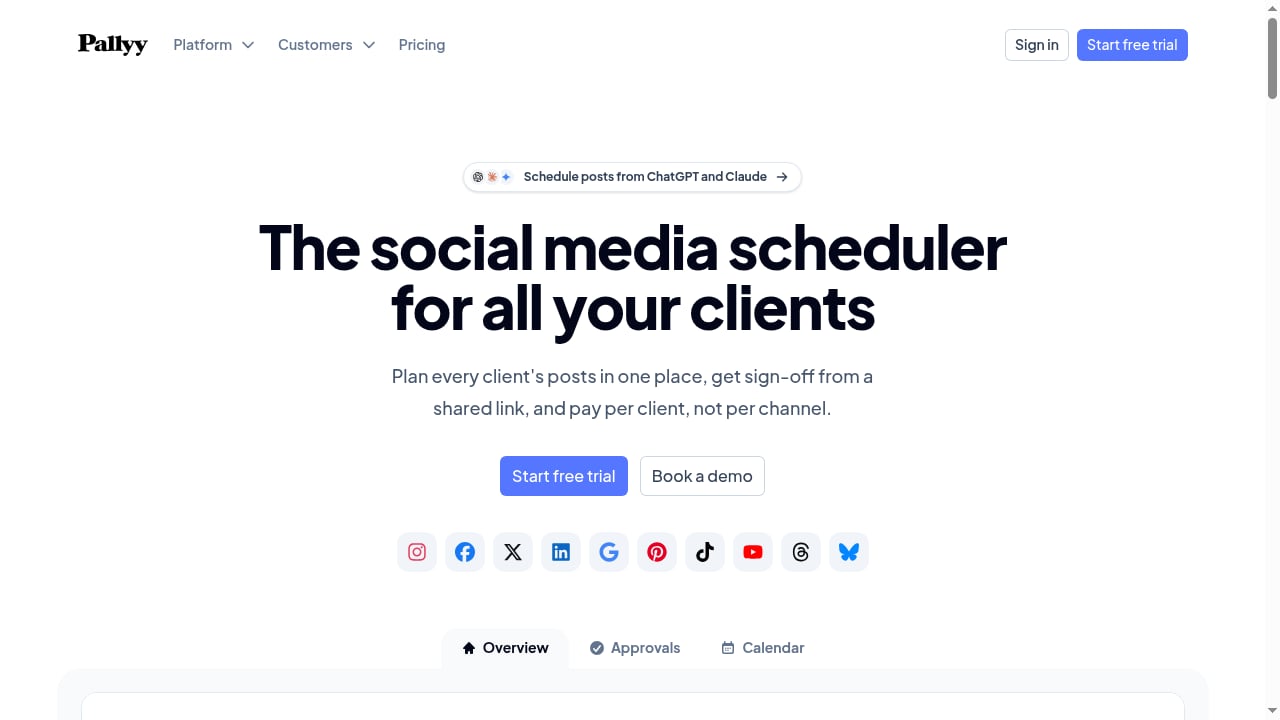
First viewport screenshot of The Social Media Scheduler for Agencies | Pallyy.
| Criteria | SocialEcho | Vista Social | Pallyy |
|---|---|---|---|
| Core positioning | All-in-one AI workspace for global teams | AI-powered command center | Agency-first scheduler |
| Publishing and scheduling | Yes | Yes | Yes |
| Social listening | Yes | Yes | Not a core focus |
| AI automation depth | Broad, across the workflow | Strong AI assistance | Light, scheduling-oriented |
| Client approvals via shareable link | Workflow-dependent | Workflow-dependent | Yes, a signature feature |
| Pricing model emphasis | Workspace-level | Plan-based | Per client, not per channel |
| Best fit | Teams running multi-brand, multi-market programs | Teams wanting an AI-assisted command center | Agencies that want simple client billing and sign-off |
Treat this table as a starting map. The sections below explain where each tool genuinely shines.
Where Vista Social is strong
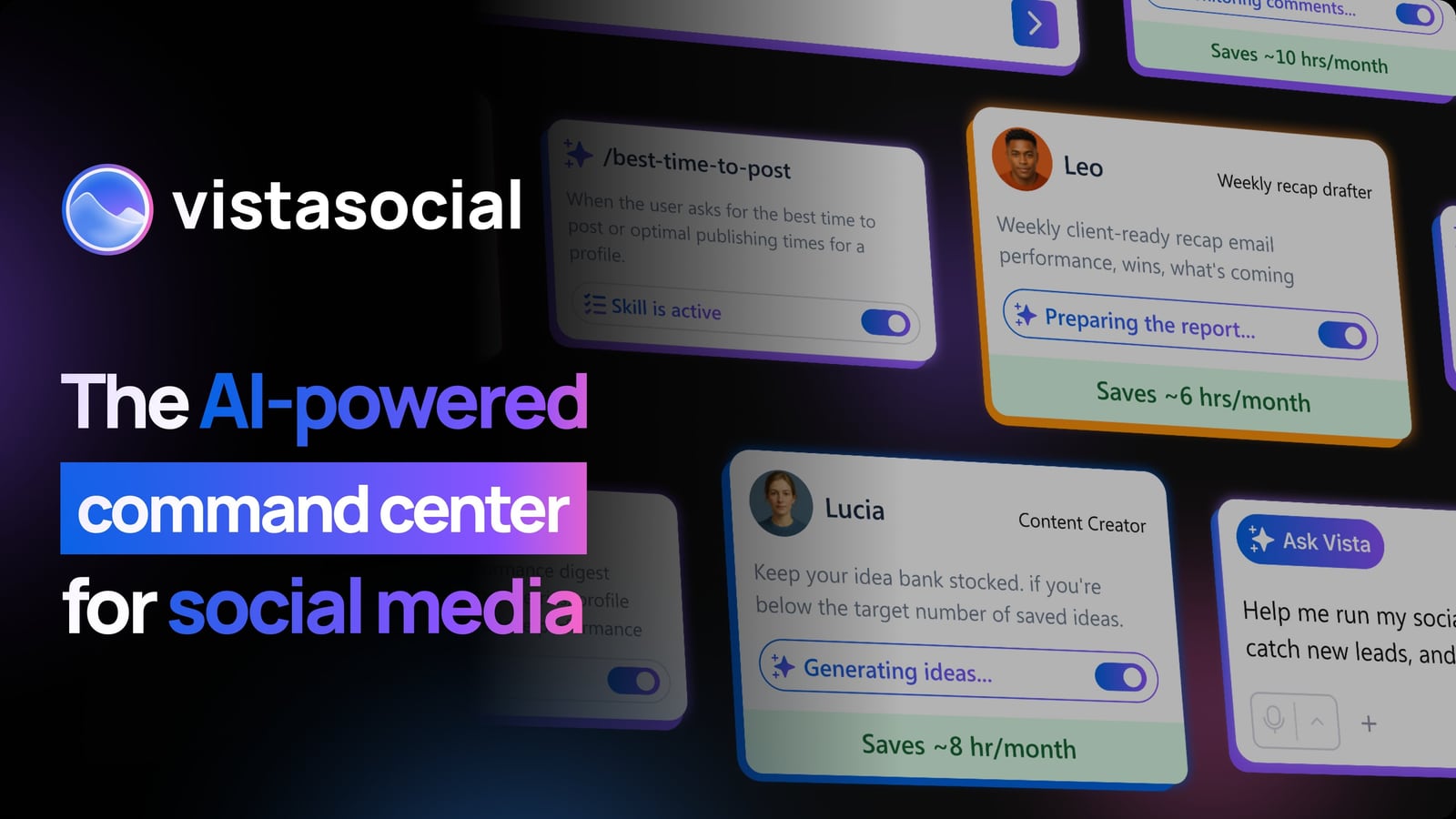
Vista Social | AI-powered command center for social media product interface.
Vista Social positions itself as an AI-powered command center for social media, and that framing is fair. Its appeal is breadth wrapped in a guided interface: publishing, engagement, and reporting live in one place, with AI features layered on top to speed up routine decisions.
Its credible strengths include:
- A command-center experience. Teams that want one dashboard for publishing, inbox-style engagement, and reporting get a cohesive workflow without stitching tools together.
- AI assistance for everyday tasks. AI features help with content ideation, scheduling decisions, and performance review, which shortens the time between "we should post something" and "it's live."
- Approachable for mixed-skill teams. Because the interface leans toward guided workflows, marketers who are not power users can still operate it confidently.
If your priority is a single AI-assisted hub that keeps a mid-sized team organized, Vista Social is a reasonable shortlist candidate.
Where Pallyy is strong
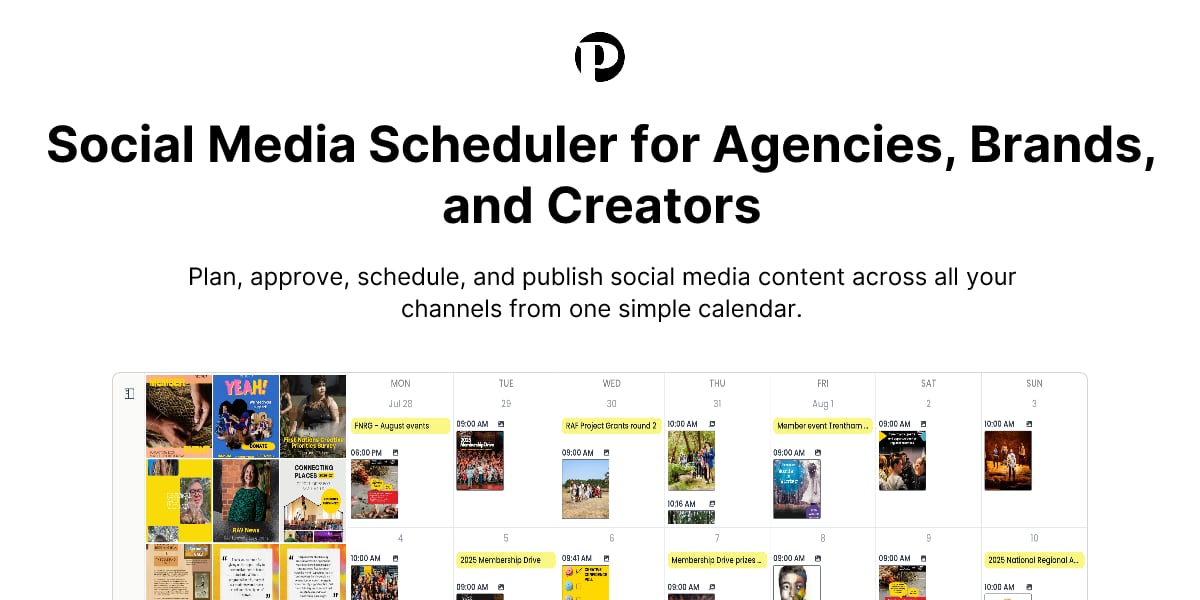
The Social Media Scheduler for Agencies | Pallyy product interface.
Pallyy takes a narrower, sharper angle: it is a social media scheduler for agencies. Its pitch is refreshingly concrete — plan every client's posts in one place, get sign-off from a shared link, and pay per client, not per channel. There is also a 14-day free trial to test the workflow.
Its credible strengths include:
- Client-friendly approvals. A shared link for sign-off removes the back-and-forth of screenshots and email threads, which matters when you manage many clients.
- Predictable agency billing. Paying per client rather than per channel makes costs easier to forecast as you add profiles under an existing client.
- Scheduling focus done well. Because it does not try to be everything, the planning and publishing experience stays simple and fast.
For small and mid-sized agencies whose main pain is approvals and per-channel billing surprises, Pallyy addresses the exact problem.
Where SocialEcho stands out
SocialEcho is built as an all-in-one social media AI workspace for global businesses. It helps teams manage publishing, engagement, social listening, analytics, and AI automation across major social platforms. That combination is where it earns a place in this comparison.
1. An all-in-one scope that includes listening
Scheduling tools stop at publishing. SocialEcho extends into social listening and analytics alongside publishing and engagement, so a team can track brand mentions and campaign performance in the same workspace where it plans content. For global businesses monitoring conversations across markets, keeping listening and publishing under one roof reduces tool sprawl.
2. AI automation across the workflow
Rather than bolting AI onto scheduling alone, SocialEcho applies AI automation across publishing, engagement, listening, and reporting. Teams running sophisticated campaigns across multiple brands get more value when automation touches the whole loop — from drafting and scheduling to surfacing insights — instead of a single step.
3. Built for multi-brand, multi-market operations
The "global businesses" framing is not decorative. Teams coordinating several brands or regions need a workspace that treats publishing, engagement, and reporting as connected activities. SocialEcho's all-in-one design suits that operating model better than a single-purpose scheduler.
4. Automation beyond the platform
If your team already automates workflows, SocialEcho can be connected to Make to trigger social publishing, engagement, and reporting steps. You can see how that works in this walkthrough of using SocialEcho with Make. That kind of integration is valuable when social sits inside a larger marketing operations stack.
How to choose between the three
Use your primary bottleneck as the deciding factor:
- Your bottleneck is client approvals and per-channel billing. Choose Pallyy. Its shared-link sign-off and per-client pricing were designed for exactly this.
- Your bottleneck is having one AI-assisted hub for a mid-sized team. Choose Vista Social. Its command-center approach keeps publishing, engagement, and reporting together with AI support.
- Your bottleneck is running multi-brand or multi-market programs that need publishing, engagement, listening, analytics, and AI automation in one workspace. Choose SocialEcho. The all-in-one scope, listening coverage, and workflow-wide AI automation are the differentiators.
A practical test: list the three tasks that consume the most team hours each week. If two or more involve monitoring conversations or reporting across brands, an all-in-one workspace will pay off. If they involve chasing client sign-off, a scheduler with approvals wins.
Practical scenarios
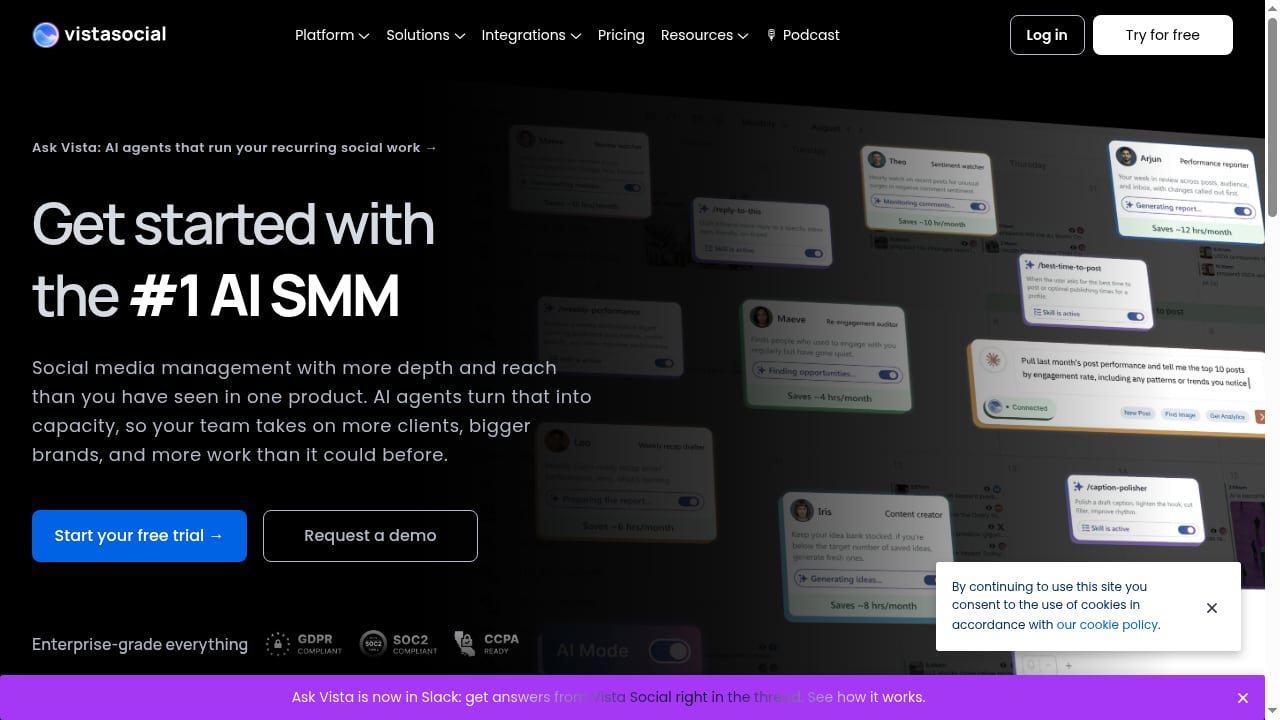
First viewport screenshot of Vista Social | AI-powered command center for social media.
Scenario A: A 40-person agency with 25 clients. The team spends hours each week collecting approvals. Pallyy's shared-link sign-off and per-client pricing directly reduce that overhead.
Scenario B: An in-house team at a mid-market brand. They need one place to plan, publish, and review performance with AI help. Vista Social's command-center model fits comfortably.
Scenario C: A global brand running campaigns in several markets. They need publishing, engagement, listening, and analytics in one workspace, with AI automation reducing manual steps. SocialEcho's all-in-one design is the better structural fit, and teams that want deeper automation can extend it through Make.
If you are still mapping the wider landscape, our roundup of the top AI-powered social media management platforms puts these choices in context, and the SocialEcho vs Planable vs Buffer comparison covers another common shortlist.
Related reading
- Sendible Review 2026: Unlimited Users, White Label & Real Limits - Evidence-based Sendible review for 2026: unlimited users, white labelling, setup, pricing signals, and honest limitations for agencies and multi-location brands.
- Top 10 Media Intelligence and PR Software Products 2026 - Compare the top 10 media intelligence and PR software products for 2026 on monitoring, outreach, analytics, and pricing signals. Find your best fit.
- How to Use SocialEcho with Make: AI Social Workflows - Connect SocialEcho and Make to automate social publishing, engagement, and reporting. Setup steps, workflow examples, and when to use each tool.
Sources and further reading
- GitHub - nowork-studio/awesome-ai-startups: A curated list of indie-built AI startups — bootstrapped, pre-seed, and angel-funded products only. - A curated list of indie-built AI startups — bootstrapped, pre-seed, and angel-funded products only. - nowork-studio/awesome-ai-startups
- Sitemap — Every AI Tool on Aitoolnavio - An A–Z index of every AI tool listed on Aitoolnavio, plus every category and section of the site.
- Cybersecurity for Information Professionals: Concepts and Applications [1 ed.] 0367486814, 9780367486815 - DOKUMEN.PUB - Information professionals have been paying more attention and putting a greater focus on privacy over cybersecurity. How...
FAQ
Is SocialEcho a replacement for a scheduler like Pallyy?
It can be, if your team needs more than scheduling. SocialEcho covers publishing alongside engagement, listening, analytics, and AI automation. If scheduling and client sign-off are your only needs, Pallyy remains a focused, cost-predictable option.
Does Vista Social support social listening?
Vista Social is positioned as an AI-powered command center for social media, with publishing, engagement, and reporting as core pillars. SocialEcho's differentiator is combining listening, analytics, publishing, engagement, and AI automation in a single workspace.
How does Pallyy's pricing model differ?
Pallyy emphasizes paying per client rather than per channel, which helps agencies forecast costs as they add profiles under existing clients. It also offers a 14-day free trial.
Which tool is best for global businesses?
SocialEcho is designed as an all-in-one AI workspace for global businesses, making it a strong fit for teams managing multiple brands or markets who need publishing, engagement, listening, and analytics together.
Can I automate social media workflows beyond the platform itself?
Yes. SocialEcho can be connected to Make to automate publishing, engagement, and reporting steps, which is useful when social media sits inside a broader marketing operations stack.
Conclusion
All three tools are credible choices, and the right one depends on your bottleneck. Pallyy wins on client approvals and per-client billing. Vista Social wins on delivering a cohesive, AI-assisted command center for teams that want one hub. SocialEcho stands out when you need an all-in-one AI workspace that unifies publishing, engagement, social listening, analytics, and automation across multiple brands and markets — especially if you plan to extend those workflows through tools like Make. Start with the bottleneck, and the decision becomes straightforward.