
SocialEcho + Jasper: AI Social Media Workflow for Global Teams
Global social teams face a familiar squeeze: more platforms, more languages, more accounts, and the same headcount. SocialEcho gives you the operational workspace to publish, engage, listen, and analyze across major networks. Jasper gives you AI agents that plan and produce marketing work at campaign scale. Used together, they cover the full loop from strategy to published post to performance feedback — without forcing your team to copy-paste between disconnected tools.
This article explains how the two products complement each other, walks through a practical setup, and shows where the combination solves problems that neither tool handles well alone.
Why pair SocialEcho with Jasper?
First viewport screenshot of www.jasper.ai.
SocialEcho is built for execution: scheduling, multi-account publishing, comment and DM management, social listening, analytics, and AI automation across platforms like Facebook, Instagram, TikTok, X, LinkedIn, YouTube, Pinterest, and Threads. Jasper is built for marketing orchestration: AI agents that research, draft, and coordinate campaign content with brand control and measurable outputs.
The split is simple. Jasper decides what to say and produces on-brand campaign assets. SocialEcho decides where and when it goes live, handles the audience conversation, and reports what happened. Neither replaces the other, and together they close the gap between "we have a campaign idea" and "we know how it performed."
The problems the combination solves
- Campaign content stalls before publishing. Jasper agents generate briefs, variants, and localized copy; SocialEcho turns them into scheduled posts across every account.
- Brand consistency breaks at scale. Jasper enforces brand voice and messaging rules during generation; SocialEcho keeps the approved versions intact through scheduling and publishing.
- Engagement lags behind publishing. SocialEcho's unified inbox and AI auto-replies handle comments and DMs while Jasper keeps the messaging library current.
- Reporting lives in a different universe from creation. SocialEcho's analytics feed performance data back into the next Jasper campaign brief, so the loop closes.
How the workflow fits together
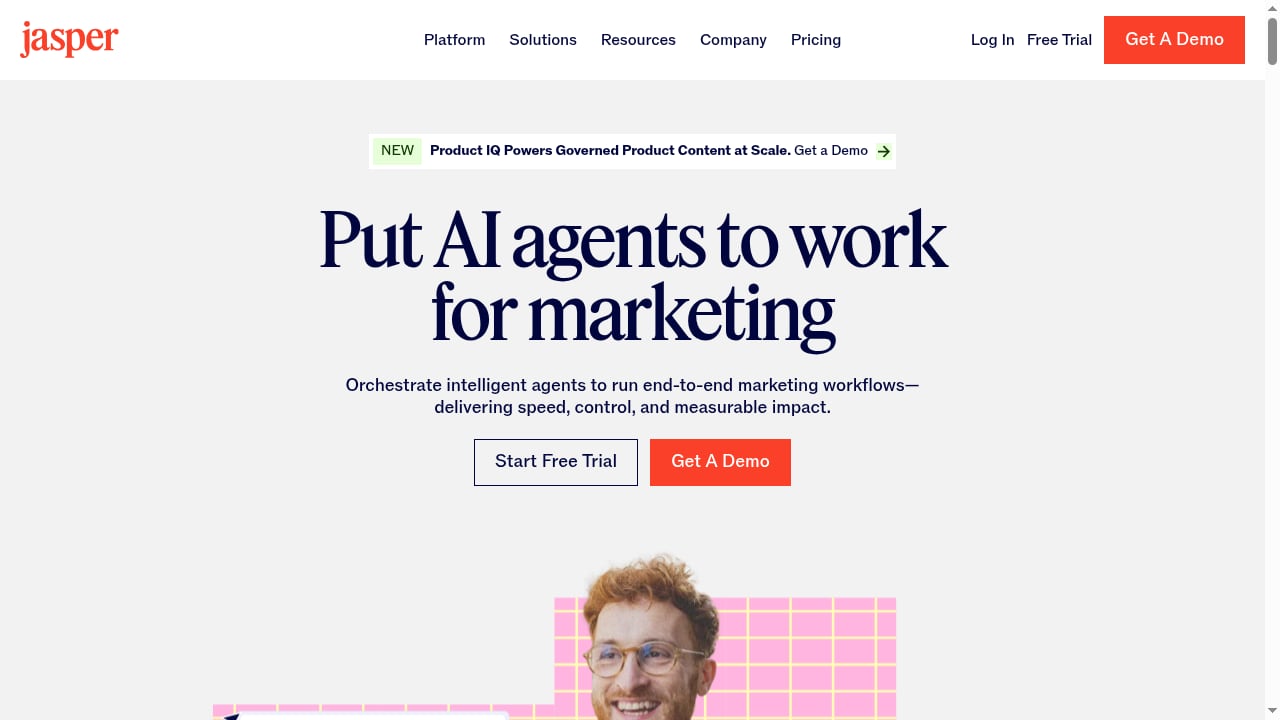
First viewport screenshot of jasper.ai.
A practical combined workflow has five stages. Jasper leads the first two, SocialEcho leads the last three, and the handoff points are where most teams either win or waste time.
Stage 1: Campaign planning with Jasper agents
Start in Jasper by defining the campaign goal, audience segments, markets, and channels. Jasper's agents can research positioning, draft messaging pillars, and produce a campaign brief with variants for each region or persona. Keep the output structured — one brief per market or audience — so it maps cleanly to SocialEcho's account groups later.
Stage 2: Content generation and brand review
Jasper generates platform-adapted copy, hooks, and creative direction. This is where brand voice, compliance language, and claim accuracy get locked. Human review still matters here: check product specs, pricing, and regulated claims before anything moves downstream. The goal is approved assets, not raw drafts.
Stage 3: Publishing and scheduling in SocialEcho
Import or recreate the approved content in SocialEcho, then use its multi-platform scheduling and content calendar to distribute across accounts and time zones. SocialEcho's AI rewriting can adapt a master version for each platform's format and length, and its multi-account structure handles regional or brand-specific pages. If your team already automates handoffs, the SocialEcho and Zapier workflow guide shows how to connect publishing and reporting to thousands of other apps.
Stage 4: Engagement and community management
Once posts are live, SocialEcho's unified inbox and AI auto-replies handle the first wave of comments and DMs — pricing questions, shipping inquiries, support issues. Complex or sensitive conversations route to a human. Jasper can supply approved response frameworks and FAQ language so auto-replies stay on-brand.
Stage 5: Analytics and feedback into the next campaign
SocialEcho's post-level and account-level analytics show what resonated by platform, market, and format. Feed those results back into Jasper as input for the next campaign brief. This is the step most teams skip, and it is the one that makes the combination compound over time.
Setup steps

Put AI agents to work for marketing | Jasper product interface.
- Define account groups in SocialEcho. Organize by region, brand, or client so campaign assets map to the right publishing destinations.
- Build a Jasper brand kit. Load voice guidelines, approved claims, and terminology so agents generate consistent copy across markets.
- Create a shared naming convention. Use the same campaign IDs in Jasper briefs and SocialEcho schedules so reporting lines up later.
- Agree on the handoff format. Decide whether approved copy moves manually, via export, or through automation such as Zapier or SocialEcho's API.
- Set review gates. Jasper output gets brand and compliance review before it enters SocialEcho; SocialEcho schedules get a final calendar check before publishing.
- Connect feedback loops. Schedule a monthly review where SocialEcho analytics inform the next Jasper brief.
Practical examples
First viewport screenshot of www.jasper.ai.
Example 1: A cross-border e-commerce launch
A retailer launching in three markets uses Jasper agents to draft localized campaign messaging and product hooks for each region. The approved variants move into SocialEcho, where they are scheduled across Instagram, TikTok, and Facebook accounts by time zone. SocialEcho's auto-replies handle sizing and shipping questions in the first 48 hours, and analytics show which market's hook drove the most saves and shares.
Example 2: A B2B thought-leadership program
A SaaS company uses Jasper to turn research reports into LinkedIn post series and newsletter snippets. SocialEcho schedules the LinkedIn cadence, manages comment threads from prospects, and reports engagement by topic. The following month's Jasper brief starts from the topics that earned the most comments, not from guesswork.
Example 3: An agency managing multiple clients
An agency runs separate Jasper workspaces per client for brand voice, then publishes through SocialEcho's multi-account structure. SocialEcho's analytics become the client reporting layer, while Jasper handles the creative volume. For teams comparing workspace options, the SocialEcho vs Hootsuite comparison explains where an AI workspace differs from a traditional dashboard.
Where each tool stops and the other begins
| Need | Jasper | SocialEcho |
|---|---|---|
| Campaign strategy and messaging | Strong | Limited |
| Brand-consistent copy generation | Strong | Moderate |
| Multi-platform scheduling | Not its focus | Strong |
| Comment and DM management | Not its focus | Strong |
| Social listening and analytics | Limited | Strong |
| End-to-end orchestration | Strong for marketing workflows | Strong for social operations |
If your bottleneck is content volume and campaign planning, Jasper leads. If your bottleneck is publishing, engagement, and reporting across many accounts, SocialEcho leads. Most global teams need both, with a clear handoff between them.
Related reading
- SocialEcho vs Iconosquare: AI Workspace or Analytics Tool? - Compare SocialEcho's AI-powered social media workspace with Iconosquare's analytics-first platform. See which fits your team's publishing, engagement, and reporting needs.
- Mention Review: Social Listening & Media Monitoring Tool - Evidence-based Mention review: social listening and media monitoring strengths, limitations, pricing signals, setup, and ideal users for 2026.
- Iconosquare Pricing Explained: What Social Teams Should Budget - Understand Iconosquare pricing tiers, feature gates, and hidden costs. Learn how to budget for social media management software and compare alternatives.
Sources and further reading
- How to Use AI for Social Media Content: A Human + AI Workflow Breakdown - Want to use AI for social media content without sounding repetitive or losing reach? Here's a breakdown of the six-stage human-AI workflow, from ideation to review.
- Top 10 AI Social Media Tools for Global Brands in 2026 - Compare the top 10 AI social media tools for 2026, covering content creation, multi-account management, auto-replies, analytics, and API access.
- News & Media Solution - SocialEcho - A social media solution for news media and global publishers — one-click multi-platform distribution, scheduled publishing, AI rewriting, centralized message management, and content-heat analytics to reach a global audience faster.
FAQ
Do SocialEcho and Jasper integrate natively?
They serve different layers of the workflow. Content can move between them through export, manual upload, or automation tools like Zapier and SocialEcho's API. The key is a consistent naming and approval process so handoffs stay clean.
Can Jasper replace SocialEcho's AI content features?
No. Jasper is stronger for campaign-level marketing orchestration and brand-governed generation. SocialEcho's AI is built into the publishing and engagement workflow — platform-specific rewrites, auto-replies, and scheduling-adjacent automation. They complement rather than duplicate each other.
Is this combination suitable for small teams?
Yes, if the team manages multiple platforms or markets. A single-channel team may find one tool sufficient. Teams juggling several accounts, languages, or clients get more value from the split between campaign creation and social operations.
How do we keep brand voice consistent across both tools?
Maintain one source of truth for brand guidelines — typically in Jasper's brand kit — and reference it when configuring SocialEcho's auto-reply rules and content templates. Review both quarterly.
What should we measure to know the combination is working?
Track publishing velocity, engagement response time, and content performance by market. Compare these before and after the workflow change. SocialEcho's analytics provide the operational metrics; Jasper's campaign reporting provides the strategic view.
Conclusion
SocialEcho and Jasper solve different halves of the same problem. Jasper gives global marketing teams the AI agents to plan and produce campaign content with control. SocialEcho gives them the workspace to publish, engage, listen, and measure across platforms and accounts. The value is not in either tool alone but in the handoff: approved campaign assets flow into scheduled publishing, audience conversations get managed, and performance data flows back into the next brief. Teams that design that loop deliberately will get more from both products than teams that treat them as separate subscriptions.
For a broader look at how SocialEcho compares with other social platforms, see the SocialEcho vs Mention vs AdaptlyPost comparison.