
SocialEcho vs Brandwatch vs Tailwind: Which Social Media Tool Fits Your Team?
Choosing a social media tool often comes down to one question: what job needs to get done? SocialEcho, Brandwatch, and Tailwind approach the market from different angles. SocialEcho is an all-in-one AI workspace for publishing, engagement, listening, analytics, and automation across major platforms. Brandwatch is a consumer intelligence and social media management suite built for enterprise insight. Tailwind focuses on Pinterest traffic and visual content scheduling.
This comparison breaks down where each tool is strong, where it is limited, and how to decide based on your team's priorities. It is written for marketing leads, social managers, and agencies evaluating a switch in 2026.
Quick comparison at a glance
| Capability | SocialEcho | Brandwatch | Tailwind |
|---|---|---|---|
| Core focus | All-in-one AI social workspace | Consumer intelligence and enterprise social management | Pinterest marketing and visual scheduling |
| Publishing and scheduling | Yes, across major networks | Yes, within enterprise workflows | Yes, with Pinterest-first scheduling |
| Social listening | Yes | Yes, deep consumer intelligence | Limited to Pinterest trends and keywords |
| AI automation | Yes, for creation, replies, and workflows | Yes, for insight and analysis | Yes, for Pin creation and timing |
| Analytics | Cross-platform performance reporting | Advanced audience and brand intelligence | Pinterest traffic and engagement metrics |
| Best fit | Teams wanting one AI workspace | Enterprise brands needing deep consumer insight | Pinterest-focused creators and e-commerce teams |
SocialEcho: an AI workspace for day-to-day social operations
SocialEcho is designed for teams that want publishing, engagement, listening, analytics, and AI automation in one place. Instead of stitching together a scheduler, an inbox, and a reporting tool, teams can run their social calendar and community responses from a shared workspace.
Strengths
- Unified publishing and engagement: Schedule posts and manage replies across major social platforms without switching tabs.
- AI-assisted workflows: Use AI to draft content, suggest replies, and automate repetitive tasks. For teams exploring automation beyond native features, combining SocialEcho with Make for AI social workflows shows how to connect publishing and reporting to no-code automations.
- Built-in listening and analytics: Monitor brand mentions and measure performance across networks in the same workspace used for publishing.
- Global team orientation: The workspace is structured for teams managing multiple markets and languages, with a shared calendar and role-based collaboration.
Limitations to consider
SocialEcho is not a dedicated consumer intelligence platform. Teams that need deep historical data, advanced sentiment modeling across millions of mentions, or influencer network analysis may find Brandwatch more specialized. Similarly, SocialEcho is not a Pinterest-first tool; teams whose primary channel is Pinterest may prefer Tailwind's focused feature set.
Brandwatch: deep consumer intelligence for enterprise teams
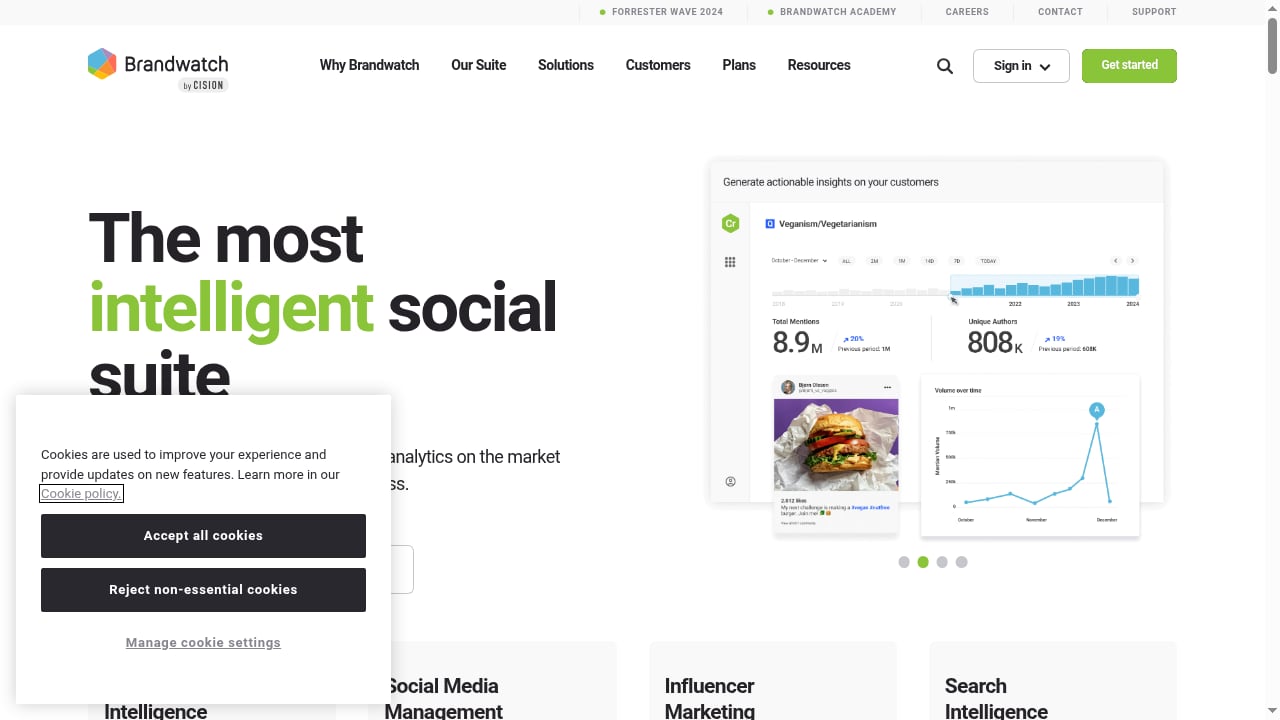
First viewport screenshot of brandwatch.com.
Brandwatch, a Cision company, is known for social listening and consumer intelligence. It is used by large brands to understand audience sentiment, track trends, and measure brand health across markets. Its suite also includes social media management and influencer marketing capabilities.
Strengths
- Consumer intelligence depth: Brandwatch excels at analyzing large volumes of social conversation, identifying sentiment shifts, and segmenting audiences.
- Enterprise-grade governance: The platform is built for complex organizations with multiple brands, markets, and stakeholders.
- Influencer marketing: Brandwatch includes tools for identifying and managing influencer relationships, which is valuable for campaigns that rely on creator partnerships.
- Trusted by large brands: Its customer base includes a significant share of the Forbes 100, which signals enterprise credibility.
Limitations to consider
Brandwatch is typically priced and scoped for enterprise buyers. Smaller teams may find the platform heavier than needed for routine publishing and community management. If your priority is a lightweight AI workspace for daily social operations, a tool like SocialEcho may be a better operational fit. For a closer look at how SocialEcho compares with another established dashboard, see SocialEcho vs Hootsuite: AI Workspace or Social Dashboard?.
Tailwind: a focused engine for Pinterest traffic
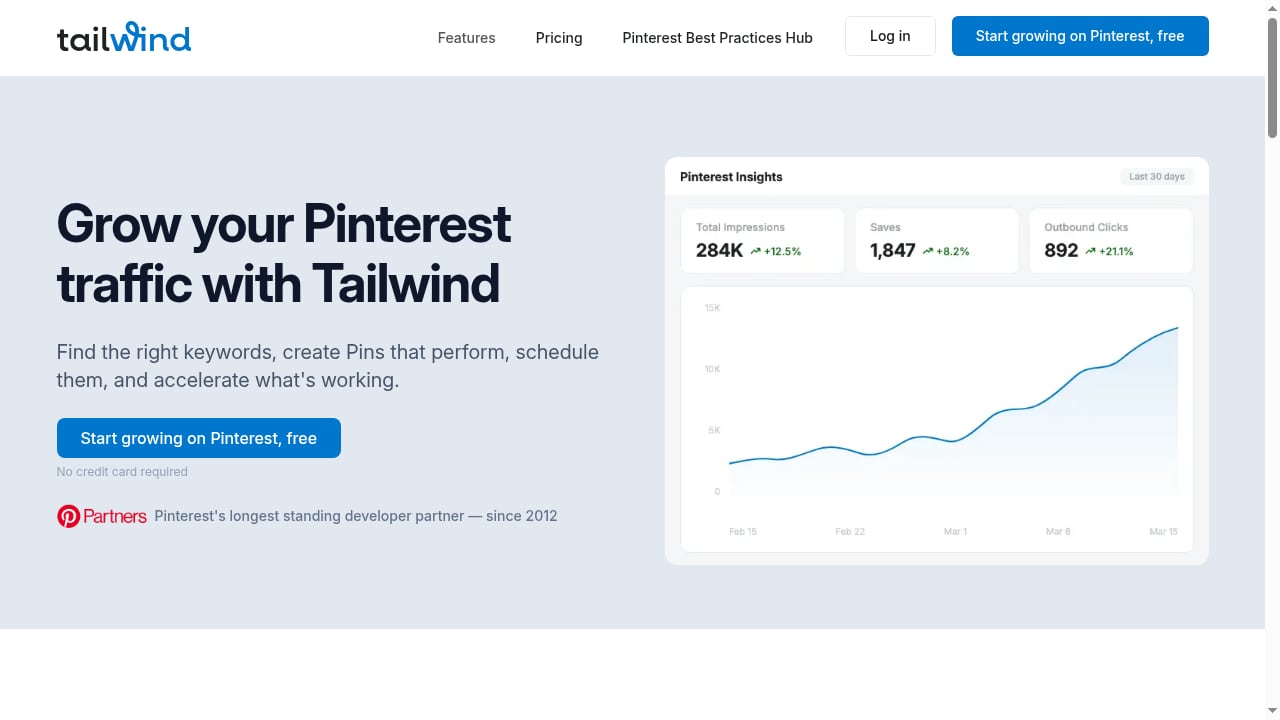
First viewport screenshot of Grow Your Pinterest Traffic with Tailwind.
Tailwind is built around Pinterest growth. It helps users find high-resonance keywords, auto-create Pins from existing content, schedule at optimal times, and accelerate reach with Turbo. It is free to start, which makes it accessible for creators and small teams testing Pinterest as a channel.
Strengths
- Pinterest-first design: Keyword research, Pin creation, and scheduling are tailored to how Pinterest discovery works.
- Automation for visual content: Auto-create Pins from blog posts or product pages, reducing manual design work.
- Optimal timing and Turbo: Schedule Pins when audiences are most active and use Turbo to extend reach.
- Low barrier to entry: A free starting tier lets teams validate Pinterest before committing budget.
Limitations to consider
Tailwind is not a full social media management suite. Teams that need cross-network publishing, a unified engagement inbox, or broad social listening will need additional tools. If your social strategy spans Instagram, LinkedIn, TikTok, and Facebook alongside Pinterest, a workspace like SocialEcho covers more ground, while Tailwind remains a strong specialist for Pinterest execution.
How to choose: decision guidance by use case
First viewport screenshot of Tailwind plans & pricing.
Choose SocialEcho if...
- You want one AI workspace for publishing, engagement, listening, and analytics.
- Your team manages multiple social networks and markets and needs a shared calendar.
- You want AI automation for content creation and replies without adding a separate tool.
- You are comparing all-in-one platforms and want to evaluate alternatives. SocialEcho vs Loomly vs RecurPost: Best Social Media Tool? offers a side-by-side view of scheduling-focused tools.
Choose Brandwatch if...
- Your priority is deep consumer intelligence and brand sentiment analysis at enterprise scale.
- You need advanced influencer marketing and audience segmentation.
- Your organization has the budget and team structure to support a comprehensive intelligence suite.
Choose Tailwind if...
- Pinterest is your primary or highest-growth channel.
- You want keyword research and Pin automation built specifically for Pinterest.
- You need a low-cost way to start driving Pinterest traffic.
Can these tools work together?
First viewport screenshot of www.brandwatch.com.
Yes. Many teams combine a specialist tool with a broader workspace. For example, a commerce brand might use Tailwind to scale Pinterest traffic while using SocialEcho for cross-network publishing, community management, and reporting. An enterprise team might use Brandwatch for consumer intelligence and a separate workspace for daily publishing and engagement.
The key is to avoid duplicating capabilities you already have. Map your must-have workflows first, then assign each tool a clear role.
Related reading
- Iconosquare Review: Analytics-First Social Media Management - Evidence-based Iconosquare review: analytics depth, scheduling, listening, pricing signals, setup, limitations, and who should choose it in 2026.
- Drag-and-Drop Editor for Social Media: A Practical Guide - Learn how a drag-and-drop editor simplifies social media management, plus how SocialEcho's AI workspace streamlines publishing, engagement, and analytics.
- Top 10 Autonomous Customer Experience (A-CX) Platforms for 2026 - Discover the top 10 Autonomous Customer Experience (A-CX) platforms for 2026, evaluated on AI autonomy, integration, analytics, and real-world fit.
Sources and further reading
- Social Media Glossary | SocialEcho - Comprehensive social media marketing glossary. Understand key industry terms and concepts.
- Best Free AI Tools for Marketing & Advertising in 2026 - Toolify - Free AI Sales · Instantly.ai - 1000 Uploaded Contacts, 5000 Emails Monthly / Automated Outreach / Deliverability Network / Lead Database - From $37/month · Clay - ...
- The Runway: every launch, by category - LaunchFree.io - The complete LaunchFree.io directory: 4095 free, human-reviewed launches from founders and builders, organized by category, each with a dofollow backlink.
FAQ
Is SocialEcho a replacement for Brandwatch?
Not entirely. SocialEcho covers publishing, engagement, listening, analytics, and AI automation in one workspace, which suits operational social teams. Brandwatch goes deeper into consumer intelligence and enterprise-scale analysis. Teams that need both daily operations and deep research may use them together.
Is SocialEcho better than Tailwind for Pinterest?
Tailwind is more specialized for Pinterest keyword research, Pin creation, and scheduling. SocialEcho is a broader social media workspace. If Pinterest is your only channel, Tailwind is likely the better fit. If Pinterest is one of several channels, SocialEcho may be more efficient overall.
Does Brandwatch include social media management?
Yes. Brandwatch offers social media management alongside its consumer intelligence and influencer marketing capabilities. It is positioned as an enterprise suite rather than a lightweight scheduler.
Which tool is best for a small team?
For small teams that need an affordable, all-in-one workspace, SocialEcho is designed for operational social management. Tailwind's free starting tier is attractive for Pinterest-focused creators. Brandwatch is generally better suited to larger organizations with dedicated insights teams.
Can I use SocialEcho and Tailwind together?
Yes. Some teams use Tailwind for Pinterest-specific scheduling and keyword research while using SocialEcho for other networks and cross-platform reporting. The right combination depends on how much of your traffic comes from Pinterest.
Conclusion
SocialEcho, Brandwatch, and Tailwind are not direct substitutes for every use case. SocialEcho is strongest as an all-in-one AI workspace for teams that need publishing, engagement, listening, analytics, and automation in one place. Brandwatch leads on deep consumer intelligence for enterprise brands. Tailwind is a focused, accessible tool for growing Pinterest traffic.
Start by identifying your primary bottleneck: daily social operations, consumer insight, or Pinterest growth. That answer will point you to the right tool, or the right combination of tools, for your team in 2026.