SocialEcho vs Ocoya vs Buffer: Which Social Media Management Tool Is Right for You?
Choosing the right social media management platform can make or break your team's efficiency. SocialEcho, Ocoya, and Buffer each take a distinct approach: SocialEcho puts AI-driven engagement and compliance at the center for global businesses, Ocoya focuses on AI content creation at scale, and Buffer champions simplicity and reliable publishing. In this comparison, we’ll break down where each platform excels—so you can pick the one that aligns with your priorities.
Understanding the Platforms at a Glance
SocialEcho vs Ocoya vs Buffer: Which Tool Fits Your Team? product interface and feature overview.
SocialEcho is an all-in-one AI workspace built for cross-border sellers, foreign trade companies, and digital marketing teams. It combines publishing, AI-powered auto-replies for comments and DMs, social listening, competitor tracking, and centralized analytics across Facebook, Instagram, X, LinkedIn, TikTok, YouTube, and Telegram. The interface supports English and Chinese, and the platform holds ISO 27001, ISO 27701, and SOC 2 certifications.
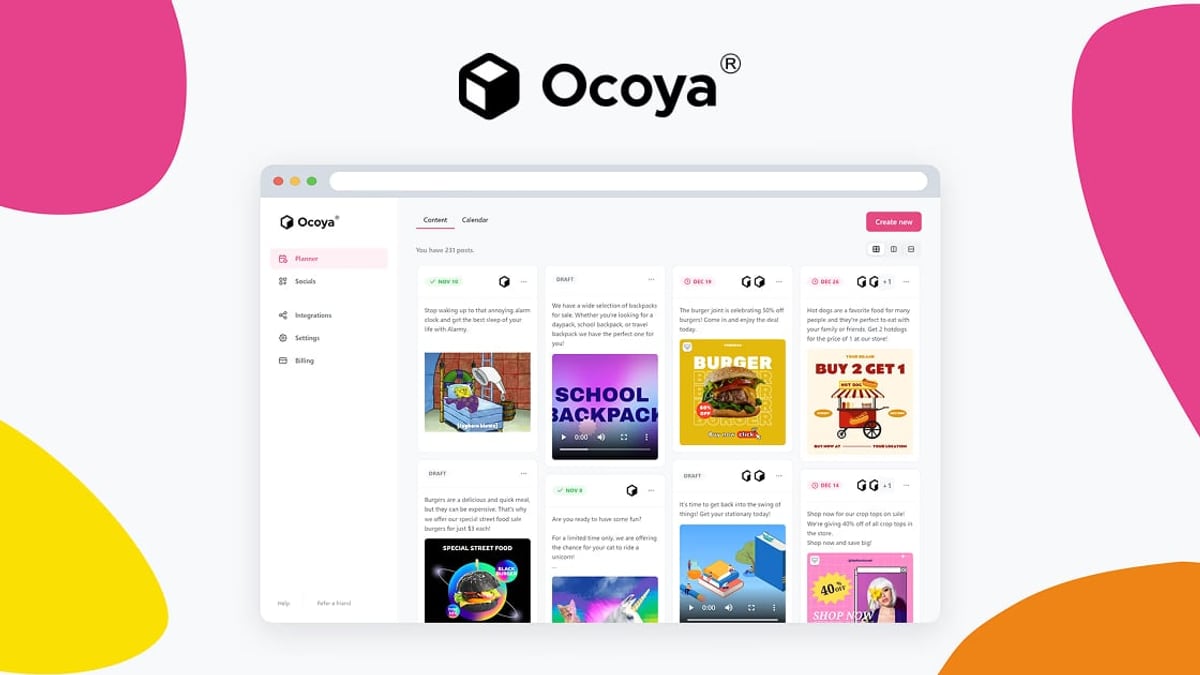
Ocoya is an AI-first social media suite that automates content creation and scheduling. It includes an in-house editor with social templates, AI-generated captions and hashtags, bulk posting, and integration with design tools like Canva. Ocoya works with major platforms plus Discord, Slack, Threads, and Pinterest, appealing to agencies and freelancers who need to produce high volumes of visual content quickly.
Buffer is known for its clean, intuitive publishing calendar and community engagement tools. Over 200,000 customers use Buffer to schedule posts, reply to comments, and analyze performance. It supports newer networks like Bluesky and Mastodon, offers an AI assistant for brainstorming and editing, and is built with accessibility (WCAG 2.1 AA) in mind.
Where Ocoya Outshines: AI-Powered Content Creation and Bulk Scheduling
SocialEcho vs Ocoya vs Buffer: Which Tool Fits Your Team? product interface and feature overview.
Ocoya’s biggest advantage lies in its content production speed. The platform uses AI agents and workflows to generate captions, hashtags, and even full social posts in seconds. Instead of jumping between a design tool and a scheduler, you can use Ocoya’s built-in editor with professionally designed templates and a direct Canva integration.
For teams that publish large volumes, Ocoya’s bulk scheduling capability (up to 1,000 posts per minute) is a standout. The drag-and-drop calendar also suggests best posting times, so you can optimize reach without manual analysis. Agencies that manage dozens of client accounts will appreciate the collaboration features and the affiliate program that pays a 30% recurring commission.
Ocoya’s tiered pricing starts at $15/month, making it accessible for solo creators, while higher plans unlock advanced AI features and higher scheduling limits. If your priority is scaling content output with minimal manual effort, Ocoya is a strong candidate.
Where Buffer Shines: Reliable Publishing and Clean Community Engagement
Buffer’s philosophy is simplicity, and it shows in every aspect of the product. The publishing calendar lets you queue and schedule posts across multiple platforms with minimal friction. Its AI assistant helps brainstorm ideas, rewrite captions, and repurpose content—keeping the creation process smooth without overwhelming you with complex automation.
Community engagement is handled through a unified inbox where you can respond to comments across networks. While it doesn’t offer AI auto-replies, the manual reply system is well-organized and suitable for teams that want a personal touch. Buffer’s analytics deliver clean, actionable insights on post performance, audience growth, and engagement trends.
Buffer also provides a generous free forever plan that’s ideal for individuals and small teams. Paid upgrades add collaboration tools, more channels, and deeper analytics. For an extra edge, startups in the Antler portfolio can get a 25% discount. If you value a clutter-free interface and straightforward publishing, Buffer is a dependable choice. For a deeper comparison that includes Buffer’s performance against another popular tool, read our SocialEcho vs Buffer vs Agorapulse breakdown.
Where SocialEcho Stands Apart: AI Auto-Reply, Social Listening, and Compliance
SocialEcho vs Ocoya vs Buffer: Which Tool Fits Your Team? product interface and feature overview.
SocialEcho is purpose-built for businesses that need more than just scheduling. Its standout feature is AI-powered auto-reply: the platform can automatically respond to public comments and direct messages with context-aware answers. For global brands handling large comment volumes across time zones, this drastically cuts response times and keeps engagement levels high.
Equally important is SocialEcho’s built-in social listening and competitor tracking. You can monitor brand mentions, industry keywords, and rival activity from a centralized dashboard—no need for a separate listening tool. This helps cross-border teams spot trends and react faster in multiple languages.
Compliance is another area where SocialEcho excels. The platform is ISO 27001, ISO 27701, and SOC 2 certified, and it complies with GDPR and CCPA. If your business operates in regulated markets or handles sensitive customer data, these certifications provide peace of mind that is rare in social media management tools.
Pricing is transparent and flexible: plans start at $3 per account per month, and a free forever plan lets you test the core features. With support for both English and Chinese interfaces, SocialEcho is uniquely positioned for companies managing social across Asian and Western markets. To see how SocialEcho’s AI engagement stacks up against Ocoya’s content automation, check out our head‑to‑head comparison.
Pricing and Plans: Which Offers the Best Value?

SocialEcho vs Ocoya vs Buffer: Which Tool Fits Your Team? product interface and feature overview.
Cost considerations vary widely depending on your team size and needs. Here’s how the three platforms compare:
- SocialEcho uses a per-account model starting at $3/account/month, plus a free forever plan. This works well for businesses that need to connect many brand profiles without paying for unused features. The free plan includes core publishing and analytics.
- Ocoya follows a tiered structure ($15–$159/month), with each plan capping the number of social profiles, scheduled posts, and AI credits. A 7-day free trial is available. Agencies investing in content creation at scale will find the upper tiers compelling.
- Buffer offers a forever free plan for up to three channels. Paid plans start affordably and unlock collaboration, more profiles, and advanced analytics. The platform’s pricing scales with the features you actually need, making it easy to start small.
For businesses managing a high volume of accounts, SocialEcho’s per-account pricing often proves the most cost-effective. For solopreneurs who want a capable free scheduler, Buffer leads. Teams focused on content production may find Ocoya’s all-inclusive AI features justify the monthly investment.
Unique Platform Integrations That Set Each Tool Apart
While all three tools cover Facebook, Instagram, X/Twitter, LinkedIn, and TikTok, each brings its own specialty networks to the table:
- SocialEcho natively supports Telegram—a powerful channel for community-building in markets like Southeast Asia and Eastern Europe. It also covers YouTube.
- Ocoya extends to Pinterest, Threads, Google Business, YouTube Shorts, Discord, Slack, and Telegram. Its Slack and Discord integrations are valuable for teams that want to centralize internal comms and social publishing.
- Buffer includes Threads, Bluesky, YouTube Shorts, Pinterest, Google Business, and Mastodon. These platforms cater to creators and communities that value decentralized or alternative social spaces.
If your audience lives on Telegram, SocialEcho is the natural pick. If you need to post to Google Business profiles or chat apps like Slack, Ocoya has the edge. Buffer lets you reach the widest array of emerging platforms with minimal setup.
Which Tool Should You Choose?
Your decision ultimately comes down to your team’s primary workflow:
Choose SocialEcho if:
- AI-powered auto-replies and social listening are must-haves
- You operate across English and Chinese-speaking markets
- Compliance certifications (ISO/GDPR) are critical
- You manage many accounts and prefer per-account pricing
Choose Ocoya if:
- Fast, AI-driven content creation is your main priority
- You need a built-in design editor and Canva integration
- Bulk scheduling and best-time suggestions will save you hours weekly
- You’re an agency or freelancer producing high volumes of visual content
Choose Buffer if:
- You value a simple, distraction-free publishing experience
- Manual community engagement fits your brand’s voice
- A generous free plan for up to three channels meets your current needs
- Accessibility and a clean mobile app are important to your team
For additional context, you can see how real users rate Buffer and Ocoya side by side in this independent comparison on Software Advice.
Related reading
- SocialEcho vs Sprout Social vs Dash Social: Which Tool Wins in 2026? - Compare SocialEcho, Sprout Social, and Dash Social on pricing, AI automation, analytics, and platform support. Find the best social media management tool for your team.
- SocialEcho vs Sendible vs Dash Social: Which One Fits Your Team? - Compare SocialEcho, Sendible, and Dash Social on AI auto-reply, agency features, enterprise AI, pricing, and compliance. Discover which social media tool suits your business best.
- SocialEcho vs Sprout Social vs Agorapulse: Which Tool Fits Your Team? - Compare SocialEcho, Sprout Social, and Agorapulse on pricing, AI auto-reply, compliance, reporting, and platform support. Find the best social media tool for your team.
Sources and further reading
- Bolta - Bolta is an AI-native social media operating system that combines specialized agents, brand context, human approvals, scheduling, publishing, and performance feedback.
- Attention Required! | Cloudflare - This website is using a security service to protect itself from online attacks. The action you just performed triggered the security solution. There are several actions that could trigger this block including submitting a certain word or phrase, a SQL command or malformed data.
Frequently Asked Questions
Is SocialEcho suitable for small businesses?
Yes. SocialEcho offers a free forever plan and flexible per-account pricing that keeps costs low for small teams. The AI auto-reply and listening features scale down for solo entrepreneurs just as well as for larger enterprises.
Does Ocoya offer social listening like SocialEcho?
Ocoya focuses primarily on content creation and scheduling. It does not include social listening or competitor tracking modules comparable to SocialEcho’s dedicated monitoring features.
Can I manage TikTok and YouTube on Buffer?
Yes. Buffer supports TikTok, YouTube Shorts, and standard YouTube publishing. You can schedule, publish, and analyze performance for both platforms from the same dashboard.
What is the cheapest option among these three?
Buffer’s free plan is the most generous for individuals. SocialEcho’s free forever plan also supports core features, and its paid plans start at just $3 per account per month. Ocoya’s lowest tier is $15/month.
Do these tools offer free trials?
SocialEcho provides a 7-day free trial and a free forever plan. Ocoya offers a 7-day free trial. Buffer has a free forever plan with no time limit; paid features can be tested by upgrading temporarily.
Which tool supports Telegram natively?
Both SocialEcho and Ocoya support Telegram. SocialEcho integrates Telegram alongside its AI auto-reply, making it particularly strong for community engagement on that platform.
Conclusion
SocialEcho, Ocoya, and Buffer each bring distinct strengths to the table. SocialEcho leads with AI engagement automation and compliance, making it ideal for global teams that need to listen and respond at scale. Ocoya excels in AI-driven content creation and bulk scheduling, perfectly suited for agencies that live and breathe visual output. Buffer keeps things simple, reliable, and accessible, which makes it a favorite for creators and small teams who want a no‑fuss publishing experience.
No single platform will be best for everyone—but by matching your team’s biggest pain point to the right strength, you’ll move from managing chaos to building a consistent, intelligent social presence. For more side-by-side comparisons like this, explore SocialEcho’ growing library of tool showdowns.