Brandwatch Review 2026: Features, Pricing & Real Limits
Brandwatch, a Cision company, is an AI-powered social media management and consumer intelligence suite used by half of the Forbes 100. This review examines its capabilities, ideal users, pricing signals, setup, and limitations so you can decide whether it fits your team.
What Brandwatch actually is
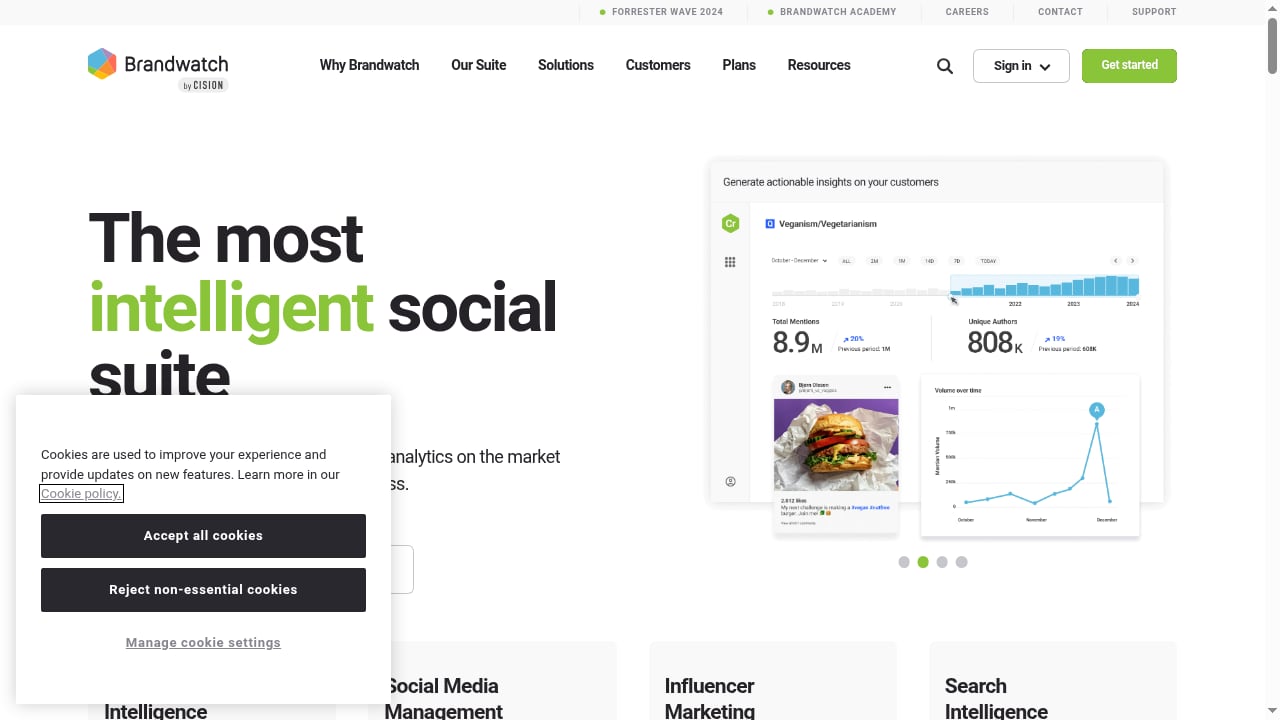
First viewport screenshot of Social Media Management & Consumer Intelligence | Brandwatch.
Brandwatch combines two product lines: Consumer Intelligence (social listening, trend research, competitor benchmarking) and Social Media Management (publishing, engagement, measurement). It also offers an Influencer Marketing solution. The platform is sold as custom plans across these three areas, with a demo-based sales process.
Unlike self-serve tools, Brandwatch targets mid-market and enterprise brands, agencies, and PR teams that need deep listening data and cross-network publishing in one place. The 2022 merger with Falcon.io added social media management to its listening roots.
Who Brandwatch is for (and who it isn't)
First viewport screenshot of Brandwatch: Innovation Spotlight 2025.
Ideal users:
- Enterprise brands and agencies managing multiple networks and large data volumes
- Market research and consumer insights teams tracking sentiment and trends
- PR and communications teams monitoring brand reputation and crises
- Influencer marketing teams needing discovery and campaign management
Less ideal for:
- Solo creators or very small teams with limited budgets
- Businesses wanting instant self-serve signup and transparent monthly pricing
- Teams that only need basic scheduling without listening or analytics depth
If you need a lighter, self-serve option, see our Agorapulse review or compare tools in our top social media scheduling software guide.
Core capabilities in practice
Consumer Intelligence and social listening
Brandwatch's listening engine queries social networks, forums, blogs, and review sites to surface consumer conversations in real time. You can build boolean queries, track sentiment, identify trending topics, and benchmark against competitors. G2 reviewers frequently highlight how easy it makes understanding consumer conversations and trends in real time.
Use case: A CPG brand tracks sentiment around a new product launch, identifies negative themes within hours, and adjusts messaging before the issue escalates.
Social Media Management
The Falcon.io heritage shows in the unified content calendar, customizable engagement inbox, and cross-network publishing. Teams can schedule posts, respond to messages, and measure performance from one dashboard. Automated reporting and customizable dashboards reduce manual reporting time.
Use case: An agency manages 20 client accounts, uses the calendar for approvals, and pulls automated monthly reports without exporting data manually.
Influencer Marketing
Brandwatch identifies influencers based on audience data and conversation analysis, then helps manage campaigns. This is useful for brands that want to combine listening insights with influencer selection.
Use case: A fashion brand finds micro-influencers whose audiences match its target demographic, then tracks campaign performance alongside social listening data.
Benchmarking and analytics
Competitor benchmarking lets you compare share of voice, engagement, and sentiment against rivals. AI-powered analytics surface anomalies and emerging trends. For teams that need to prove social ROI, these dashboards are a strong selling point.
Pricing signals
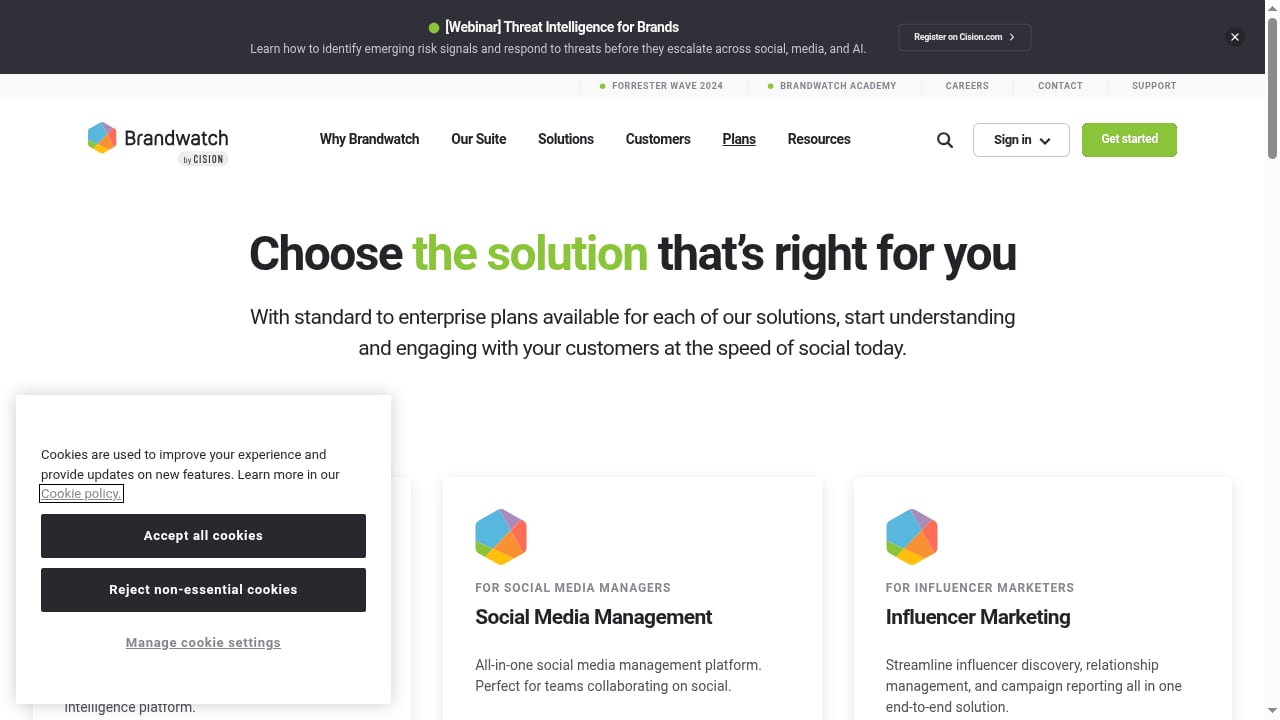
First viewport screenshot of Pricing & Plans for Every Team | Brandwatch.
Brandwatch does not publish standard pricing. The sales process is demo-based, and plans are custom across Consumer Intelligence, Social Media Management, and Influencer Marketing. Historical third-party sources mention an Essentials plan around $108 per month for 1–2 users, but this may no longer reflect current offerings. Expect enterprise-level pricing for full-suite access, with costs scaling by data volume, users, and modules.
Decision tip: If you need transparent pricing and self-serve checkout, Brandwatch may not be the best fit. If you need deep listening data and can invest in a sales-led process, it is worth a demo.
Setup and onboarding
Setup involves defining queries, connecting social profiles, and configuring dashboards. Listening queries require some training to get right—boolean logic and data source selection affect results. Brandwatch provides onboarding support, but enterprise deployments typically take weeks, not days. Agencies with many clients should plan for a structured rollout.
Strengths and limitations
Strengths:
- Deep social listening and consumer intelligence
- Unified publishing, engagement, and measurement
- Influencer identification and campaign management
- Strong benchmarking and AI-powered analytics
- Trusted by major brands and agencies
Limitations:
- No transparent pricing; demo-based sales only
- Steeper learning curve for listening queries
- May be overkill for small teams or basic scheduling needs
- Case study library lacks filtering, making it harder to find relevant examples
How Brandwatch compares to alternatives
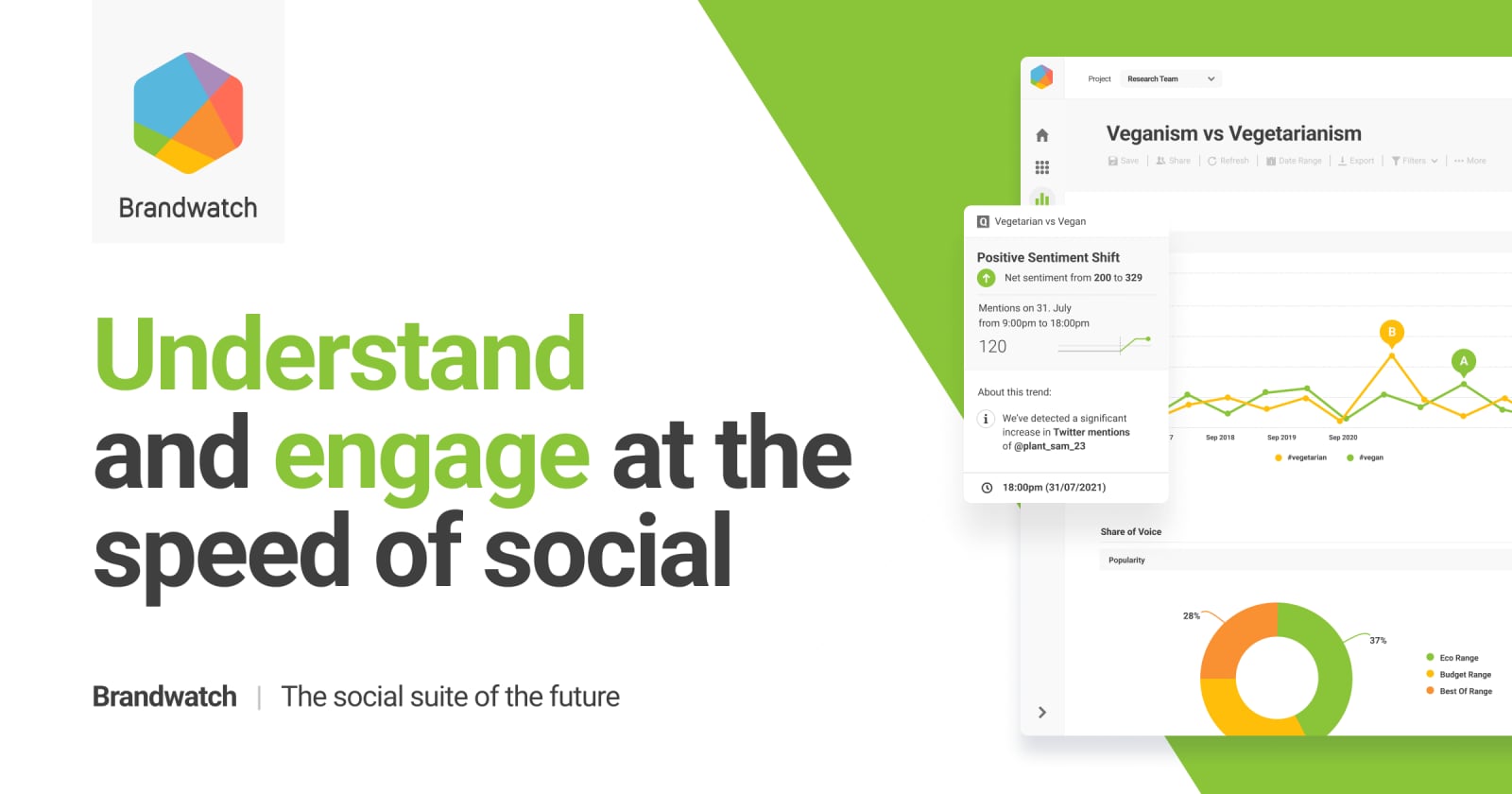
Brandwatch product interface.
Brandwatch sits in the enterprise tier alongside platforms like Sprinklr and Sprout Social. For a deeper look at AI-native CXM features, see our Sprinklr review. If you are comparing mid-market options, our Sociality.io review covers credit-based pricing and dashboard features.
Choose Brandwatch if: you need advanced listening, influencer tools, and enterprise-grade publishing in one suite.
Choose a lighter tool if: you want self-serve pricing, quick setup, and basic scheduling without deep listening.
Frequently asked questions
Is Brandwatch good for small businesses?
Generally no. Brandwatch targets mid-market and enterprise teams. Small businesses may find the pricing and complexity excessive unless they specifically need advanced listening.
Does Brandwatch offer a free trial?
Brandwatch offers demos rather than a standard free trial. Some historical plans included a free trial, but current access is typically arranged through sales.
What is Brandwatch best at?
Social listening and consumer intelligence. Its ability to track conversations, sentiment, and trends across the web is its core strength.
Can Brandwatch manage social media publishing?
Yes. The Social Media Management solution includes a content calendar, engagement inbox, and cross-network publishing.
How much does Brandwatch cost?
Pricing is custom and demo-based. Historical references mention an Essentials plan around $108 per month, but full-suite enterprise pricing is significantly higher and depends on data volume, users, and modules.
Conclusion
Brandwatch is a powerful choice for enterprises and agencies that need deep social listening, consumer intelligence, and influencer marketing in one platform. Its strengths lie in data depth, benchmarking, and unified social management. The trade-offs are pricing opacity, a learning curve, and limited suitability for small teams. If you need transparent pricing and simple scheduling, consider lighter alternatives. If you need to understand consumer conversations at scale and manage social activities across networks, Brandwatch deserves a place on your shortlist.
Sources: Trustpilot reviews, Ignite Social Media review, G2 reviews.