
SocialEcho vs Ocoya vs Agorapulse: Which SMM Tool Wins in 2026?
Choosing the right social media management platform isn’t just about features—it’s about matching the tool to how your team works, what you sell, and how you want to scale. SocialEcho, Ocoya, and Agorapulse all promise to streamline your social media operations, but they come at the problem from very different angles.
In this honest comparison, we break down where each platform shines, where they fall short, and which one fits your priorities—whether you’re a cross-border seller, a content‑heavy agency, or a marketing team that lives inside the social inbox. We highlight credible strengths of both substitutes while showcasing SocialEcho’s advantages only where it genuinely leads.
Quick Comparison: Strengths at a Glance
SocialEcho vs Ocoya vs Agorapulse: Which SMM Tool Wins in 2026? product interface and feature overview.
| Category | SocialEcho | Ocoya | Agorapulse |
|---|---|---|---|
| Best for | Global teams needing AI‑powered engagement, listening, and TikTok Shop | Solo marketers & agencies that want bulk AI content creation at scale | Teams that require deep manual inbox management, approvals, and ROI reporting |
| Pricing model | Per account ($3–$4/month) | Tiered plans based on profiles & AI credits ($15–$159/month) | Per user ($49–$149/user/month) + extra profiles |
| AI content creation | Text, images & short-form video from a single prompt | AI captions, hashtags, and image generation (credit‑based) | AI writing assistant for post copy only |
| Social inbox | AI intent triage & auto‑replies that cut manual volume | Not a focus—built for publishing, not engagement | Most mature manual inbox with labels, assignments, and bulk actions |
| Ecommerce | TikTok Shop publishing & store GMV analytics | Integrations with Shopify, WooCommerce, BigCommerce, Etsy | None |
| Social listening | Keyword, competitor & KOL tracking across any platform | Not available | Brand mention monitoring limited to connected profiles |
| Standout strength | Per‑account pricing slashes team costs; full‑cycle AI automation | Rapid content generation with AI credits; broad e‑commerce integrations | Award‑winning support; advanced collaboration & ROI‑tied reporting |
Pricing: Per-Account, Per-User, or Credit‑Based?
SocialEcho vs Ocoya vs Agorapulse: Which SMM Tool Wins in 2026? product interface and feature overview.
Agorapulse charges per user, not per social profile. Plans start at $49/month (Standard) for 10 social profiles, with each additional profile costing $10/month. Seats quickly add up: a 3‑person team on the Professional plan will pay $237/month (annual billing). Full inbox and collaboration features are gated behind the Professional and Advanced tiers.
SocialEcho flips the model entirely: you pay per social account, not per person. Pricing starts at $3/account/month, with a 5‑account minimum, keeping a 10‑profile setup at just $30–$40/month regardless of team size. This makes it dramatically cheaper for teams where multiple people handle engagement, and you get AI‑powered inbox triage on every paid plan. For a deeper dive into how this stacks up, check out SocialEcho’s head‑to‑head pricing comparison with Agorapulse.
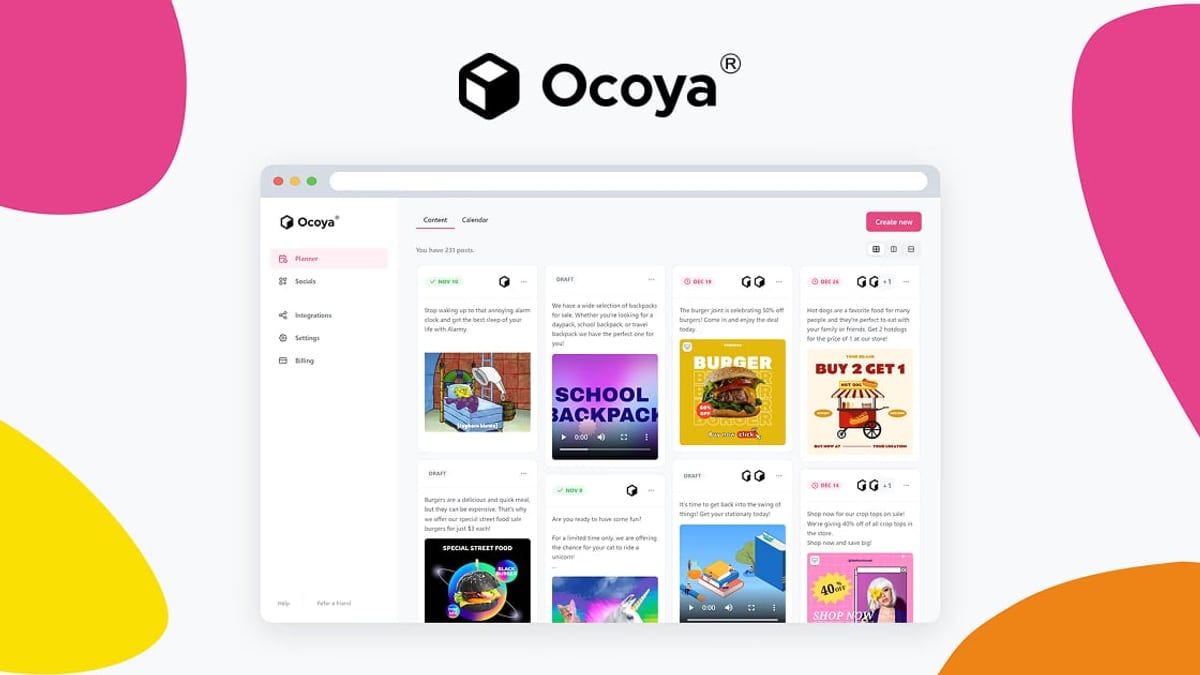
Ocoya uses a tiered model based on the number of social profiles and monthly AI credits. The Bronze plan ($15/month) gives you 5 profiles and 100 AI credits; the Diamond plan ($159/month) scales to 150 profiles and unlimited AI credits. It’s ideal for solo creators or small teams that need generous AI‑powered content generation without per‑user penalties.
Social Inbox and Engagement Management
SocialEcho vs Ocoya vs Agorapulse: Which SMM Tool Wins in 2026? product interface and feature overview.
If your team spends hours each day answering comments, DMs, and mentions, the inbox is where the real difference lives.
Agorapulse built the benchmark for manual inbox management. Its unified inbox supports message assignment, review states, labels, saved replies, automated moderation rules, and bulk actions. For teams that are organized around “inbox zero” rituals and need granular control, Agorapulse remains the gold standard—every user who touches the inbox, however, adds another paid seat.
SocialEcho takes a workload‑reduction approach. AI automatically tags every incoming message by intent (question, complaint, praise) and can auto‑reply to repetitive queries, deflecting up to half of the inbox before a human even sees it. This means you can handle high volumes with a lean team, and billing never increases with headcount. It doesn’t offer the same depth of manual review states, so teams that thrive on strict manual workflows will still prefer Agorapulse.
Ocoya primarily focuses on content creation and scheduling. It doesn’t offer a unified social inbox for managing incoming conversations; its strength lies in automating outbound publishing, not multi‑channel engagement. If you need to reply to followers at scale, you’ll need either SocialEcho or Agorapulse.
AI Content Creation: Who Generates What?

SocialEcho vs Ocoya vs Agorapulse: Which SMM Tool Wins in 2026? product interface and feature overview.
SocialEcho delivers full‑stack AI generation: one prompt creates platform‑ready text, custom images, and short‑form video, automatically adapted per network. This is a significant time‑saver for teams that need visual variety without hopping between separate design tools.
Ocoya is built for content velocity. Its AI generates captions and hashtags in 28+ languages, and AI credits unlock image generation (from built‑in templates or custom prompts). The platform also offers an in‑house editor, social templates, and a media library. For agencies that need to produce hundreds of posts quickly, Ocoya’s bulk workflows and rich integrations with Canva, Unsplash, and Pexels make it a strong choice. However, video generation isn’t part of the package—you’ll need to create or source videos elsewhere.
Agorapulse includes a writing assistant that polishes post copy, plus AI‑powered reply suggestions (limited to the Custom plan). It doesn’t generate images or video, so visual content must be created externally. In this category, both SocialEcho and Ocoya lead Agorapulse for content creation breadth.
To see how Ocoya’s AI credits work in practice, read our full Ocoya review.
Social Listening and Competitor Tracking
Understanding what people say about your brand (and your rivals) beyond your own profiles is essential for strategy.
SocialEcho includes native social listening that monitors keywords, competitor accounts, and key opinion leaders across any platform—not just the ones you’ve connected. Alerts flow into the same workspace you use for publishing and engagement, so you can instantly react to trends or threats.
Agorapulse offers brand mention monitoring, but it’s limited to the networks of profiles you have connected. It won’t surface conversations happening on platforms you don’t actively manage through the tool, leaving blind spots in your wider landscape.
Ocoya does not include a social listening module. If market intelligence is critical, SocialEcho is the clear winner here.
Ecommerce and Social Selling Features
SocialEcho is purpose‑built for social commerce on TikTok. It supports shoppable video publishing directly to TikTok Shop, with store‑level GMV analytics that tie sales back to content. For cross‑border sellers and global brands leaning into live and short‑video commerce, this is a unique advantage.
Ocoya integrates with major e‑commerce platforms—Shopify, WooCommerce, BigCommerce, Etsy, and Ecwid—letting you manage product links and schedule promotional posts from one place. While it doesn’t provide native TikTok Shop analytics, it bridges e‑commerce stores with social media content seamlessly.
Agorapulse offers no e‑commerce module. Product tagging is available for Instagram, but it lacks inventory sync, store analytics, or TikTok Shop integration. For social selling, both SocialEcho and Ocoya outpace Agorapulse significantly.
Reporting and Analytics: ROI Proof vs. Monitoring
Agorapulse excels at tying social activity to business outcomes. Its advanced ROI reports connect posts and inbox interactions with Google Analytics goal completions, revenue, and conversions. Power reports are customizable, and white‑label options are available. For marketing managers who must prove social’s financial impact, Agorapulse’s analytics are a genuine strength.
SocialEcho layers competitor benchmarking on top of standard account and post analytics and supports white‑label report exports. It doesn’t currently offer the same depth of in‑tool ROI attribution as Agorapulse, but it gives you broader market insight and flexible reporting formats.
Ocoya provides basic analytics on all plans, with more advanced, branded reporting unlocked at the Diamond tier ($159/month). Its analytics are functional but not as deep as Agorapulse’s, nor as competitively oriented as SocialEcho’s.
According to Agorapulse’s own G2 category leader page, its reporting and ROI measurement consistently outperform Sprout Social and Hootsuite in independent reviews—a testament to its strength in this area.
Collaboration and Team Workflows
This is an area where SocialEcho takes a back seat by design—its per‑account pricing and AI automation reduce the need for complex manual handoffs. Both substitutes offer richer collaboration tools.
Agorapulse is purpose‑built for team coordination. Multi‑step approval workflows, custom user roles, SSO, shared calendars, assignment logs, and team performance reports give enterprises and agencies absolute control over who does what. It’s why G2 reviewers consistently score Agorapulse higher than competitors on collaboration and user permissions.
Ocoya supports team collaboration through unlimited workspaces, role assignments, and a visual content calendar. Teams can customize themes and invite up to 50 members on the Diamond plan, making it suitable for scaling agencies that produce content collaboratively.
If team workflow precision is non‑negotiable, Agorapulse leads. For content‑centered teams that still need light approval flows, Ocoya is a strong contender.
Which Tool Should You Choose?
Choose SocialEcho if you:
- Manage a global or multi‑lingual team and need AI to cut inbox volume.
- Want per‑account pricing that never penalizes team growth.
- Require full AI generation (text, images, video) and built‑in social listening.
- Sell on TikTok Shop or live commerce channels and need shoppable video analytics.
- Prefer white‑label reports and competitor benchmarking.
Choose Ocoya if you:
- Are a solo creator, freelancer, or small agency that lives on content velocity.
- Need AI‑powered captions, hashtags, and images generated at scale without seat limits.
- Run an e‑commerce store on Shopify, WooCommerce, or Etsy and want direct integrations.
- Value a credit‑based AI model that accelerates bulk creation while keeping costs low.
Choose Agorapulse if you:
- Depend on a highly structured, manual social inbox with assignment and review states.
- Require advanced collaboration, custom approvals, and team performance tracking.
- Must prove social ROI with deep attribution tied to Google Analytics.
- Want award‑winning customer support and can absorb per‑user pricing.
Related reading
- SocialEcho vs AdaptlyPost: Which Tool Wins in 2026? - Compare SocialEcho vs AdaptlyPost: AI social media management, social listening, engagement, pricing, and security. See why SocialEcho is the more complete solution for global teams.
- Pallyy Review 2026: Features, Pricing & Honest Verdict - Is Pallyy the right social media scheduler for your agency or brand? We review features, pricing, UI, and real-world strengths to help you decide.
- SocialEcho vs Sendible vs Buffer: Which One Wins in 2026? - Compare SocialEcho, Sendible, and Buffer on pricing, features, and ideal use cases. Honest analysis to help agencies, creators, and global teams choose.
FAQ
Is SocialEcho cheaper than Agorapulse and Ocoya?
For teams, yes. SocialEcho starts at $3/account/month with no per‑user fee, so a 10‑profile setup costs $30–$40/month regardless of team size. Agorapulse charges $49–$149 per user, making a 3‑person team at least $147/month. Ocoya’s lowest plan is $15/month for 5 profiles but restricts AI credits; scaling to 50 profiles costs $79/month. For multi‑user scenarios, SocialEcho offers the most dramatic savings.
Does Ocoya offer a social inbox?
No. Ocoya is a publishing and content creation platform. It doesn’t include a unified inbox for managing incoming comments, DMs, or mentions across networks. For engagement management, you’ll need SocialEcho or Agorapulse.
Can SocialEcho handle TikTok Shop?
Yes. SocialEcho supports shoppable video publishing and store‑level GMV analytics for TikTok Shop—something neither Ocoya nor Agorapulse provide.
Which tool has the best AI for content creation?
SocialEcho generates text, images, and video from one prompt, offering the broadest AI content suite. Ocoya excels at high‑volume caption and image generation with its AI credits. Agorapulse’s AI is limited to copy assistance.
Does Agorapulse support ecommerce?
No. Agorapulse does not offer native ecommerce integrations or TikTok Shop features. Ocoya connects to major e‑commerce platforms, while SocialEcho focuses on TikTok commerce.
Conclusion
SocialEcho, Ocoya, and Agorapulse each carve out a distinct lane in the social media management landscape. Agorapulse remains the champion for teams that need rigorous manual inbox control and ROI‑proven reporting. Ocoya gives content‑focused marketers and agencies a budget‑friendly way to generate and schedule massive amounts of AI‑assisted posts. SocialEcho bridges the gap for global teams that want AI to reduce manual engagement work, full‑cycle content creation, and cross‑border commerce capabilities—all at a per‑account price that scales without punishing headcount.
At SocialEcho, we believe the best tool is the one that aligns with how you actually work. If you’re ready to explore deeper, check our in‑depth SocialEcho vs Agorapulse comparison for a feature‑by‑feature breakdown, or read our unbiased Ocoya review to see if its AI content engine fits your workflow. The right choice isn’t about the loudest feature list—it’s about the one that makes your team move faster, understand more, and spend less on what a machine can do.