
Top 10 Social Media Management and MCP Platforms 2026
Social media tools used to compete on calendars and inboxes. In 2026 they also compete on how well an AI agent can operate them. A platform that schedules posts but cannot expose its data or actions to an assistant leaves your team copying and pasting between tabs. A platform with a Model Context Protocol (MCP) server lets an agent draft, schedule, pull analytics, or triage messages inside the same workspace you already trust.
This review ranks ten products that genuinely belong to the social media management and MCP category. Each entry is judged on what the product does for human teams and what its MCP layer actually allows an AI client to do. Prices and capabilities reflect public documentation reviewed in 2026; confirm plan details before connecting production accounts.
How We Evaluated These Platforms
We used five criteria and weighted them equally:
- Core social media management depth — publishing, scheduling, inbox/engagement, listening, and reporting across major networks.
- MCP capability and scope — whether an official MCP server exists, what tools it exposes (drafts vs. publish, read-only vs. write), and which networks are documented.
- Access and permissions — authentication (OAuth or API key), plan eligibility, and whether permissions can be scoped to specific accounts or clients.
- Pricing transparency and scaling — published entry prices, per-user or per-channel models, and how costs grow with team size or API usage.
- Evidence quality — official documentation, public pricing pages, and independent comparisons rather than marketing claims.
A note on scope: MCP support is still early. The Postman 2025 State of the API Report found that 70% of developers were aware of MCP but only about 10% used it regularly. That gap matters here — a tool can be excellent at social management and still have a thin or beta MCP layer. We rank the combined product, not just the connector.
The Top 10 Social Media Management and MCP Platforms for 2026

Social Media Management Tools and MCP | Sociality.io product interface.
1. Buffer
Best for: Creators and small teams that want simple scheduling plus AI-agent access on every plan.
Buffer combines a clean content calendar, a unified comments inbox, and cross-channel analytics with per-channel pricing that starts around $6 per month, plus a free plan for up to three channels. Its MCP server is available on every plan, including Free, and lets an assistant create and schedule posts, manage the queue, save ideas, and pull post analytics. Authentication works through OAuth or an API key, and Buffer is listed as an approved connector in Claude.
Why it ranks first: It is the rare case where the MCP layer is not an enterprise add-on. A solo creator can connect an agent on day one. The trade-off is depth: listening and advanced enterprise workflows are lighter than what Hootsuite or Sprinklr offer.
2. Hootsuite
Best for: Larger teams that need publishing, listening, care, and advocacy in one suite.
Hootsuite covers the widest workflow in this list: content planning and publishing (Perch), insights and listening (Lumen), social inbox and customer care (Nest), and employee advocacy (Parliament). Its MCP is split across those products rather than offered as one endpoint, so an agent only gets the capabilities your plan includes. Entry pricing is around $99 per user per month on annual billing.
Why it ranks here: The breadth is unmatched, and the product-split MCP is a sensible permission model. It ranks below Buffer because MCP access is tied to higher-tier products and the cost per seat is steep for small teams.
3. Metricool
Best for: Teams that want scheduling and analytics in the same agent workflow.
Metricool's MCP server covers publishing, analytics, and inbox work, and access is included on every plan, including Free, within plan limits. That makes it one of the most accessible connectors for a small brand. The main caution is permission scope: Metricool states the connection grants full account access, similar to signing in, so treat the token carefully.
Why it ranks here: Strong value and a genuinely useful tool set. It sits below Hootsuite because its listening and enterprise care features are less developed.
4. Sociality.io
Best for: Agencies and brands that want social data piped into AI agents and tools.
Sociality.io is an all-in-one social media management platform for agencies and brands, and Sociality MCP connects social media data to AI agents and tools. Its MCP is documented as mostly read-only, which makes it a strong intelligence layer — competitor and performance data for research and reporting — rather than a publishing endpoint. Entry pricing is around $49 per month.
Why it ranks here: It fills the analytics-and-intelligence gap that many schedulers leave open. Teams that need the agent to publish will pair it with a write-capable connector.
5. Agorapulse
Best for: Teams that want AI-assisted drafting with a human approval step.
Agorapulse's MCP beta can create drafts and also exposes performance data, calendar notes, inbox conversations, and listening results. It does not publish directly; drafts still go through Agorapulse's scheduling and approval flow. It works with Claude, ChatGPT, and Microsoft Copilot Studio via OAuth, and Free and Legacy plans are excluded.
Why it ranks here: The approval-first design is a real safety feature for regulated brands. It ranks mid-list because publishing through the agent is not possible and beta pricing may change.
6. Sprout Social
Best for: Enterprise social teams that need influencer and advocacy workflows alongside analytics.
Sprout Social pairs publishing, engagement, and analytics with influencer marketing (Tagger) and employee advocacy. Its documented MCP connection is narrow: read-only TikTok analytics, OAuth-based, and documented for ChatGPT only. That is a real limitation for teams hoping to automate publishing.
Why it ranks here: The core platform is strong and the analytics depth is excellent, but the MCP layer is the least capable among the top half of this list. Choose it for the suite, not the connector.
7. Planable
Best for: Agencies and approval-heavy teams that want an agent to prepare content, not publish it.
Planable's MCP connector creates drafts and supports approvals; it does not publish. It can read comments and team notes, upload media, pull analytics, and approve or reject posts if the user's role allows. It is included on all paid plans and uses OAuth.
Why it ranks here: Excellent for collaborative review workflows, but the no-publish constraint limits what an agent can finish end to end.
8. SocialPilot
Best for: Agencies managing many client accounts who want white-label reporting and a publishing-capable MCP.
SocialPilot supports drafting, scheduling, and publishing through its MCP server, and can surface undelivered or skipped posts. Its overview page does not publish a separate MCP network list, and plan eligibility is not clearly stated, so confirm support for your specific accounts before committing. Entry pricing is around $30 per month.
Why it ranks here: Strong agency value and a write-capable connector, held back by documentation gaps.
9. Publer
Best for: Enterprise teams already on Publer that want scoped agent access.
Publer's MCP is in beta and limited to Enterprise customers and top ambassadors. Where available, an assistant can review drafts and schedule posts across connected accounts using scoped API keys. The server URL carries the key, so it must be treated like a password.
Why it ranks here: The scoping model is thoughtful, but availability is too restricted for most teams in 2026.
10. Vista Social
Best for: Teams that want a broad MCP tool set and are comfortable with beta software.
Vista Social exposes scheduling, analytics, inbox work, and reporting across 50+ MCP tools. Access requires the Advanced plan or higher, and the documentation describes it as beta. The assistant inherits the user's role permissions, and revoking the token disconnects every client using it.
Why it ranks here: The tool breadth is impressive for a beta, but plan gating and beta status keep it at the bottom of this list.
Quick Comparison: What Each MCP Can Actually Do
First viewport screenshot of What's new | Sociality.io.
| Platform | MCP publishing | Analytics via MCP | Plan access |
|---|---|---|---|
| Buffer | Draft or schedule | Yes | Every plan, including Free |
| Hootsuite | Draft, schedule, publish | Yes, via Lumen | Product-dependent |
| Metricool | Create and publish | Yes | Every plan, including Free |
| Sociality.io | Mostly read-only | Yes | Paid plans |
| Agorapulse | Drafts only | Yes | Paid plans, beta |
| Sprout Social | No | TikTok only | Documented for ChatGPT |
| Planable | No (drafts and approvals) | Yes | All paid plans |
| SocialPilot | Draft, schedule, publish | Not stated | Not clearly stated |
| Publer | Draft, schedule | Limited | Enterprise and ambassadors, beta |
| Vista Social | Schedule and publish | Yes | Advanced and higher, beta |
How to Choose Between These Platforms
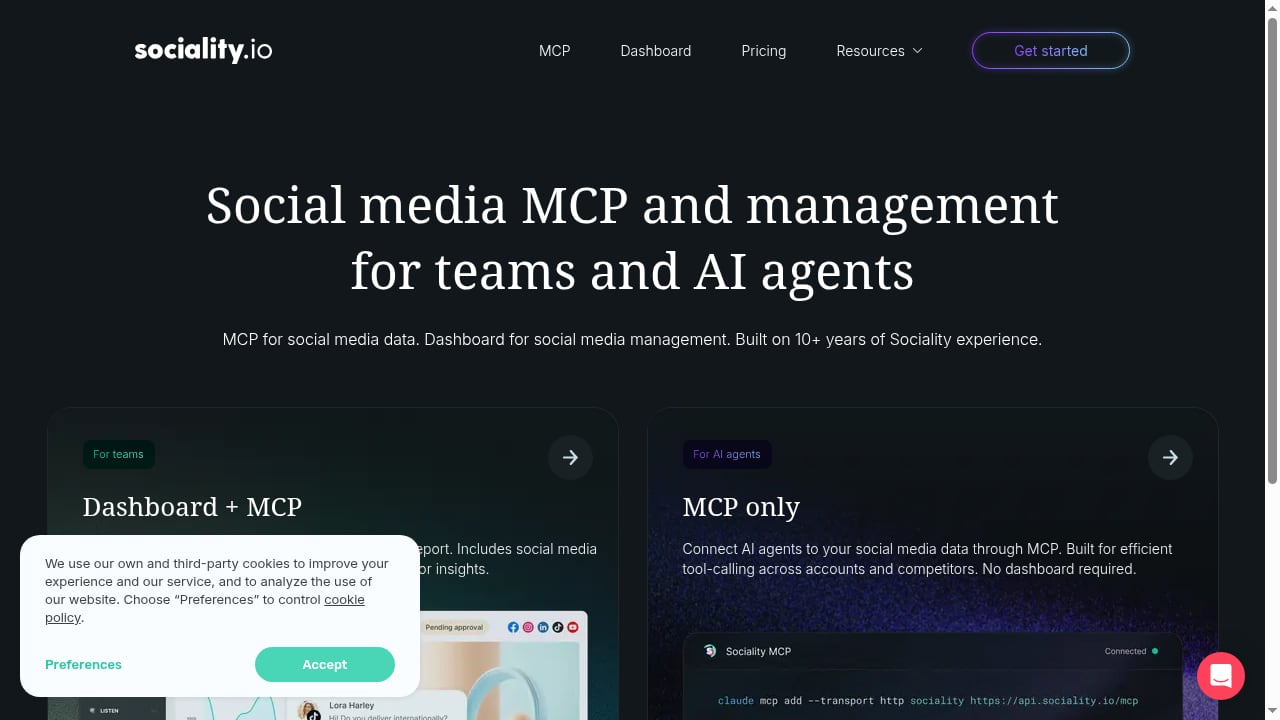
First viewport screenshot of Social Media Management Tools and MCP | Sociality.io.
Start with the job you want the agent to finish. If the answer is "publish without a human in the loop," narrow the list to Buffer, Hootsuite, Metricool, SocialPilot, and Vista Social. If the answer is "prepare drafts for review," Agorapulse and Planable are purpose-built for that. If the answer is "give the agent better data," Sociality.io is the specialist.
Then check the permission model. A connector that grants full account access is convenient but risky for agencies with multiple clients. Scoped access — as Publer and Pallyy describe — is safer, even if it means more setup.
Finally, model the cost twelve months out. Per-user pricing (Hootsuite, Sprout Social) scales with headcount; per-channel pricing (Buffer) scales with the number of accounts; credit-based or API-usage pricing scales with how often the agent runs. An agent that polls analytics every hour will cost more than one that publishes twice a day.
For teams that want a broader AI workspace alongside these connectors, SocialEcho is a complementary option: it handles publishing, engagement, listening, analytics, and AI automation across major platforms, and can sit next to a specialist MCP server rather than replace it. If you are comparing AI-first workspaces directly, see our SocialEcho vs Planable vs Dash Social comparison and the wider top 10 social media management software roundup.
Practical Examples: What an MCP Workflow Looks Like

Dashboard + MCP.
Creator workflow: A solo creator connects Buffer's MCP to Claude, asks the agent to turn a blog post into five short-video captions, schedules them across TikTok and Instagram, and pulls last week's engagement to decide what to repeat. No publishing tool is opened manually.
Agency workflow: An agency uses Sociality.io's MCP to pull competitor performance into an AI research session, then drafts client posts in Agorapulse's MCP for approval. The account manager reviews and schedules inside Agorapulse, keeping the approval trail intact.
Enterprise workflow: A large brand uses Hootsuite's Perch connector for publishing and Nest for inbox triage, with Lumen feeding listening insights into the same assistant. Because each product is a separate server, access follows the plan the team already pays for.
If you are combining a social workspace with a media-intelligence platform, our guide to using SocialEcho with Meltwater walks through a similar two-tool setup.
Related reading
- SocialEcho vs Emplifi: AI Social Media Management Compared 2026 - Compare SocialEcho and Emplifi for AI social media management in 2026: publishing, auto-replies, listening, analytics, API access, and pricing fit.
- NapoleonCat Review 2026: Inbox, Moderation, Pricing Fit - Evidence-based NapoleonCat review for 2026: Social Inbox, AI auto-moderation, pricing signals, setup, pros and cons, and who should choose it.
Sources and further reading
- Top 10 MCP Servers for Social Media Management in 2026 - The best MCP servers for social media management in 2026, compared: publishing, scheduling, analytics, research, and creative tools you can connect to AI agents.
- The 11 Best Social Media Management Tools in 2026 — Tried + Tested - The 11 best social media management tools for 2026, tried and tested by a social media marketer — from free creator picks to enterprise platforms, with pricing and who each is for.
- 12 Social Media MCP Servers Compared (2026) - Compare 12 social media MCP servers: which can schedule posts, which only create drafts, what they cost to access, and where each has limits.
Frequently Asked Questions
What is an MCP server for social media management?
It is a connector built on the Model Context Protocol that lets an AI client — such as Claude, ChatGPT, or Copilot — call a social media tool's features. Depending on the provider, the agent can create drafts, schedule or publish posts, read analytics, or manage inbox conversations.
Can an AI agent publish posts directly through these platforms?
Some can. Buffer, Hootsuite, Metricool, SocialPilot, and Vista Social document publishing or scheduling through MCP. Agorapulse and Planable stop at drafts and approvals. Sprout Social's documented connector is read-only analytics.
Is MCP access included in free plans?
It varies. Buffer and Metricool include MCP access on every plan, including Free, within plan limits. Hootsuite requires access to the relevant product, Agorapulse excludes Free and Legacy plans, and Vista Social requires the Advanced plan or higher.
Which platforms have no official MCP server yet?
As of the September 2026 review, no official MCP documentation was found for Later, SocialBee, or Sendible. Third-party connectors may exist, but check who maintains them and which actions they support.
How should agencies handle permissions when connecting an agent?
Prefer scoped access over full-account access. Where a provider grants full access — as Metricool notes — use a dedicated connection, rotate keys, and revoke tokens when a client engagement ends.
Conclusion
The best social media management and MCP platform in 2026 depends on whether you want the agent to finish the work or prepare it. Buffer wins for accessible, publish-capable MCP on every plan. Hootsuite wins for suite depth and enterprise governance. Metricool wins on value. Sociality.io wins when the agent's job is intelligence rather than publishing. Agorapulse and Planable are the right choice when a human must approve every post.
Before you connect production accounts, verify three things in the provider's current documentation: which actions the MCP exposes, which plans include it, and how permissions are scoped. Those three answers will separate a useful agent workflow from an expensive integration that only creates drafts.