
Top 10 Social Media Scheduling and Management Software Products for 2026
Social media scheduling and management software has become the operational backbone for teams that publish across five or more networks. The category now spans simple per-channel schedulers, agency approval hubs, and enterprise suites with listening and CRM integrations. This review ranks ten products that genuinely belong to the scheduling and management category, explains the evidence behind each placement, and helps you match a tool to your team shape rather than to a feature checklist.
How we evaluated these products
First viewport screenshot of pallyy.com.
We scored every candidate on five criteria, using publicly listed pricing, documented platform support, and hands-on descriptions from credible 2026 reviews:
- Scheduling depth: calendar and queue flexibility, bulk upload, evergreen recycling, and platform-specific formats.
- Management and collaboration: approval workflows, roles, client workspaces, and inbox handling.
- Analytics and reporting: native reports, competitor benchmarking, and export options.
- Platform breadth: support for Instagram, Facebook, X, LinkedIn, TikTok, YouTube, Pinterest, Google Business Profile, Threads, and Bluesky.
- Value at realistic scale: what a five-person team or a ten-client agency actually pays after twelve months.
We excluded tools that only automate direct messages or only serve one network, because they solve an adjacent problem rather than the scheduling and management job. We also excluded SocialEcho, an all-in-one AI social workspace, from the ranking because its core positioning is publishing plus listening, engagement, and AI automation across the whole social operation. It is a useful complement to several tools below, not a direct substitute for a pure scheduler.
The top 10 at a glance
First viewport screenshot of pallyy.com.
| Rank | Product | Best for | Pricing signal |
|---|---|---|---|
| 1 | Buffer | Creators and small teams wanting simplicity | Free for 3 channels; from $6/mo per channel |
| 2 | Hootsuite | Larger teams needing listening and governance | From $99/user/mo (annual) |
| 3 | Sprout Social | Premium social care and reporting | From $99/seat/mo |
| 4 | Pallyy | Agencies billing per client | Free plan; Pro $25/mo; Agency $99/mo |
| 5 | Vista Social | Small teams wanting features at a low price | From $79/mo |
| 6 | Agorapulse | Inbox-first community management | From $99/mo |
| 7 | Metricool | Analytics-led planning with ads data | Free plan; from $25/mo |
| 8 | Sendible | Affordable all-in-one for agencies | From $29/mo |
| 9 | Later | Visual and influencer-led brands | From $25/mo |
| 10 | SocialPilot | Agencies managing many clients | From $30/mo |
1. Buffer
Best for: creators, solo marketers, and small businesses that want to publish within minutes.
Buffer remains the easiest entry point into scheduling. It supports Facebook, Instagram, Threads, TikTok, LinkedIn, Pinterest, YouTube Shorts, X, Bluesky, Mastodon, Substack Notes, and Google Business Profile, and its free plan covers three channels with a limited post allowance. Paid plans start at $6 per channel per month, which keeps costs predictable for a one-person operation.
The 2026 version adds AI-agent connectors and an MCP server, so teams experimenting with automated drafting can push approved content into Buffer rather than rebuilding a publishing layer. The trade-off is depth: approvals, listening, and advanced reporting are thinner than in agency or enterprise tools.
2. Hootsuite
Best for: mid-size and large teams that need listening, governance, and a familiar interface.
Hootsuite pairs scheduling with Talkwalker-powered listening and broad team controls. Entry pricing sits around $99 per user per month on annual billing, and approval workflows require higher tiers, so the real cost climbs quickly for teams of five or more.
Choose Hootsuite when social listening and brand monitoring are part of the daily job, not an occasional add-on. If you mainly need a calendar and an inbox, the per-seat model is hard to justify.
3. Sprout Social
Best for: customer care teams and brands that treat social as a service channel.
Sprout Social is the premium option for unified inboxes, case management, employee advocacy, and influencer tracking through its Tagger acquisition. Plans start near $99 per seat per month, with fuller reporting and workflow features at $199 and above.
The platform earns its place for organizations where response time and service quality are measured. Smaller teams often find the seat cost prohibitive relative to the scheduling features they actually use.
4. Pallyy
First viewport screenshot of pallyy.com.
Best for: agencies and freelancers who bill per client and need approvals built in.
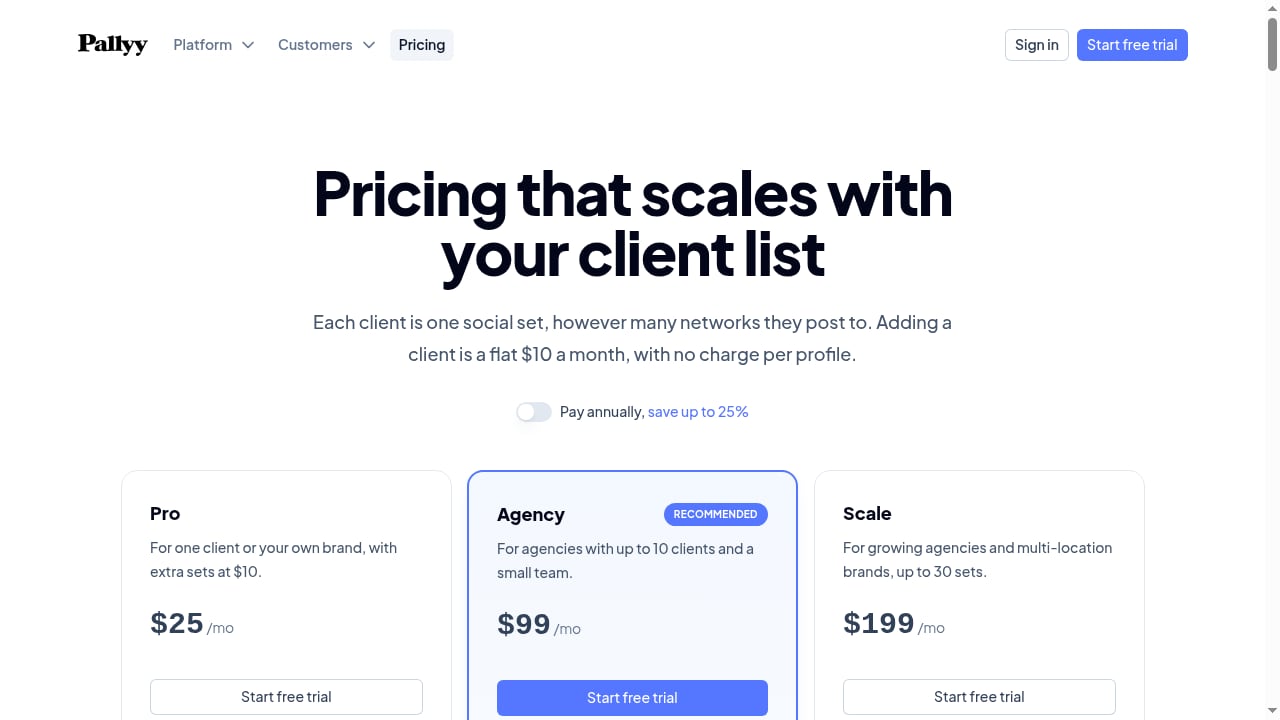
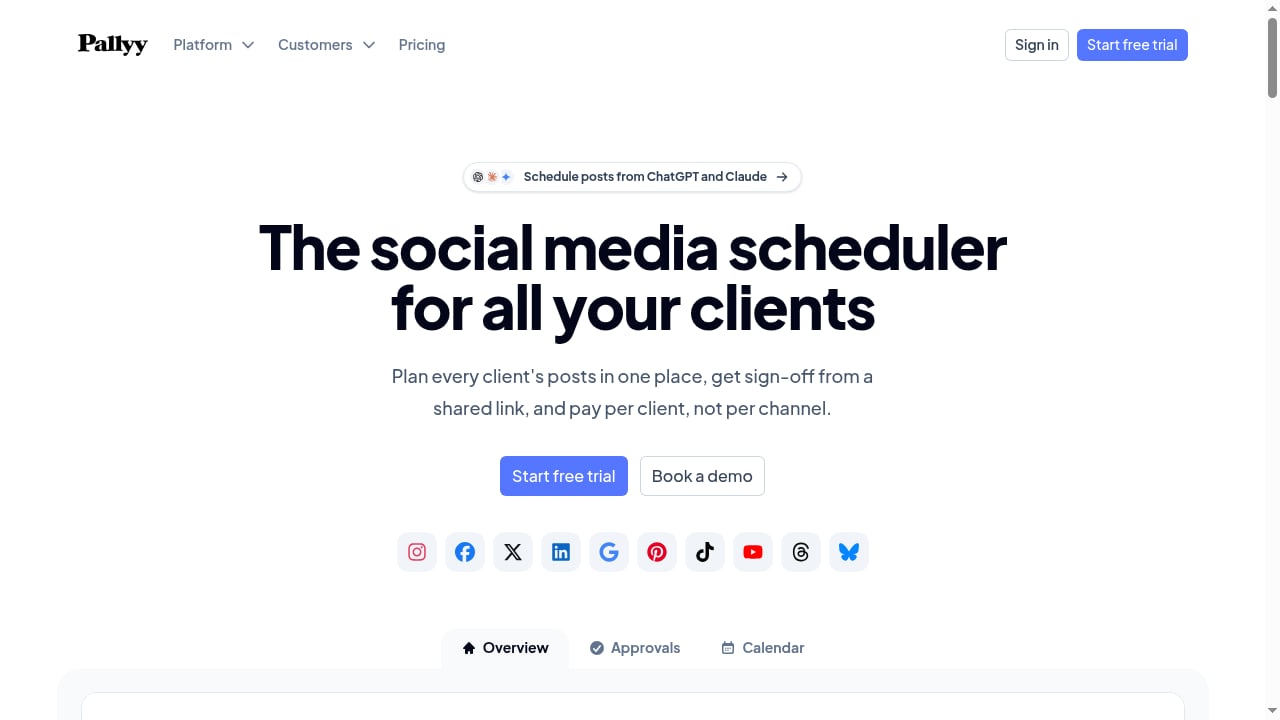
Pallyy organizes accounts into "social sets," where one client can include any number of connected networks for a single price. That model is unusually friendly to agencies managing many small clients. It covers Instagram, Facebook, X, LinkedIn, Google Business Profile, Pinterest, TikTok, YouTube, Threads, and Bluesky.
Features include shared calendars for client approval, Editor, Collaborator, and Viewer roles, a social inbox, link-in-bio pages, AI captions, queue scheduling, and API access. Pricing is a free plan, Pro at $25 per month for one social set, Agency at $99 per month for ten sets and three users, and Scale at $199 per month for thirty sets and ten users, with a 14-day trial and a 50% nonprofit discount. Customer stories describe scheduling a month ahead and simplifying approval chains.
For a deeper look at a comparable per-client scheduler, see our Publer review 2026.
5. Vista Social
Best for: small teams that want a broad feature set without enterprise pricing.
Vista Social bundles scheduling, inbox, review management, and reporting from around $79 per month. Reviewers consistently note that it punches above its price on features, though the interface and integrations are less polished than category leaders.
It suits lean teams that need more than Buffer but cannot justify Hootsuite's per-seat cost.
6. Agorapulse
Best for: community managers who live in the inbox.
Agorapulse starts near $99 per month and is built around a strong unified inbox with assignment, saved replies, and moderation tools. Scheduling and reporting are solid rather than spectacular.
If your social team spends more time responding than publishing, Agorapulse is a better fit than calendar-first tools. For teams comparing broader AI workspaces, our SocialEcho vs Sociality.io comparison covers how listening and automation differ.
7. Metricool
Best for: marketers who need analytics, ads, and web traffic in one report.
Metricool has a free plan and paid tiers from $25 per month. Its differentiator is reporting that combines organic social, paid campaigns, and website analytics, which makes it popular with consultants who must prove ROI.
Scheduling is competent but less flexible than Buffer or Pallyy for complex approval workflows.
8. Sendible
Best for: agencies that want an affordable all-in-one with client reporting.
Sendible starts at $29 per month and covers scheduling, inbox, and white-label reporting. It handles the basics reliably and is often shortlisted by small agencies that find Hootsuite too expensive.
The interface feels dated compared with newer tools, and advanced analytics require higher plans.
9. Later
Best for: visual brands and influencer-led campaigns.
Later starts at $25 per month and remains strongest for Instagram-first planning, with a visual grid planner and creator discovery features. It also supports Facebook, X, TikTok, Pinterest, and LinkedIn.
Teams that publish mostly text or B2B content will find Later's strengths misaligned with their needs. For a visual-heavy agency, it is a strong second tool alongside a management suite.
10. SocialPilot
Best for: agencies managing many client accounts on a budget.
SocialPilot starts at $30 per month and includes white-label client dashboards, bulk scheduling, and approval workflows on higher tiers. It supports the major networks and is a common choice for agencies that need volume without per-client pricing.
Reporting depth and UI polish trail the leaders, but the value is hard to beat for high-volume scheduling.
How to choose by team shape
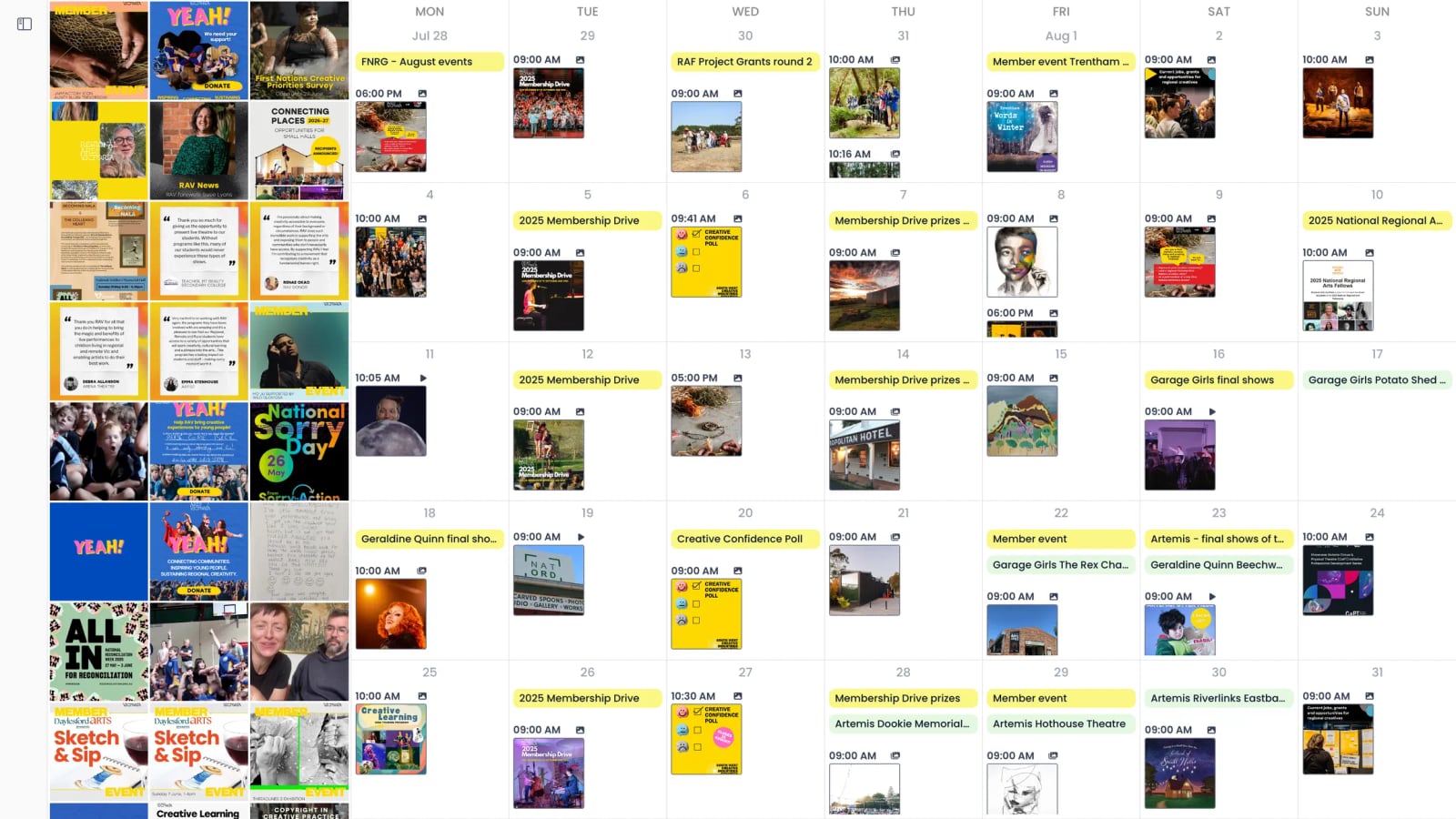
Social media scheduler calendar with scheduled posts across multiple platforms and a drag and drop rescheduling feature.
- Solo creator or small business: start with Buffer or Metricool. Both have free tiers and low entry prices.
- Agency billing per client: Pallyy's social-set model or SocialPilot's flat tiers usually beat per-seat pricing. Add a listening layer separately if clients demand it.
- Customer care team: Sprout Social or Agorapulse, depending on budget and reporting needs.
- Enterprise with listening requirements: Hootsuite or Sprout Social, with a clear-eyed look at seat costs.
- Teams adding AI automation: pair a scheduler with an AI workspace. SocialEcho, for example, can handle publishing, engagement, listening, and AI automation across platforms, which complements a scheduler rather than replacing it. Our guide to SocialEcho with Mentionlytics shows how that listening layer works in practice.
For a broader view that includes consumer intelligence platforms, see our top 10 social media management and consumer intelligence software.
Related reading
- SocialEcho vs Sked Social vs ContentStudio: 2026 Comparison - Compare SocialEcho, Sked Social, and ContentStudio on AI automation, publishing, listening, security, and pricing to pick the right social media workspace.
FAQ
What is the difference between social media scheduling and management software?
Scheduling software focuses on planning and publishing posts. Management software adds inbox handling, approvals, analytics, and sometimes listening. Most products in this list blend both, but the emphasis varies.
Which tool is best for agencies in 2026?
Pallyy and SocialPilot offer the most agency-friendly pricing models. Pallyy charges per client social set, while SocialPilot uses flat tiers with white-label dashboards. Sendible is a budget alternative.
Do I need a separate social listening tool?
If you only need to monitor mentions occasionally, native analytics may suffice. For daily brand monitoring, pair a scheduler with a listening-capable workspace such as SocialEcho or choose Hootsuite or Sprout Social, which include listening at higher tiers.
How much should a five-person team expect to pay?
Budget $100 to $300 per month for scheduling and inbox features. Enterprise suites with listening and governance can exceed $500 per month once seats and approval tiers are included.
Conclusion
The right scheduler in 2026 depends less on feature counts and more on how your team bills, approves, and reports. Buffer wins on simplicity, Hootsuite and Sprout Social on governance and listening, and Pallyy on per-client agency economics. Shortlist two tools, run a real publishing cycle through each, and check the twelve-month cost before you commit.
Sources: Zapier's best social media management tools, Buffer's tried and tested list, and DemandBird's scheduling tools comparison.