
SocialEcho vs Sociality.io: Which AI Social Workspace Fits Your Team?
Two products show up repeatedly when teams search for an all-in-one social media workspace: SocialEcho, which bundles publishing, engagement, listening, analytics, and AI automation, and Sociality.io, a social media management suite that now also offers an MCP layer for connecting social data to AI agents. They overlap on the basics, but they are built around different priorities. This comparison breaks down where each one is strong, where it falls short, and which type of team should pick which.
What each product actually is
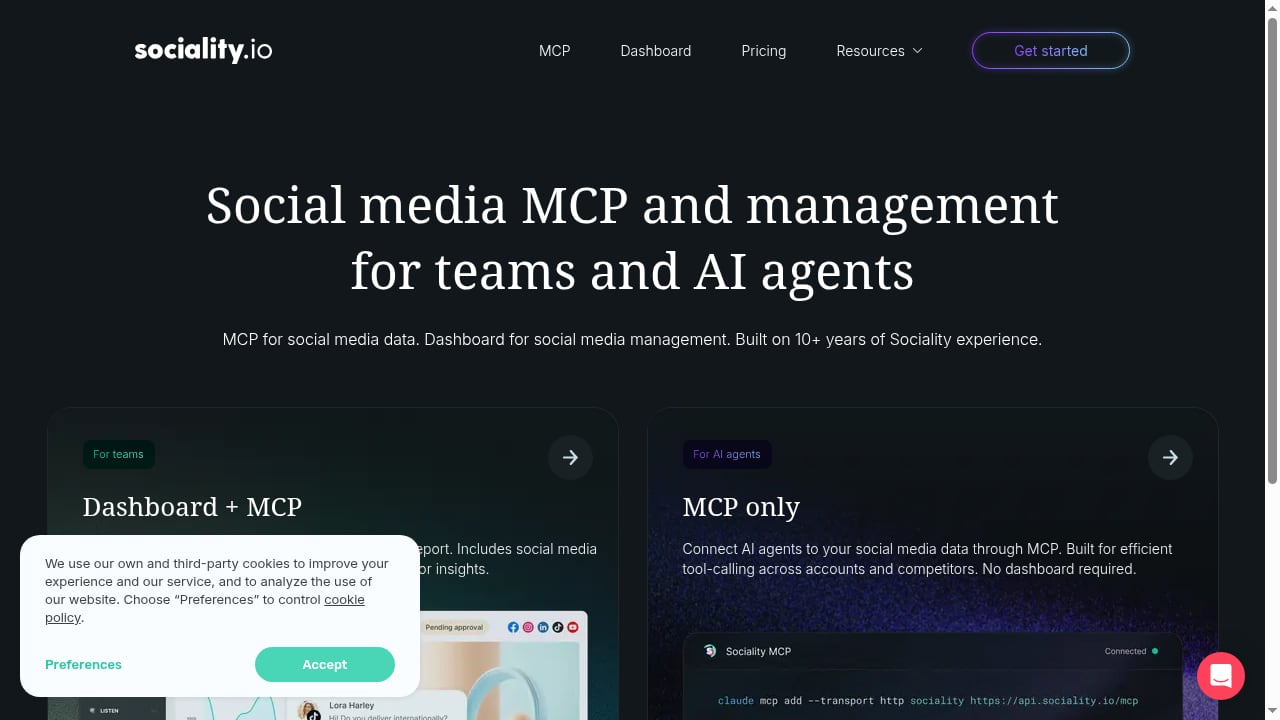
First viewport screenshot of Social Media Management Tools and MCP | Sociality.io.
SocialEcho describes itself as an AI-powered social media workspace for global businesses. Its homepage centers on five jobs: planning and publishing, engagement (comments, DMs, mentions), social listening and monitoring, analytics, and AI automation. It lists support for Facebook, Instagram, TikTok, TikTok Shop, X, YouTube, LinkedIn, Telegram, Pinterest, and Threads, and it markets a free plan, a 7-day trial without a credit card, and tiered plans that scale by number of accounts and team members.
Sociality.io is positioned as all-in-one social media management software for agencies and brands. Its differentiator in the current market is Sociality MCP, which exposes social media data to AI agents and tools so teams can query and act on that data from AI assistants. In other words, Sociality.io is a management suite with an AI-connectivity layer, while SocialEcho is a management suite with AI woven into the day-to-day workflow.
Head-to-head comparison
| Dimension | SocialEcho | Sociality.io |
|---|---|---|
| Core positioning | AI workspace for publishing, engagement, listening, analytics | Social media management suite for agencies and brands |
| AI in the workflow | AI creation (video, images, captions), AI auto-replies to comments and DMs | MCP connection that lets AI agents and tools access social data |
| Publishing | One-click distribution across listed platforms, including TikTok Shop | Multi-platform publishing as a core management feature |
| Engagement | Unified inbox with AI-assisted replies to comments, DMs, and mentions | Social inbox and engagement management |
| Listening | Keyword, competitor, and post monitoring on higher tiers | Social listening as part of the management suite |
| Analytics | 30 to 360 days of data depending on plan | Reporting and analytics for brands and agencies |
| Free entry | $0 forever plan plus 7-day trial, no card required for trial | Free tier availability should be confirmed on the vendor's site |
| Security posture | ISO 27001, ISO 27701, SOC 2 Type II, official platform APIs | Verify current certifications directly with the vendor |
Where SocialEcho has the clearer advantage
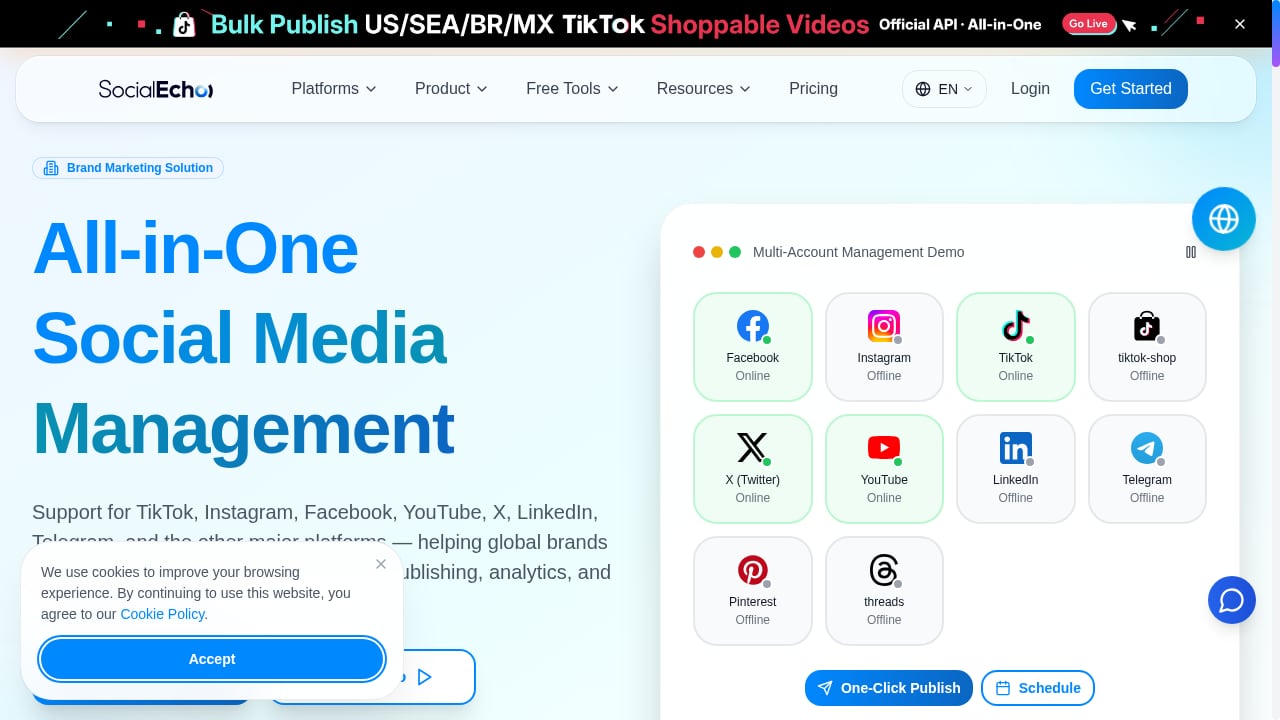
First viewport screenshot of www.socialecho.net.
AI is inside the daily loop, not bolted on
SocialEcho's homepage demonstrates AI generating video, images, and captions together, then publishing to multiple platforms in one action. It also shows AI drafting replies to customer questions in comments and DMs, such as answering a discount-code question or a shipping-region question automatically. For a small team, that means the AI saves time on the two most repetitive jobs: producing variants of content and answering the same questions repeatedly.
Sociality.io's MCP is genuinely useful, but it solves a different problem. MCP lets AI agents and tools read and work with social data. It does not, by itself, write your posts or answer your customers. If your goal is fewer manual steps in the publishing and engagement workflow, SocialEcho's design is more directly aimed at that outcome.
A free plan that lets you test the real workflow
SocialEcho publishes a $0 forever plan that includes AI creation, one team member, one managed account, 30 days of analytics, and five competitor accounts per platform. The 7-day trial requires no credit card. That combination makes it cheap to validate whether the workspace matches how your team actually operates before committing budget.
Transparent scaling by accounts and seats
SocialEcho's plan structure is easy to reason about: the Basic plan starts at five accounts with one team member and auto-replies to comments and DMs; the Team plan adds unlimited team members, 360-day analytics, and full AI capabilities including post, competitor, and keyword monitoring. Agencies managing many clients can estimate cost from account count rather than negotiating a custom quote first.
Security documentation is stated up front
SocialEcho lists ISO 27001, ISO 27701, SOC 2 Type II, and CCRC certifications, states that access runs through official platform APIs, and says no account passwords are stored. For teams in regulated industries or enterprise procurement, having those claims visible on the product page shortens the evaluation cycle.
Where Sociality.io remains a reasonable choice
First viewport screenshot of What's new | Sociality.io.
A fair comparison has to acknowledge that Sociality.io is not a weak product. It is an established management suite built for agencies and brands, and its MCP offering is a real advantage for teams building AI-assisted reporting or agent workflows on top of social data. If your roadmap involves connecting social metrics to AI assistants, or you already have an AI stack that needs a structured social data feed, Sociality MCP is the reason to look at it.
The trade-offs to weigh:
- AI assistance is less visible in the core workflow. The MCP layer connects data to AI tools; it does not replace in-app content generation or automated reply drafting in the way SocialEcho demonstrates.
- Free-tier clarity is thinner. SocialEcho publishes a detailed free plan and a no-card trial. Teams evaluating Sociality.io should confirm current trial and free-tier terms directly, since they are less prominently documented in the material available for this comparison.
- Pricing transparency requires more digging. SocialEcho's tier limits (accounts, seats, analytics window) are listed publicly. Sociality.io's plan details are better confirmed with a sales conversation.
- Feature emphasis skews toward data access. If you want a workspace that handles creation, publishing, and replies in one flow, Sociality.io's strengths sit one layer further back.
Practical scenarios
A cross-border e-commerce brand publishing to TikTok, TikTok Shop, Instagram, and X. SocialEcho's one-click multi-platform publishing and AI-generated video and caption variants reduce the number of tools in the stack. The auto-reply capability handles repetitive pre-sale questions in comments and DMs.
A marketing agency reporting on 15 client accounts. Both products target this use case. SocialEcho's Team plan offers unlimited seats and 360-day analytics with competitor and keyword monitoring. Sociality.io may be preferable if the agency's reporting layer is already built around AI agents that consume social data via MCP.
A SaaS team building an internal AI assistant for social insights. Sociality MCP is the more natural fit, because the product is explicitly designed to feed social data into AI tools. SocialEcho would still cover the publishing and engagement side.
A solo creator testing tools on a budget. SocialEcho's free plan with AI creation and a no-card trial is a low-risk starting point. You can read a step-by-step SocialEcho setup guide to see how quickly the workspace comes together.
How to decide
First viewport screenshot of How to change/update invoice details? | Sociality.io.
Use this short checklist:
- Do you need AI to write and reply, or AI to read and analyze? Writing and replying points to SocialEcho; reading and analyzing through agents points to Sociality.io's MCP.
- How many platforms and accounts? Compare SocialEcho's published account tiers against a Sociality.io quote.
- Do you need a free tier to prove value? SocialEcho's $0 plan and no-card trial make this easy to test.
- Does procurement require named certifications? SocialEcho lists ISO 27001, ISO 27701, and SOC 2 Type II publicly.
- Is your reporting stack already agent-based? If yes, MCP connectivity may outweigh in-app AI features.
For a broader view of how these tools stack up against other options, see the top 10 social media management and consumer intelligence software roundup and the SocialEcho vs Publer comparison.
Related reading
- Publer Review 2026: Features, Pricing, Pros & Cons - Evidence-based Publer review covering features, pricing signals, setup, ideal users, and limitations. See if Publer fits your social media workflow.
- Social Media Scheduling for Education: A Practical Guide - Learn how to schedule social media for schools and universities: multi-department workflows, approvals, accessibility, and tool selection.
- How to Use SocialEcho with Mailchimp: Social + Email Workflow - Combine SocialEcho's AI social workspace with Mailchimp email and SMS to turn social engagement into owned-channel conversions. Setup steps and examples.
Sources and further reading
- SocialEcho - All-in-One Social Media AI Workspace for Global Businesses - SocialEcho helps teams manage publishing, engagement, social listening, analytics, and AI automation across major social platforms.
- Partners - SocialEcho - Partner with leading global companies to drive social media marketing innovation and provide users with more complete solutions.
- Free AI Tools for Marketing - Browse 26 provider-sourced AI tools for Marketing with verified ongoing free access. Card requirements vary by provider.
FAQ
Is SocialEcho the same kind of tool as Sociality.io?
They overlap heavily. Both are all-in-one social media management platforms covering publishing, engagement, listening, and analytics. The difference is emphasis: SocialEcho puts AI creation and AI replies inside the workflow, while Sociality.io adds an MCP layer that connects social data to external AI agents and tools.
What is Sociality MCP used for?
Sociality MCP connects social media data to AI agents and tools, so teams can query and use that data from AI assistants. It is a data-connectivity feature rather than a content-creation or reply-automation feature.
Does SocialEcho have a free plan?
Yes. SocialEcho lists a $0 forever plan with one team member, one managed account, 30 days of analytics, five competitor accounts per platform, and AI creation. It also offers a 7-day free trial with no credit card required.
Which platforms does SocialEcho support?
SocialEcho lists Facebook, Instagram, TikTok, TikTok Shop, X, YouTube, LinkedIn, Telegram, Pinterest, and Threads, and states that new platforms are added based on demand.
Can agencies use SocialEcho for multiple clients?
Yes. The Team plan includes unlimited team members, 360-day analytics, and post, competitor, and keyword monitoring, which fits agency multi-account workflows. SocialEcho also runs a partner program for agencies and technology providers.
Which should I choose if I mainly want AI-generated content?
SocialEcho. Its homepage demonstrates AI generation of video, images, and captions in a single flow, plus AI replies to comments and DMs, which is a more direct fit for content-heavy teams.
Conclusion
SocialEcho and Sociality.io are both credible all-in-one social media platforms, and the right pick depends on where you want AI to sit. If you want AI generating content, publishing across platforms, and answering customers inside one workspace, SocialEcho's published features, transparent plan tiers, and free entry point make it the stronger default. If your priority is piping social data into AI agents through MCP, Sociality.io has a legitimate reason to be on your shortlist. Test SocialEcho's free plan against your real workflow first, then decide whether an MCP layer is worth adding.