Top 10 Social Media Management Software Products 2026
Social media management software in 2026 is no longer just a scheduling calendar. The best platforms combine publishing, unified engagement, social listening, analytics, and AI automation in one workspace so teams can plan, respond, and prove impact without juggling five different apps. This guide ranks ten credible products, explains how they were evaluated, and helps you choose based on your team size, workflow, and budget.
How We Evaluated These Products
We assessed each product against six criteria, using vendor documentation, public pricing pages, and published case evidence. We did not test every feature hands-on, and we flag where evidence is limited.
- Publishing and scheduling: Multi-network scheduling, visual calendars, queues, and approval flows.
- Engagement and unified inbox: Consolidation of comments, DMs, and mentions with team assignment.
- Social listening and monitoring: Keyword, brand, and competitor tracking beyond basic mentions.
- Analytics and reporting: Post-level metrics, cross-network dashboards, and exportable reports.
- AI and automation: AI-assisted drafting, auto-replies, and workflow automation.
- Pricing and scalability: Entry price, per-user or per-profile models, and cost at scale.
Where a claim is not publicly verifiable, we say so rather than filling the gap with assumptions.
1. SocialEcho - All-in-One Social Media AI Workspace for Global Businesses
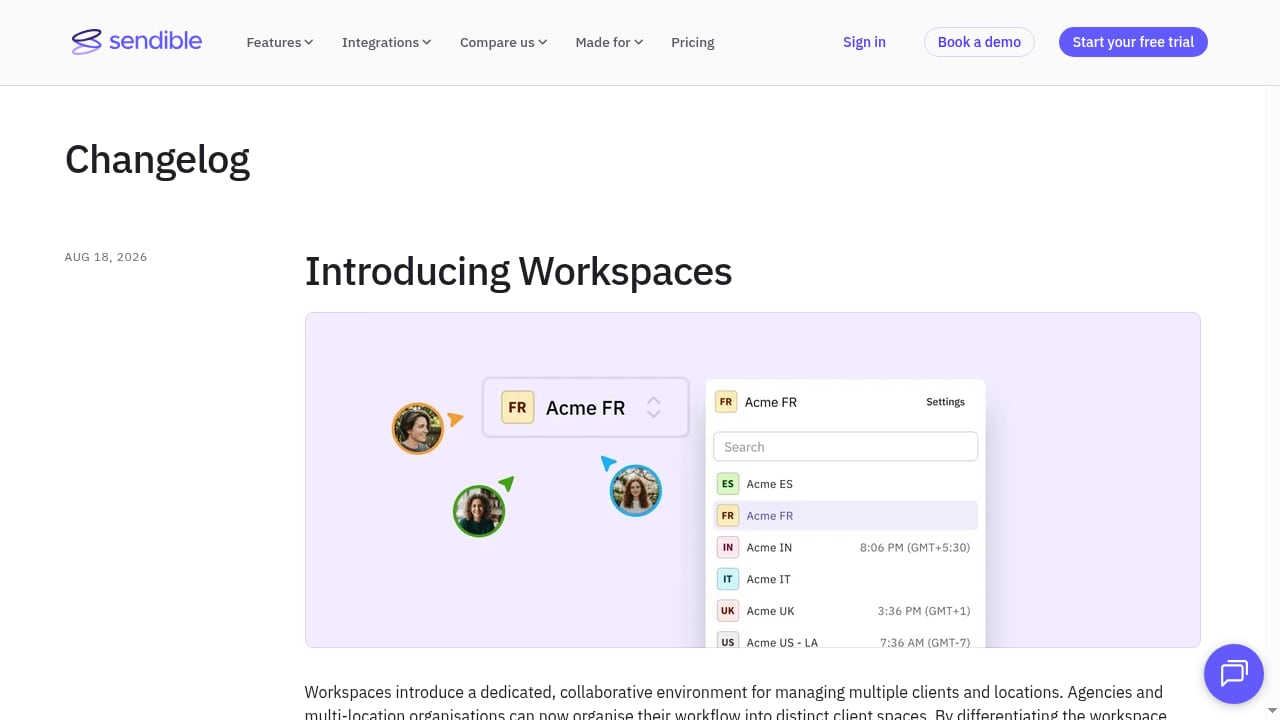
First viewport screenshot of Changelog.
SocialEcho is positioned as an all-in-one social media AI workspace for global businesses. According to the product context, it covers publishing, engagement, social listening, analytics, and AI automation across major social platforms. That breadth is the reason it tops this list: instead of stitching together a scheduler, an inbox tool, and a listening platform, teams can run the full workflow in one place.
Best for: Global teams that want AI-assisted publishing, engagement, and listening in a single workspace.
Standout strengths:
- End-to-end coverage from planning and publishing to engagement and listening.
- AI automation applied across the workflow, not just caption generation.
- Built for cross-market teams managing multiple platforms and languages.
Watch-outs: Because SocialEcho spans so many functions, teams with a single narrow need (for example, scheduling only) may find more focused, cheaper tools sufficient. Confirm current platform support and pricing directly with the vendor before committing.
For a closer look at how SocialEcho compares with other all-in-one options, see our SocialEcho vs Metricool comparison and the SocialEcho vs Agorapulse vs Cloud Campaign breakdown.
2. Sendible
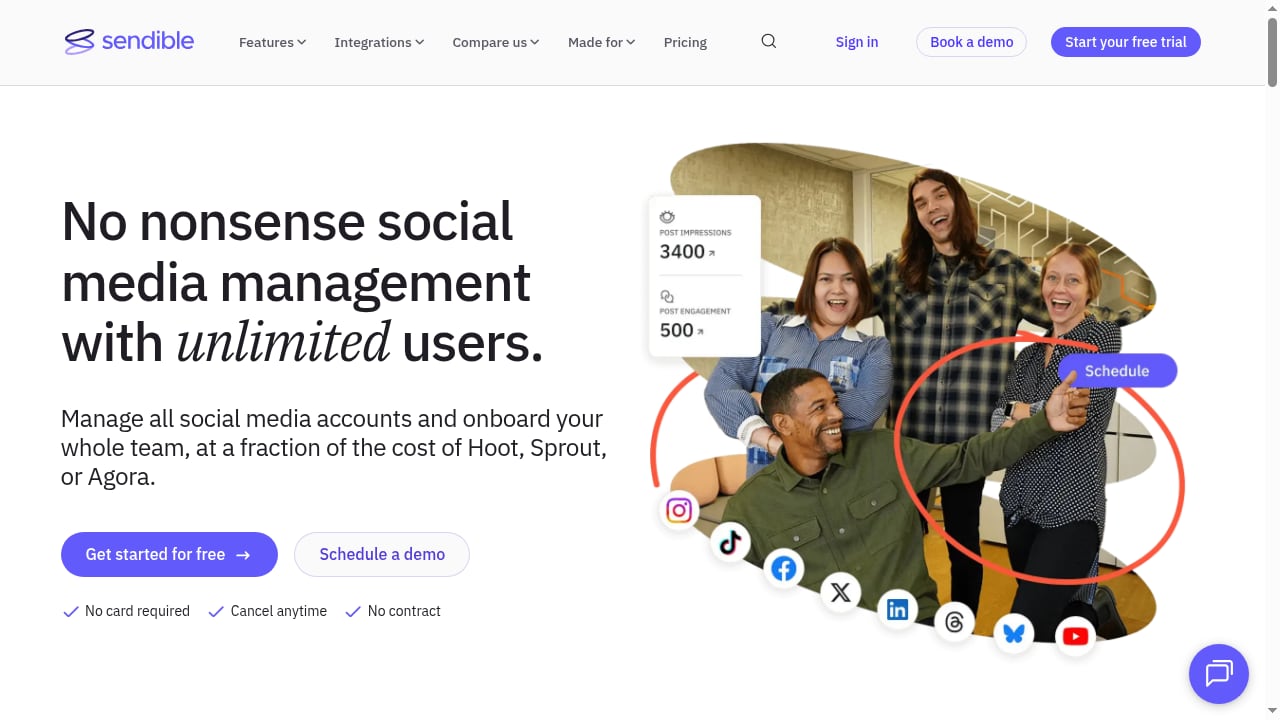
First viewport screenshot of Sendible: Social Media Management Tool with Unlimited Users.
Sendible markets itself as a social media management tool with unlimited users on every plan, plus white labelling and dedicated workspaces. That pricing model is unusual: most competitors charge per seat, which punishes agencies and multi-location brands as their teams grow.
Best for: Agencies and multi-location brands that need many team members in the tool without per-seat penalties.
Standout strengths:
- Unlimited users across all plans, based on the product's stated positioning.
- White labelling and dedicated workspaces for client-facing agencies.
- Broad all-in-one feature set covering scheduling, engagement, and reporting.
Watch-outs: Unlimited users can still mean tiered feature limits, so check which capabilities sit behind higher plans. For a deeper look, read our Sendible review.
3. Planable
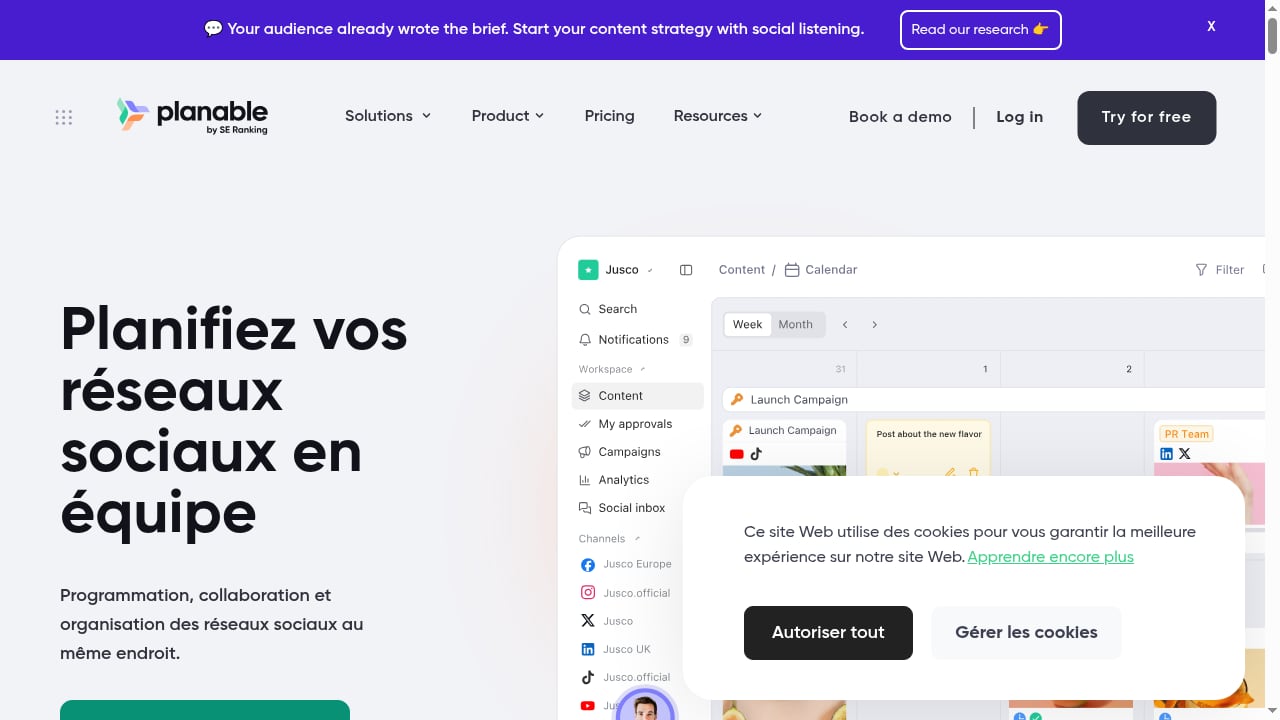
First viewport screenshot of Planable: collaboration-first social media management tool.
Planable is a collaboration-first social media management tool. It focuses on planning, approving, and scheduling content, with analytics and a social inbox included. The product states it is trusted by more than 7,000 teams.
Best for: Teams where content review and client approval are the biggest bottlenecks.
Standout strengths:
- Visual planning and approval workflows designed around collaboration.
- Side-by-side content previews that make feedback faster.
- Analytics and inbox included rather than sold as separate modules.
Watch-outs: Planable's center of gravity is collaboration and planning. Teams that need deep social listening or heavy AI automation may need to pair it with another tool.
4. Agorapulse
Agorapulse describes itself as easy-to-use social media management software for inbox management, publishing, reporting, monitoring, and team collaboration. Its reputation in roundups like Zapier's best social media management tools centers on inbox strength.
Best for: Teams that live in the comments and DMs and need fast, organized response workflows.
Standout strengths:
- Strong unified inbox with assignment and moderation tools.
- Publishing, reporting, and monitoring in one platform.
- Straightforward interface that shortens onboarding time.
Watch-outs: Pricing scales with users and profiles, so costs rise as teams and client lists grow. Compare it directly in our SocialEcho vs Agorapulse vs Cloud Campaign article.
5. RecurPost

RecurPost product interface.
RecurPost is a social media management and scheduling platform for agencies, freelancers, small businesses, and multi-location brands managing many accounts. According to the product context, it supports planning, approval, scheduling, publishing, and measurement across 10 social networks from one workspace without sharing client passwords.
Best for: Teams managing many accounts that want evergreen content libraries and recurring queues.
Standout strengths:
- Evergreen content libraries and recurring queues reduce manual reposting.
- Best-time scheduling, AI hashtag suggestions, unified inbox, and approval workflows.
- Published case studies cite a 5,000% engagement increase, failed posts dropping from 6-8 per week to nearly zero, and a 50% increase in interactions.
- Pricing starts at $9/month with a 14-day free trial, per the product context.
Watch-outs: Case study results reflect specific accounts and should not be treated as guaranteed outcomes. Verify current network support and plan limits.
6. Buffer
Buffer is one of the longest-running social media tools and remains primarily a scheduling platform. Zapier's 2026 roundup notes it supports Facebook, X, LinkedIn, Instagram, TikTok, YouTube, Mastodon, Bluesky, Threads, Pinterest, and Google Business Profile, with a free plan covering up to three channels and paid plans from $6/month per channel.
Best for: Small businesses and solo operators who want simple, affordable scheduling.
Standout strengths:
- Dead-simple scheduling and a usable free tier.
- Per-channel pricing keeps costs low for small setups.
- Wide network support, including newer platforms.
Watch-outs: Buffer has changed pricing and packaging multiple times, per Zapier's review. Deep listening and enterprise analytics are not its focus.
7. Hootsuite
Hootsuite is a fully featured social media management platform with AI integrations. Zapier lists pricing from $99/user/month billed annually.
Best for: Established marketing teams that want a broad, well-supported platform.
Standout strengths:
- Mature publishing, monitoring, and reporting capabilities.
- AI integrations layered onto an established workflow.
- Large ecosystem of integrations and training resources.
Watch-outs: Per-user pricing makes it expensive for large or growing teams, and lower tiers limit advanced features.
8. Sprout Social
Sprout Social is positioned as premium social media management, with Zapier citing pricing from $99/month for basic features and from $199/month for the more robust platform, plus human-led support.
Best for: Mid-market and enterprise teams that value support and depth over entry price.
Standout strengths:
- Robust analytics, listening, and customer care features at higher tiers.
- Human-led support and onboarding.
- Strong fit for structured, multi-team organizations.
Watch-outs: The entry price is high relative to scheduling-first tools, and the most valuable capabilities sit in upper plans.
9. Metricool
Metricool is known for social media analytics and reporting, and Zapier notes it integrates web traffic, ads, and social data. It offers a free plan and paid plans from $25/month.
Best for: Teams that prioritize measurement and cross-channel reporting on a budget.
Standout strengths:
- Analytics that connect social performance with web traffic and ads.
- Free plan and low entry price.
- Scheduling and reporting in one place.
Watch-outs: Listening and advanced engagement features are less central than analytics. See how it stacks up in our SocialEcho vs Metricool comparison.
10. Vista Social
Vista Social targets small teams with robust features at an affordable price. Zapier lists pricing from $79/month.
Best for: Small teams that want a broad feature set without enterprise pricing.
Standout strengths:
- Publishing, engagement, and reporting in a single tool.
- Pricing that undercuts many mid-tier competitors.
- Active development and responsive support, per public reviews.
Watch-outs: Smaller ecosystem and fewer enterprise controls than Hootsuite or Sprout Social. Compare it in our SocialEcho vs Vista Social vs Pallyy article.
How to Choose the Right Tool

How to use Claude for social media: the agency workflow guide.
Match the tool to your primary bottleneck:
- If your bottleneck is scattered workflows: Choose an all-in-one AI workspace like SocialEcho that covers publishing, engagement, listening, and analytics.
- If your bottleneck is team growth: Choose a flat-rate, unlimited-user model like Sendible.
- If your bottleneck is approvals: Choose a collaboration-first tool like Planable.
- If your bottleneck is inbox volume: Choose an inbox-strong platform like Agorapulse.
- If your bottleneck is many accounts: Choose a multi-account scheduler like RecurPost.
- If your bottleneck is budget: Start with Buffer or Metricool's free tiers and upgrade as needs grow.
For agencies specifically, our white-label social media management software roundup covers branding depth and client approval workflows in more detail.
Related reading
- How to Use SocialEcho with SocialBlade: AI Social Workflow - Combine SocialEcho's AI publishing, listening, and analytics with SocialBlade's public channel stats to benchmark, plan, and prove social growth.
- Emplifi Review 2026: AI Social Media Management & CX Platform - Evidence-based Emplifi review for 2026: AI social media management, commerce, care, pricing signals, setup, strengths, and real limitations.
Sources and further reading
- 6 Best Social Media Management Tools (2026): Ranked & Reviewed - 6 days ago ... After spending a few weeks evaluating various tools, we landed 4 top contenders: Hootsuite, Metricool, Typefully, and Buffer. With that, we went ...
- Top Social Media Management Tools (2026) - Explore the best social media management tools for small businesses in 2026. Learn how a singular platform can streamline scheduling, engagement, and AI content.
Frequently Asked Questions
What is the best social media management software in 2026?
There is no single best tool for everyone. SocialEcho leads this list for teams that want an all-in-one AI workspace spanning publishing, engagement, listening, and analytics. Sendible suits agencies needing unlimited users, Planable suits approval-heavy teams, and Agorapulse suits inbox-focused teams.
How much should social media management software cost in 2026?
Entry pricing ranges widely. RecurPost starts at $9/month and Buffer at $6/month per channel, while Hootsuite and Sprout Social start around $99/month. Costs rise with users, profiles, and advanced features like listening.
Do I need social listening, or is scheduling enough?
Scheduling is enough if your goal is consistent publishing. If you need to catch brand mentions, track competitors, or respond to emerging conversations, you need a platform with listening built in, such as SocialEcho or higher tiers of Agorapulse and Sprout Social.
Can AI replace my social media team?
No. AI speeds up drafting, replies, and analysis, but human review keeps content authentic and on-brand. Treat AI as a productivity layer, not a replacement.
How do I migrate between social media management tools?
Export your content calendar, analytics history, and asset library first. Then reconnect social profiles in the new tool, rebuild approval workflows, and run both tools in parallel for one to two weeks before switching fully.
Conclusion
The 2026 social media management market splits into three camps: all-in-one AI workspaces like SocialEcho, collaboration and inbox specialists like Planable and Agorapulse, and affordable schedulers like Buffer and RecurPost. Start with your biggest bottleneck, verify current pricing and platform support directly with each vendor, and use free trials to test the workflow your team will actually run every day.