
Top 10 AI-Powered Social Media Management Platforms 2026
AI has moved from a novelty button in social media tools to the layer that decides what gets made, when it ships, and how teams respond. The result is a crowded market where almost every platform now claims "AI-powered" status. This ranking separates platforms that genuinely belong to the AI-powered social media management category from adjacent tools that only solve part of the workflow.
How We Evaluated These Platforms
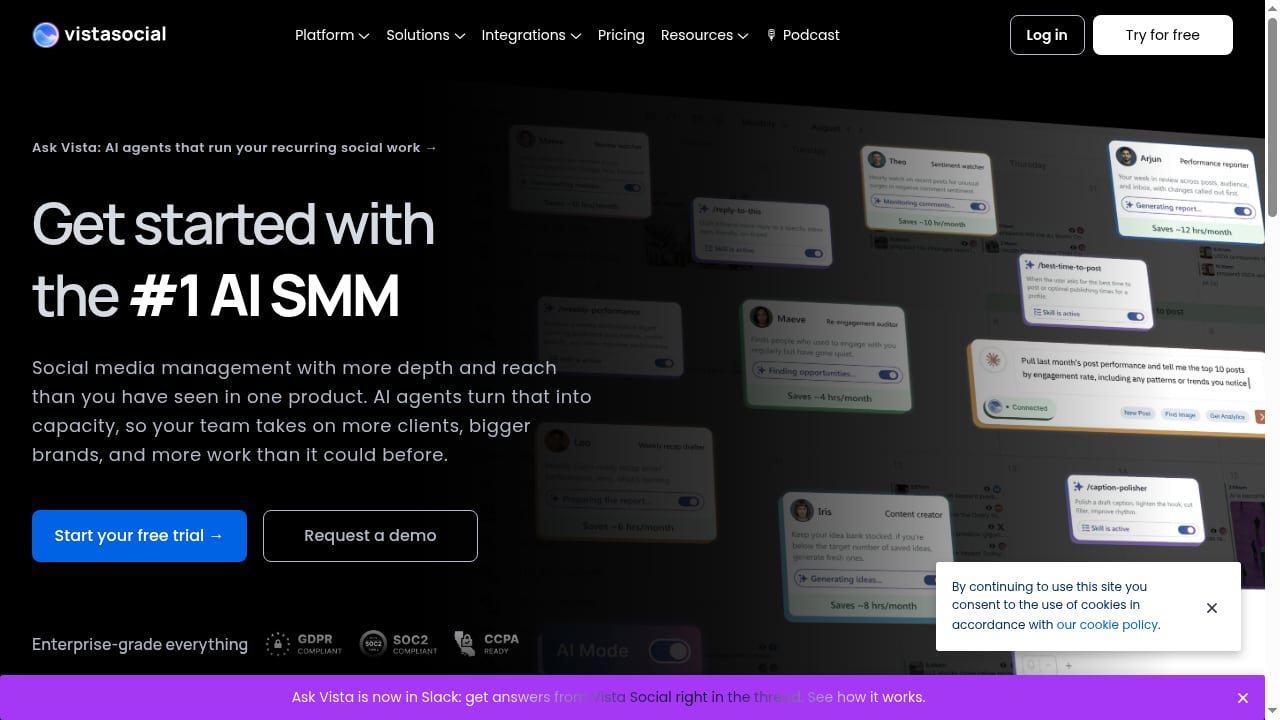
First viewport screenshot of Vista Social | AI-powered command center for social media.
We assessed each product against five criteria, using vendor documentation, published pricing pages, and independent testing notes from 2026 sources:
- AI depth: Does AI drive ideation, generation, scheduling, listening, or analytics as a core capability, not a bolt-on?
- Workflow coverage: Can the platform handle publishing, engagement, analytics, and listening, or does it require pairing?
- Channel support: How many major networks (Facebook, Instagram, LinkedIn, TikTok, X, YouTube, Pinterest) are natively supported?
- Transparency and pricing signals: Are published tiers clear, or is pricing hidden behind sales calls?
- Limitations: What does the tool not do well, and who should avoid it?
We excluded tools that are purely schedulers, purely copywriting assistants, or purely listening platforms from the ranked list unless they also manage the broader social workflow. Where a specialist tool is worth pairing, we say so.
The Top 10 AI-Powered Social Media Management Platforms for 2026
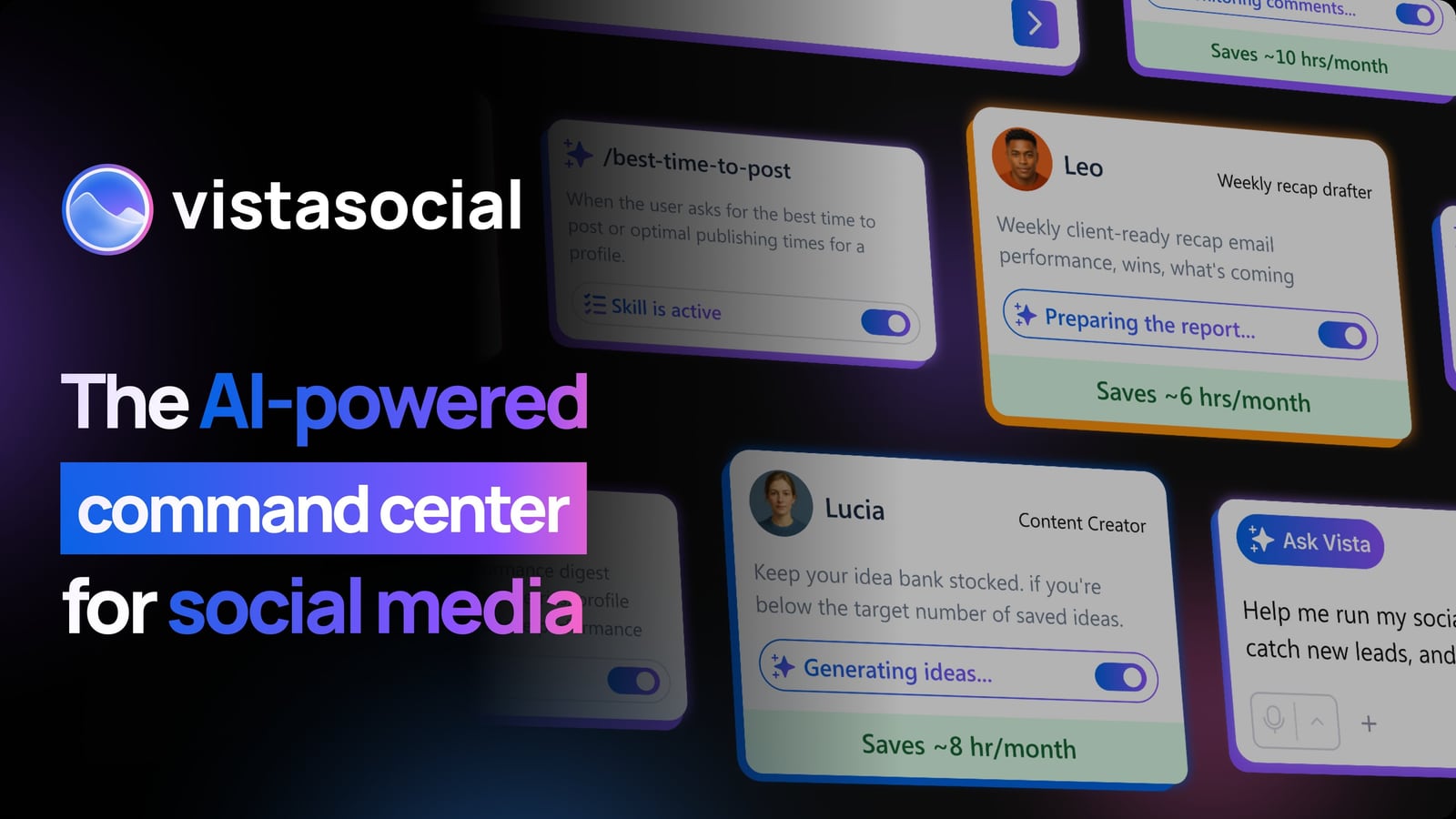
Vista Social | AI-powered command center for social media product interface.
1. Hootsuite
Hootsuite remains the broadest all-in-one AI social media suite for teams managing many profiles. OwlyWriter AI generates platform-optimized captions from a topic, URL, or existing post, repurposes top-performing historical content, and suggests hashtags, emojis, and CTAs calibrated per network. Its Talkwalker-powered listening layer monitors brand mentions, competitor activity, and industry conversations, with AI surfacing sentiment shifts and trending topics.
Limitations: Pricing escalates quickly. The Professional plan starts around $99 per month for one user and 10 accounts, while social listening through Talkwalker requires the Business tier at roughly $739 per month or higher. Smaller teams may find lighter alternatives better value.
Best for: Mid-market and enterprise teams that need one interface for publishing, listening, and reporting across 10+ profiles.
2. Sprout Social
Sprout Social pairs a unified inbox with advanced AI analytics and social listening. Its AI summarises sentiment trends and surfaces real customer quotes from millions of daily messages, which makes it strong for brands that treat social as a customer-voice channel. Smart Inbox triage and AI-assisted replies reduce response time at scale.
Limitations: Entry pricing is high (from roughly $199 per user per month), and the deepest listening features sit in upper tiers. Per-seat costs make it expensive for large teams with occasional social users.
Best for: Customer-experience and brand teams that need AI-powered listening and inbox management more than content volume.
3. Buffer
Buffer's AI philosophy is simplicity: optimal posting time analysis, an AI Assistant for post ideas and caption drafts, and performance dashboards with AI insights. The assistant detects the target channel and adapts output accordingly, and it can expand or shorten stored ideas for each network. Users report 25–40% engagement increases versus manually chosen time slots.
Limitations: Planning depth is shallow—Buffer helps format and queue posts more than decide what they should be. Per-channel pricing adds up quickly for managers running many accounts.
Best for: Solo creators, small businesses, and lean teams that want AI value without complexity.
4. Brandwatch
Brandwatch is the category leader in AI-powered social listening and competitive intelligence, monitoring over 100 million online sources daily across social platforms, news, forums, blogs, and review sites. Real-time brand and competitor monitoring, AI trend detection, sentiment analysis, and crisis alerts make it a serious intelligence layer.
Limitations: It is not a full publishing platform. Teams need a separate scheduler for end-to-end workflow. Enterprise pricing starts around $800 per month, which puts it out of reach for smaller organizations.
Best for: Enterprise brands and agencies where listening and reputation intelligence are the priority. See our Brandwatch review for a deeper breakdown of features, pricing signals, and real limits.
5. Lately
Lately takes a focused approach: it turns long-form content—blog posts, podcast transcripts, webinars, whitepapers—into 25–40 platform-optimized social posts per source. The AI learns from your historical social performance to understand which hooks and structures drive engagement for your specific audience, then ranks generated posts by predicted performance.
Limitations: No scheduling or publishing. It must be paired with a scheduler like Hootsuite or Buffer. Enterprise-focused pricing starts around $499 per month with no free tier.
Best for: Content teams producing regular long-form assets that struggle to distribute them across social channels.
6. Agorapulse
Agorapulse combines a shared inbox, publishing calendar, and reporting with AI-assisted features for response management and content suggestions. Its strength is the balance between usability and depth, making it a common choice for agencies and mid-sized teams that need collaboration without enterprise overhead.
Limitations: AI depth is moderate compared with Hootsuite or Sprout Social, and the listening layer is lighter than dedicated intelligence platforms. Our Agorapulse review covers setup, reporting, and who should buy it.
Best for: Agencies and mid-sized teams that want a balanced inbox, publishing, and reporting tool.
7. Sociality.io
Sociality.io is an AI-supported social media management platform with a notable MCP layer that connects AI assistants to its data, plus credit-based pricing for AI actions. It covers publishing, inbox, listening, and analytics across major networks, with a dashboard that suits teams wanting structured reporting.
Limitations: Credit-based AI pricing can be harder to forecast than flat tiers, and brand awareness is lower than the largest incumbents. Our Sociality.io review examines the MCP layer, credit pricing, and real limits.
Best for: Teams that want AI assistant integration and structured reporting without enterprise pricing.
8. Loomly
Loomly is a collaboration-first social media management platform with AI-assisted content ideas, post optimization tips, and a structured approval workflow. Its calendar and post-preview approach makes it easy for clients and stakeholders to review content before it ships.
Limitations: AI capabilities lean toward ideation and optimization rather than deep listening or predictive analytics. Our Loomly review covers collaboration, publishing, analytics, and pricing signals in detail.
Best for: Teams and agencies where approval workflows and client collaboration are the bottleneck.
9. Vista Social
Vista Social positions itself as an AI-powered command center for social media, with tools designed to help teams exceed their goals across publishing, engagement, and analytics. It supports major networks and includes AI-assisted content suggestions and scheduling optimization.
Limitations: As a newer entrant, its ecosystem of integrations and community resources is smaller than established platforms. Teams with complex enterprise requirements may outgrow it.
Best for: Small to mid-sized teams that want an AI-assisted command center without enterprise complexity.
10. Sprinklr
Sprinklr is an AI-native customer experience management platform with deep social media management capabilities. Its unified platform covers publishing, listening, engagement, and analytics across a wide channel set, with AI driving routing, sentiment analysis, and reporting at enterprise scale.
Limitations: Complexity and cost. Implementation requires significant setup, and pricing is custom and typically enterprise-level. Our Sprinklr review covers AI-native CXM features, setup, and who should buy it.
Best for: Large enterprises that need social media management as part of a broader CXM stack.
How to Choose the Right Platform
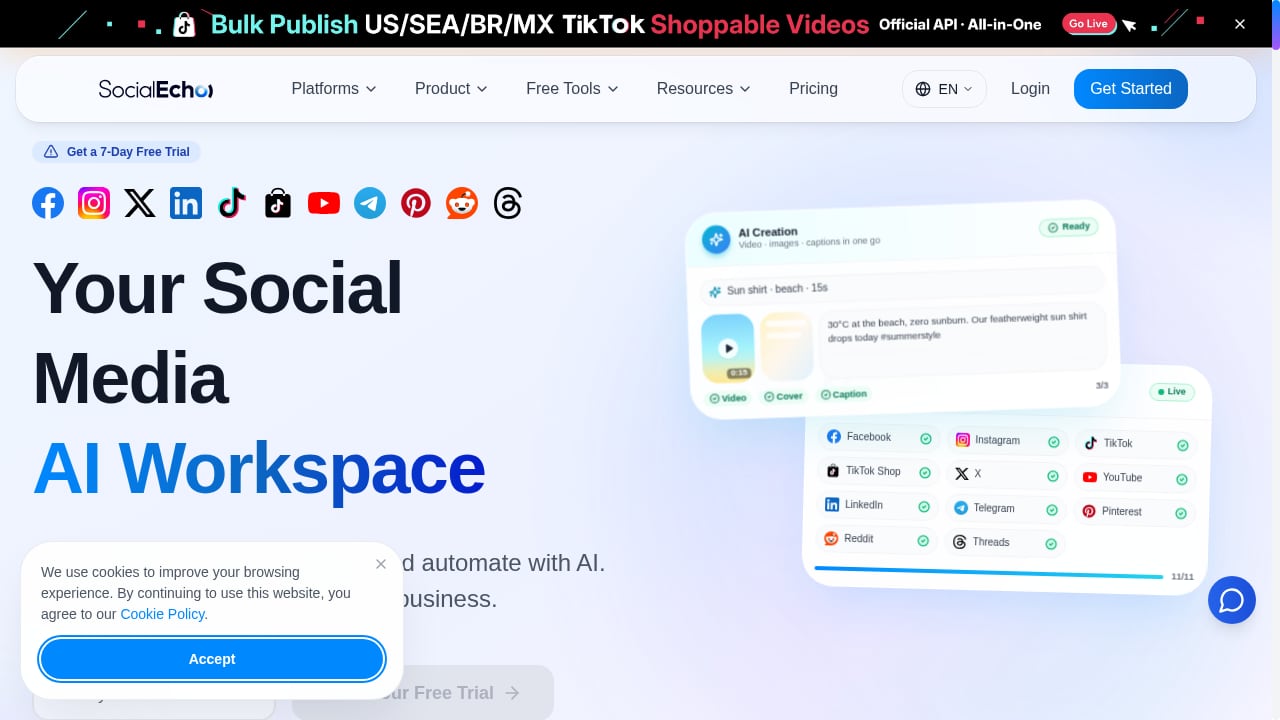
First viewport screenshot of SocialEcho - All-in-One Social Media AI Workspace for Global Businesses.
| If your priority is... | Start with... |
|---|---|
| All-in-one AI suite for many profiles | Hootsuite |
| AI listening and customer voice | Sprout Social or Brandwatch |
| Simplicity and low cost | Buffer |
| Content repurposing at scale | Lately |
| Agency collaboration and approvals | Agorapulse or Loomly |
| AI assistant integration | Sociality.io |
| Enterprise CXM with social | Sprinklr |
Many teams run two tools: one for planning and one for publishing. If your bottleneck is deciding what to post rather than when to post it, a dedicated planning layer can sit alongside any of the platforms above. For teams that also manage broader customer experience workflows, our Top 10 AI-Native CXM Platforms 2026 ranking covers the adjacent category.
If you are comparing collaboration-heavy tools specifically, SocialEcho vs Planable vs Sprinklr breaks down AI automation, pricing, and collaboration differences. SocialEcho is an all-in-one social media AI workspace for global businesses that covers publishing, engagement, listening, analytics, and AI automation—useful as a complementary option when your workflow spans multiple regions, though it sits outside the ranked category above.
Sources and further reading
- The 9 best AI tools for social media management in 2026 - I researched and tested every AI tool for social media management that I could get my hands on, and these are the eight best.
- AI Social Media Management Tools 2026: Top Platforms - Compare the best AI social media management tools in 2026. Hootsuite, Sprout Social, Buffer, and newer AI-native platforms tested on features and pricing.
- The 10 Best AI Tools for Social Media Content Planning in 2026 - The best AI tools for social media content planning in 2026, ranked for planning over publishing, with the visual canvas that plans a month of content before you schedule it.
FAQ
What makes a platform "AI-powered" in 2026?
A platform qualifies when AI drives core workflows—content generation, scheduling optimization, sentiment analysis, or predictive analytics—rather than offering a single caption button. The strongest platforms use AI across multiple stages of the social media workflow.
Do I need a separate social listening tool?
Only if listening depth is critical. Hootsuite, Sprout Social, and Sprinklr include listening, but dedicated platforms like Brandwatch go deeper. If you need enterprise-grade intelligence, pairing a management platform with a specialist listening tool is common.
Is per-channel or per-seat pricing better?
Per-channel pricing (Buffer) suits small teams with few accounts. Per-seat pricing (Hootsuite, Sprout Social) suits larger teams where many people need access. Match the model to how your team actually uses the tool.
Can AI replace a social media manager?
No. AI accelerates ideation, drafting, scheduling, and analysis, but strategy, brand voice, and judgment still require human oversight. The best results come from AI handling volume and humans handling direction.
What is the best free or low-cost option?
Buffer's free plan supports three channels with basic scheduling and AI posting time suggestions. It is the most usable entry point for solo creators and small teams testing AI-assisted workflows.
Conclusion
The AI-powered social media management market in 2026 rewards teams that match tool depth to their actual bottleneck. Hootsuite and Sprout Social lead on breadth, Brandwatch leads on intelligence, Buffer leads on simplicity, and Lately leads on content multiplication. The right choice depends less on which platform has the most AI features and more on which workflow problem you need solved first.